
Industrial
Big slabs, forklifts, and no time to close
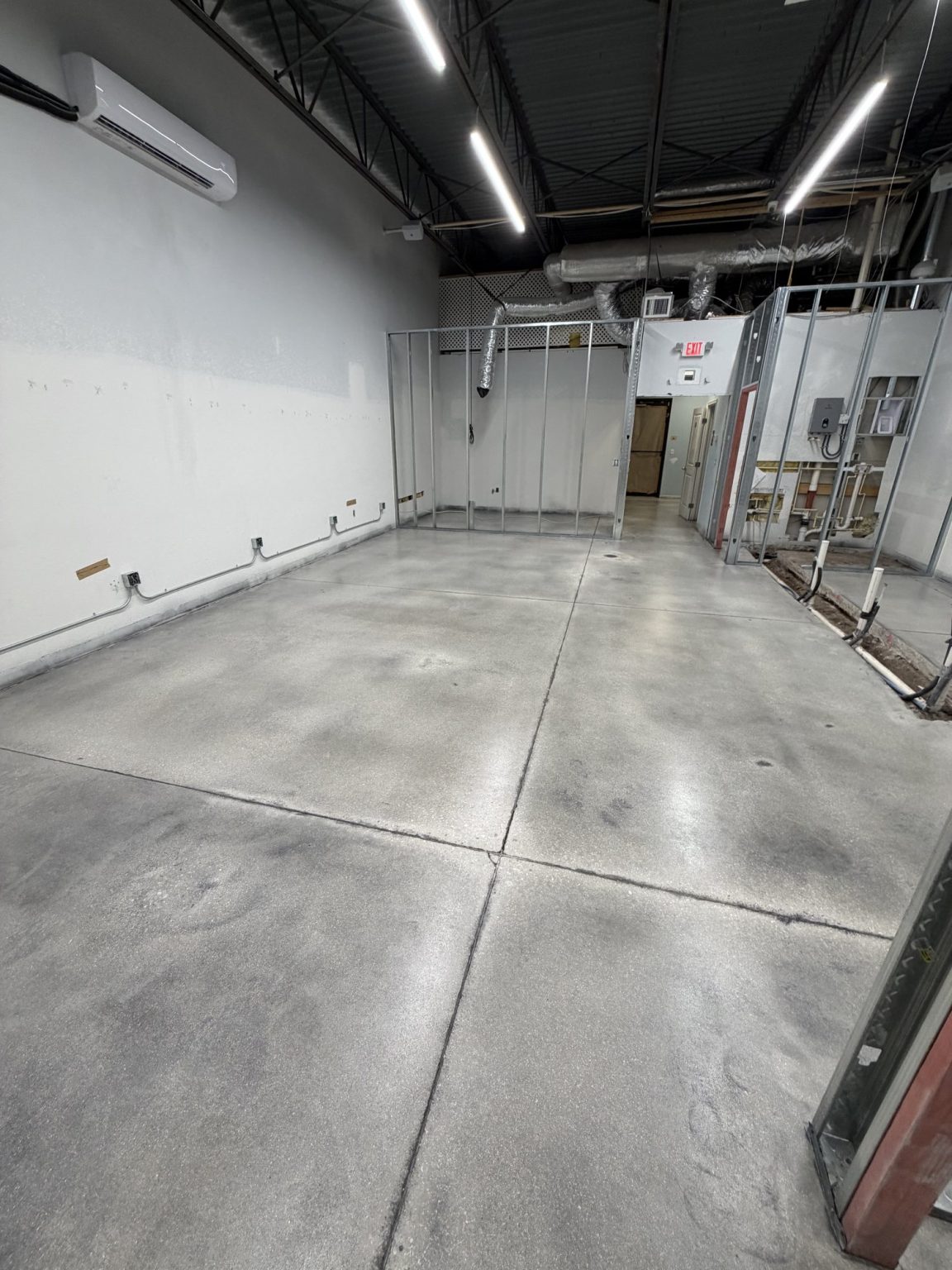
Warehouse floors are a scale problem before they are a coating problem. Thousands of square feet, joints every few meters, racking that cannot move, forklifts that cannot stop running, and an aisle layout that decides where the wear actually happens.
Pour this floor
Tell us the space and rough size. Or call (941) 504-9132.
Detail
Wear is not evenly distributed
Nearly all the damage in a warehouse happens in a small fraction of the floor. The main forklift runs, the turns at aisle ends, the dock apron, the pick faces. Vast areas under static racking barely get touched from one year to the next.
So a sensible specification is not one build everywhere. Heavy, aggregate-filled systems on the traffic lanes and dock area; a lighter, cheaper build under the racking. That routinely halves what a blanket specification would cost.
Turns punish a floor hardest. A loaded forklift pivoting a steel wheel puts enormous shear into one small patch, which is why aisle ends fail years before the straight runs do.
Joints and slab movement
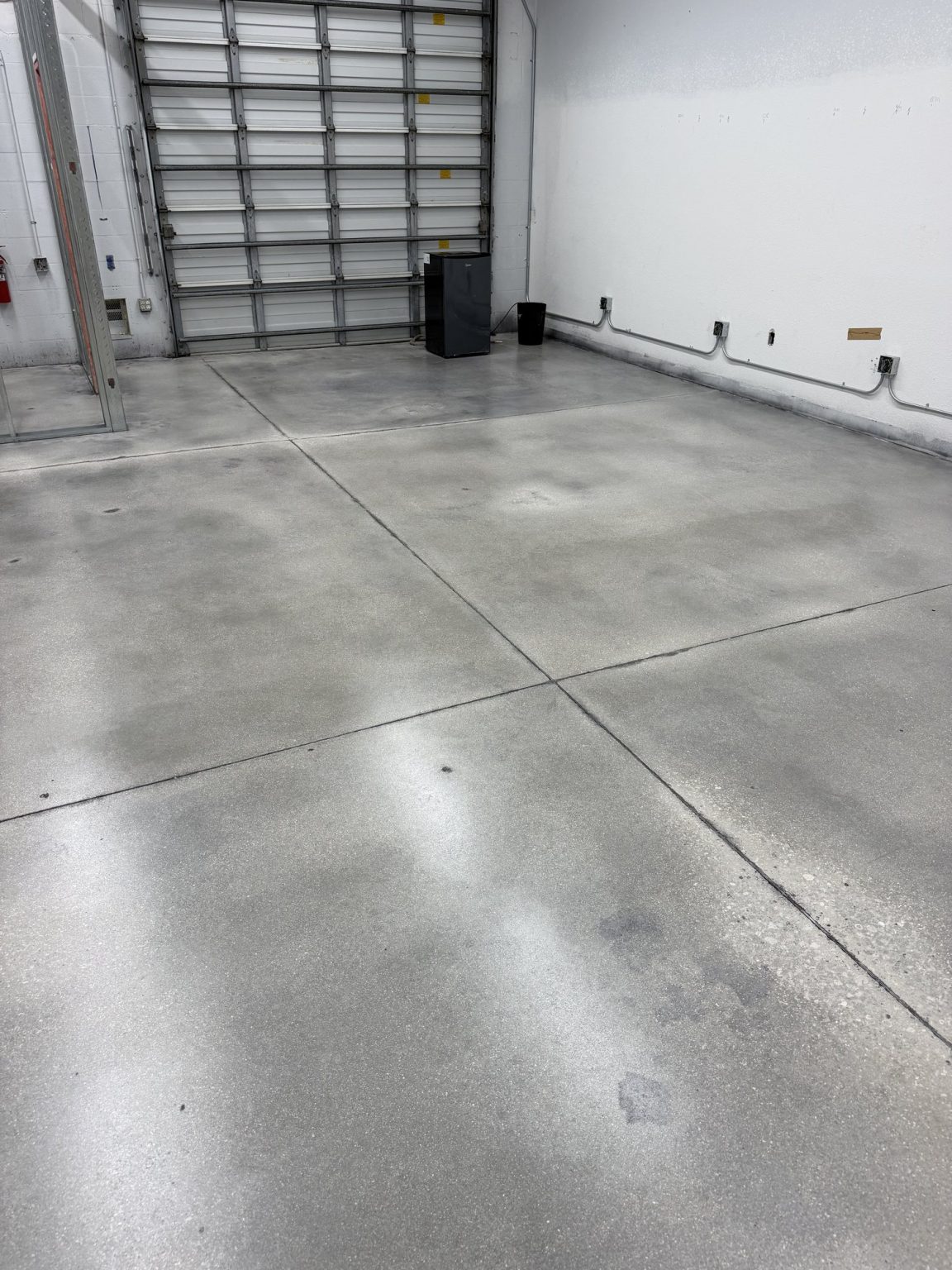
Warehouse slabs are poured in bays with control joints between them, and those joints move. Coating straight across one guarantees a tear along the line within the first season.
Joints get treated on their own terms: cleaned out, filled with a semi-rigid filler that supports the wheel crossing it while still allowing movement, then the coating detailed up to them. Where joints have already spalled at the edges, that damage gets cut out and repaired first, because a coating over a broken joint arris just breaks again.
Then there are the cracks. A crack that has stopped moving gets routed and filled. A crack that is still moving gets treated as a joint. Telling the difference is a judgement call made on site, not from a photograph.
Working around operations
Almost no warehouse can close. We phase by bay or by aisle: clear a section, grind, coat, cure, restack, move on. Containment sheeting keeps grinding dust off inventory, and vacuum-shrouded grinders keep the airborne dust down to something that will not migrate across a live floor.
Fast-cure topcoats are the other half of the answer. A section can go from grinding to light traffic inside a day where the schedule needs it, which turns a shutdown into a rolling programme.
Line marking gets planned in the same pass. Aisle lines, pedestrian walkways, racking footprints and hazard zones laid in as coating rather than tape, so they survive the traffic that erases tape within a month.
Preparation
What happens before any resin comes out
Industrial floors fail from the bottom up. Impact and chemistry get blamed, but the crack almost always starts at a bond that was never properly made.
The first day is the grinder. We work the slab with diamond tooling until it is uniformly open, vacuuming as we go so the dust stays out of the house. Skip this and you are relying on the resin to stick to a sealed surface, which is the reason so many coatings come up in sheets.
After grinding we measure what the slab is doing with water. Sandy subgrade and a shallow water table make vapor drive a constant in this climate, and it is the failure nobody sees coming because the floor looks perfect for the first season. We test before quoting so the system suits the slab.
Cracks get chased out to a clean edge and filled rather than skimmed over, spalls and pop-outs get rebuilt, and any previous coating comes off entirely. Only when the slab is sound, open and dry does anything get mixed.
The finish is what you see. The grind underneath it is what decides whether you are still happy in year eight, and it is where we spend the time other quotes save money.
This is also where we sometimes stop. If the slab has a structural problem, putting resin over it only hides it for a while before the crack works back through. We tell you that up front instead of leaving a floor with our name on it to fail.
Related work
Restaurant Floor Coatings
A commercial kitchen floor has to be jointless, coved at the walls, grippy under grease and water, tough enough for…
See the system →Retail Floor Coatings
Retail floors carry two jobs at once. They have to look considered, because the floor is a large share of what a…
How it works →Industrial Garage Floor Coatings
An industrial garage is not a big residential garage. Trucks, plant, trailers and forklifts put loads through a slab…
Read the detail →Pool Deck Coatings
A pool deck has to do three jobs at once. It has to hold grip when it is soaking wet, it has to stay cool enough for…
What it suits →Questions
Warehouse Floor Coatings questions
How much does warehouse floor coatings cost?
Prep is the part that varies. Every floor gets diamond ground, but a slab with oil, cracks or a failing coating needs more hours before the resin comes out, and that shows up in the price. Size and system choice matter too. You get a real number once we have seen it.
How long does warehouse floor coatings take?
Two to four days on site covers most residential floors. Humidity can stretch the cure, which is why we hand you real dates rather than a round number. Commercial and industrial jobs are slotted around your operating hours, and a lot of them happen overnight or over a weekend.
Do you grind the floor first?
We diamond grind before anything else. A working floor has usually soaked up oil and may carry an old sealer, and none of that comes off with a wash or an acid rinse. Grinding takes it down to sound concrete the coating can key into.
What about moisture in the slab?
Florida slabs move water upward constantly, and vapor trapped under a coating is a guaranteed failure. We take a reading before quoting. If the numbers are high we specify a moisture-tolerant primer rather than pretending the problem is not there.
Can you match a color or a look I have seen?
Usually. We carry eighteen flake blends and mix metallic per floor, so bring a photo, a cabinet door or a paint chip and we will get close. We put samples down in your own light before you commit.
Do you work outside Sarasota?
Yes. We cover a 120-mile radius from Sarasota, which is twenty-four counties from Naples up to Ocala and across to Orlando. Check the service areas page or call and ask.
Send us the space. We will send back a number.
Rough size and a photo is enough to start. We cover Sarasota and twenty-four counties around it, so tell us where you are and we will tell you when we can get there.
Pour this floor
Or call (941) 504-9132.