Outdoor
Why standard epoxy goes yellow, and what to use instead
Put a standard epoxy in Florida sunlight and it will amber. Not maybe, and not slowly. Ultraviolet light breaks down the bonds in the resin, the film yellows, then it chalks and loses its gloss. A white floor goes cream, then tan. This is chemistry, not workmanship.
Pour this floor
Tell us the space and rough size. Or call (941) 504-9132.
Detail
What ultraviolet light does to a resin film
Standard epoxy is built on aromatic chemistry, and aromatic rings absorb ultraviolet energy. That energy breaks bonds in the top few microns of the film, which produces the yellow shift and then a powdery chalk on the surface as the resin degrades and lets go of its pigment.
Aliphatic resins, which is what polyaspartics and quality urethanes are, do not carry that vulnerability in the same way. They hold their color and their gloss under sunlight for years rather than months.
Whites and pale grays show the change first and worst, because there is nothing in the color to disguise the shift. Dark charcoals mask it for a while, which is why an ambering floor sometimes goes unnoticed until the gloss dies too.
Indoor floors get sun too
A garage with the door up through the afternoon gets serious ultraviolet exposure across the first several feet of slab, which is exactly why so many garages have a visibly yellower strip at the front. Same coating throughout, different light dose.
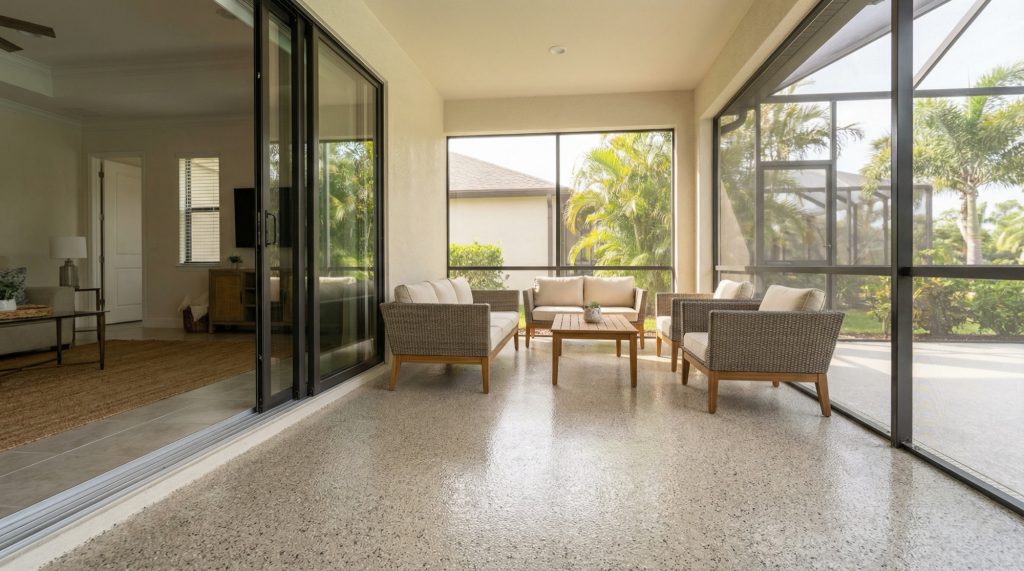
Skylights and big west-facing sliders do the same thing indoors, printing a bright rectangle onto the floor that color-shifts while the rest of the room stays put.
So we ask where the light actually lands before specifying. Inside or outside is too blunt a question. Where a coating has to run continuously from a sun-hit zone into a shaded one, the whole run gets the UV-stable topcoat so there is no visible line where the specification changed.
The build we use outdoors
The base layer can still be epoxy or polyurea, because once it is buried it never sees light. The topcoat is what has to be aliphatic, and that is where the UV stability comes from.
Outdoors the topcoat is doing several jobs at once: color stability, abrasion resistance against sand tracked in from the beach, and grip when it rains. So it usually carries aggregate as well.
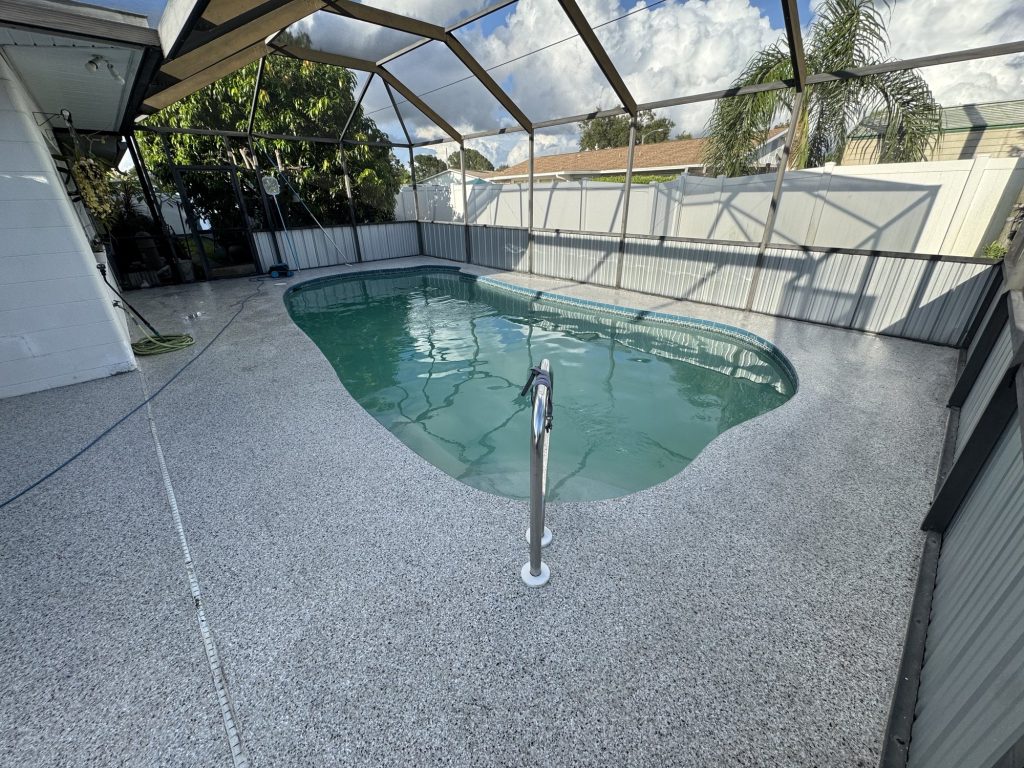
Heat is the other Florida factor. A dark exterior slab in July gets hot enough to be uncomfortable barefoot regardless of coating, so on pool decks and lanais we steer toward lighter tones that reflect rather than absorb, and a coating that will actually hold that light color.
Preparation
What happens before any resin comes out
Outdoor concrete in Florida takes ultraviolet light, standing water and constant vapor from below, so preparation matters even more here than it does inside.
Grinding comes first, always. Diamond tooling opens the surface so the coating has something to bite into, because a coating bonds mechanically rather than by sticking. The etching kit sold with retail epoxy does almost nothing to a slab that was power troweled smooth, which is most of them.
Moisture is the second reading. Concrete here pushes water vapor up through itself day and night, and a coating that seals it in will blister and let go regardless of what it cost. High numbers mean a moisture-tolerant primer goes down first, not that we carry on and hope.
Cracks get chased out to a clean edge and filled rather than skimmed over, spalls and pop-outs get rebuilt, and any previous coating comes off entirely. Only when the slab is sound, open and dry does anything get mixed.
The finish is what you see. The grind underneath it is what decides whether you are still happy in year eight, and it is where we spend the time other quotes save money.
That checking sometimes turns up a slab that should be repaired first. When it does, we tell you, even though it means a longer job or a pause. A crack with a structural cause comes back through a coating, and we are not putting our name on that.
Related work
Slip-Resistant Pool Deck Coatings
Anyone can make a floor grippy. Throw enough sand in the topcoat and nobody will ever slip on it, and nobody will…
See the system →Garage Floor Coatings
A garage floor takes more punishment than anything else in the house. Hot tires, dropped tools, road salt in winter…
How it works →Epoxy Garage Floors
Epoxy earned its reputation twice over: once as the toughest thing you can put on a garage slab, and once as the…
Read the detail →Polyaspartic Floor Coatings
Polyaspartic is what you use when the space cannot be out of service for a week and when the floor is going to see…
What it suits →Questions
UV-Resistant Floor Coatings questions
How much does uv-resistant floor coatings cost?
We would rather give you one honest number than a wide range. To get there we check the slab, because cracks, old coatings and moisture all change how much prep the job needs, and prep is where the cost moves. Size and system round it out.
How long does uv-resistant floor coatings take?
It depends on two things, the size of the floor and the system going down. Residential work typically takes two to four days on site. If you run a business, we plan around your hours and often work nights or weekends. Weather can shift cure times, so dates are confirmed up front.
Do you grind the floor first?
Always. Diamond grinding is the only way to get a profile the coating can key into, and it is the single biggest reason floors either last or fail. We do not acid etch and we do not coat over a sealed slab.
What about moisture in the slab?
Florida slabs move water upward constantly, and vapor trapped under a coating is a guaranteed failure. We take a reading before quoting. If the numbers are high we specify a moisture-tolerant primer rather than pretending the problem is not there.
Can you match a color or a look I have seen?
Usually. We carry eighteen flake blends and mix metallic per floor, so bring a photo, a cabinet door or a paint chip and we will get close. We put samples down in your own light before you commit.
Do you work outside Sarasota?
Yes. We cover a 120-mile radius from Sarasota, which is twenty-four counties from Naples up to Ocala and across to Orlando. Check the service areas page or call and ask.
Send us the space. We will send back a number.
Rough size and a photo is enough to start. We cover Sarasota and twenty-four counties around it, so tell us where you are and we will tell you when we can get there.
Pour this floor
Or call (941) 504-9132.