Garage
Epoxy, done the way it is supposed to be done
Epoxy earned its reputation twice over: once as the toughest thing you can put on a garage slab, and once as the stuff that peels up in sheets. Both are true. The difference is entirely in the preparation.
Pour this floor
Tell us the space and rough size. Or call (941) 504-9132.
Detail
Why epoxy fails, and why ours does not
Two-part epoxy cures into a hard, chemically resistant film that bonds mechanically to concrete. The word doing the work there is mechanically. It needs a profiled surface with somewhere to key into. Acid etching, which is what most kits tell you to do, barely touches a hard-troweled slab.
We grind with diamond tooling to a consistent profile, vacuum the dust as we go, then fill every crack and pinhole. Only then does resin come out of the bucket.
Build and thickness
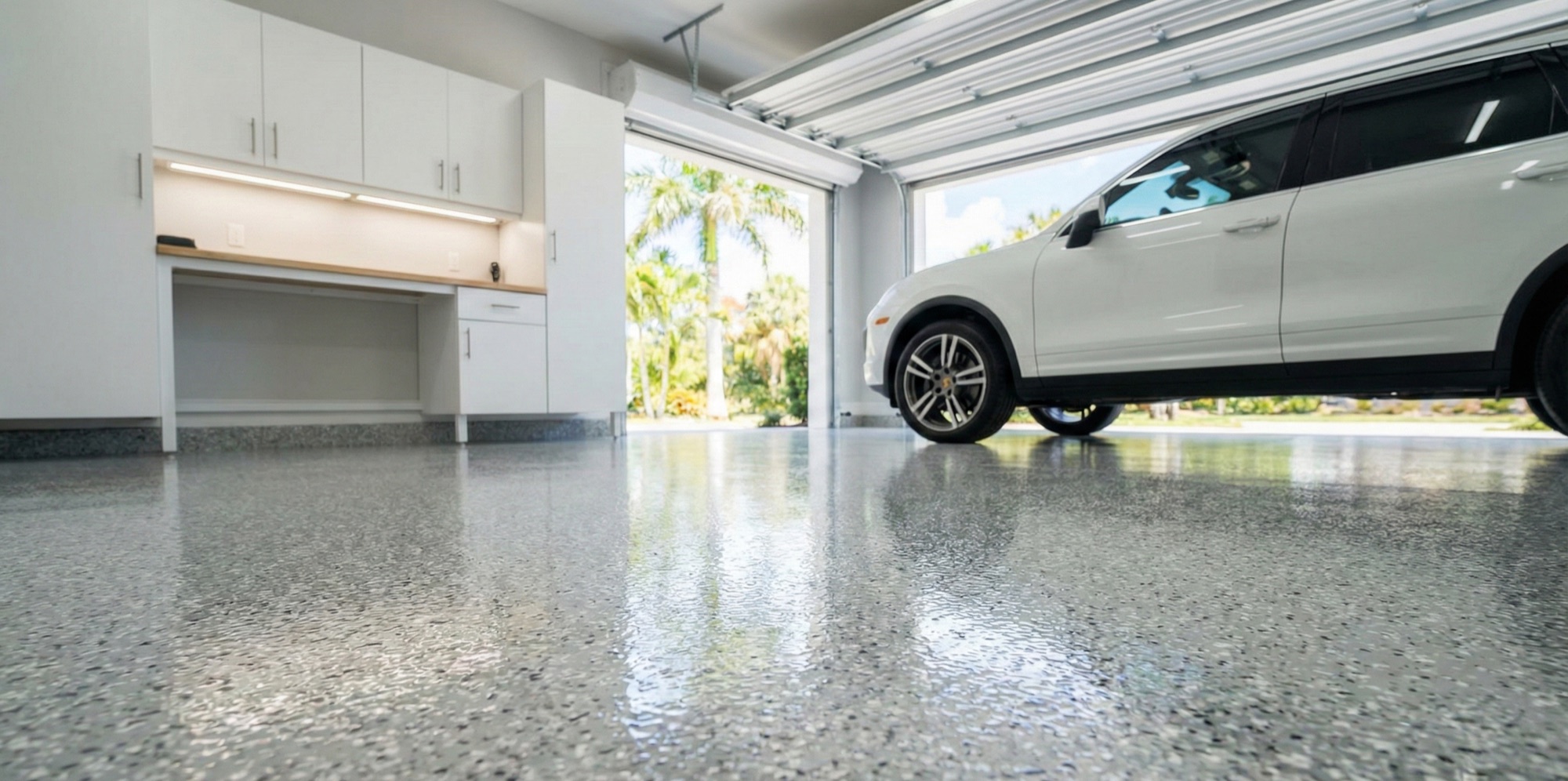
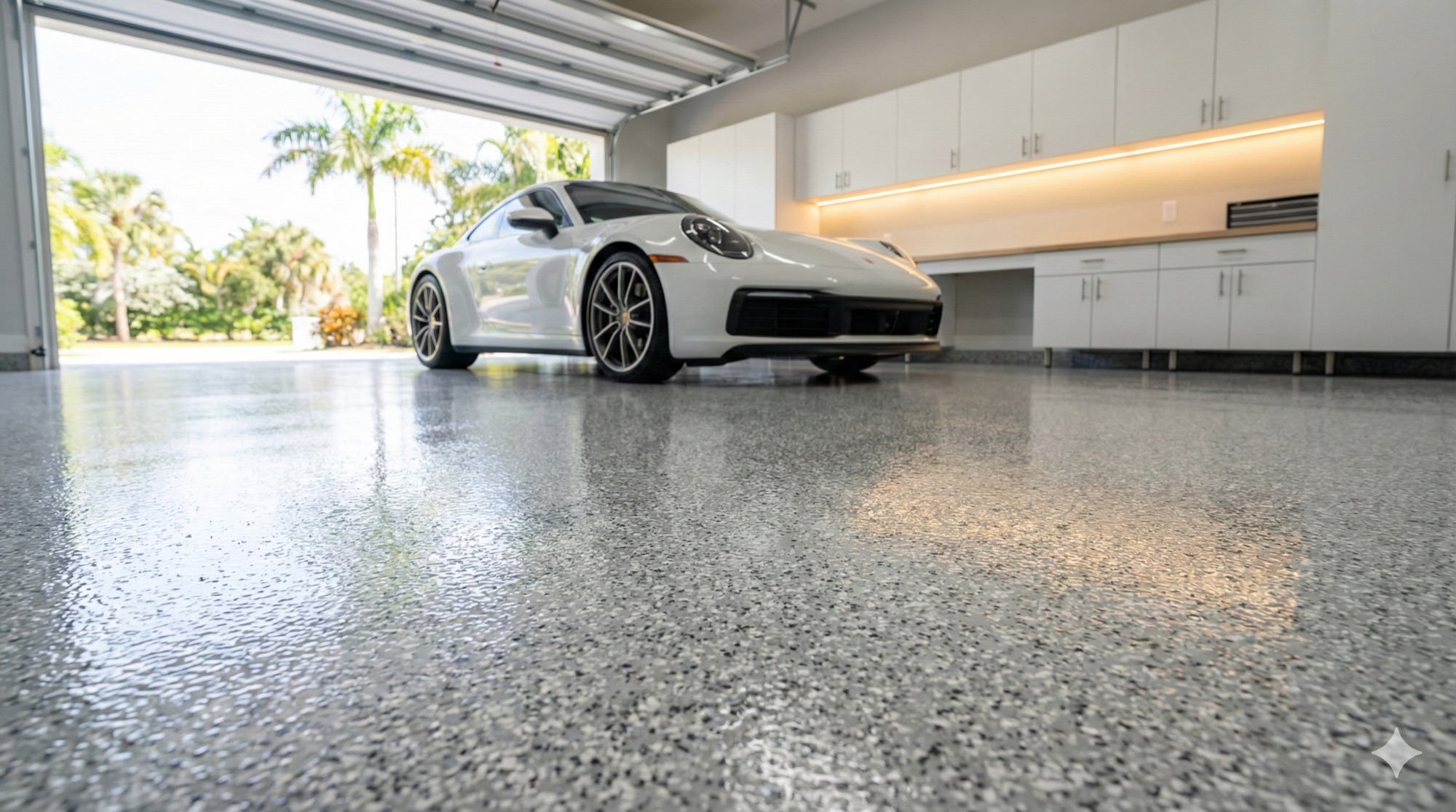
A proper garage build is a primer, a pigmented base, the flake or metallic layer, and a clear topcoat. That stack is several times thicker than a rolled-on kit and it behaves completely differently under a jack stand or a dropped wrench.
Thickness is also what lets us bury a broadcast of flake and still sand it back to a smooth, sealed surface rather than something that feels like sandpaper.
Living with it
Sweep it, mop it when it needs it, and do not use acid-based cleaners. Hot tire pickup, which is the classic epoxy failure where the tire lifts the coating off, is a bond problem and a topcoat problem. Neither happens on a properly ground floor with a polyaspartic or high-build clear over it.
Preparation
What happens before any resin comes out
A garage slab is usually the worst-prepared concrete on a property: hard-troweled smooth when it was poured, then twenty years of tire rubber, oil and road salt on top of it.
The first day is the grinder. We work the slab with diamond tooling until it is uniformly open, vacuuming as we go so the dust stays out of the house. Skip this and you are relying on the resin to stick to a sealed surface, which is the reason so many coatings come up in sheets.
After grinding we measure what the slab is doing with water. Sandy subgrade and a shallow water table make vapor drive a constant in this climate, and it is the failure nobody sees coming because the floor looks perfect for the first season. We test before quoting so the system suits the slab.
Cracks get chased out to a clean edge and filled rather than skimmed over, spalls and pop-outs get rebuilt, and any previous coating comes off entirely. Only when the slab is sound, open and dry does anything get mixed.
The finish is what you see. The grind underneath it is what decides whether you are still happy in year eight, and it is where we spend the time other quotes save money.
It is also why we will occasionally tell someone their slab needs repair before it needs a coating. A floor that should be fixed structurally is not a floor we will put resin on, because the crack comes back through and then it is our name on it.
Related work
Concrete Scarification
A scarifier does not abrade the surface. It hits it. A drum of hardened steel or carbide cutters spins at speed and…
See the system →Shot Blasting
A shot blaster fires small steel beads at the floor at high velocity, fractures the surface, then vacuums the shot…
How it works →Epoxy Removal
Somebody laid epoxy on this floor and it did not hold. Now it is lifting in sheets, or bubbling, or peeling wherever…
Read the detail →Old Coating Removal
Not everything on an old floor is epoxy. Cure and seal from the day it was poured, deck paint somebody rolled on in…
What it suits →Questions
Epoxy Garage Floors questions
How much does epoxy garage floors cost?
Price follows square footage, the condition of the slab and the system you choose. A sound slab that only needs grinding costs far less to prepare than one with cracks, old coating or a moisture problem. We look at the floor and give you a real number rather than a range that means nothing.
How long does epoxy garage floors take?
Most residential work is two to four days on site depending on size and system. Commercial and industrial floors are scheduled around your hours and often run nights or weekends. You get exact dates before we start, including when you can walk on it and when you can put weight on it.
Do you grind the floor first?
Always. Diamond grinding is the only way to get a profile the coating can key into, and it is the single biggest reason floors either last or fail. We do not acid etch and we do not coat over a sealed slab.
What about moisture in the slab?
Florida slabs move water upward constantly, and vapor trapped under a coating is a guaranteed failure. We take a reading before quoting. If the numbers are high we specify a moisture-tolerant primer rather than pretending the problem is not there.
Can you match a color or a look I have seen?
Usually. We carry eighteen flake blends and mix metallic per floor, so bring a photo, a cabinet door or a paint chip and we will get close. We put samples down in your own light before you commit.
Do you work outside Sarasota?
Yes. We cover a 120-mile radius from Sarasota, which is twenty-four counties from Naples up to Ocala and across to Orlando. Check the service areas page or call and ask.
Send us the space. We will send back a number.
Rough size and a photo is enough to start. We cover Sarasota and twenty-four counties around it, so tell us where you are and we will tell you when we can get there.
Pour this floor
Or call (941) 504-9132.