Commercial
Closed Friday night, open Monday morning
A business floor gets judged on two things: whether it survives what happens on it all day, and how many trading hours it costs to put in. We plan the second one as carefully as the first.
Pour this floor
Tell us the space and rough size. Or call (941) 504-9132.
Brief
The trade decides the floor
Four businesses can share a plaza and need four different builds. What goes on the slab depends on what happens above it, so the first conversation is about your operation rather than about resin.
Retail and showroom
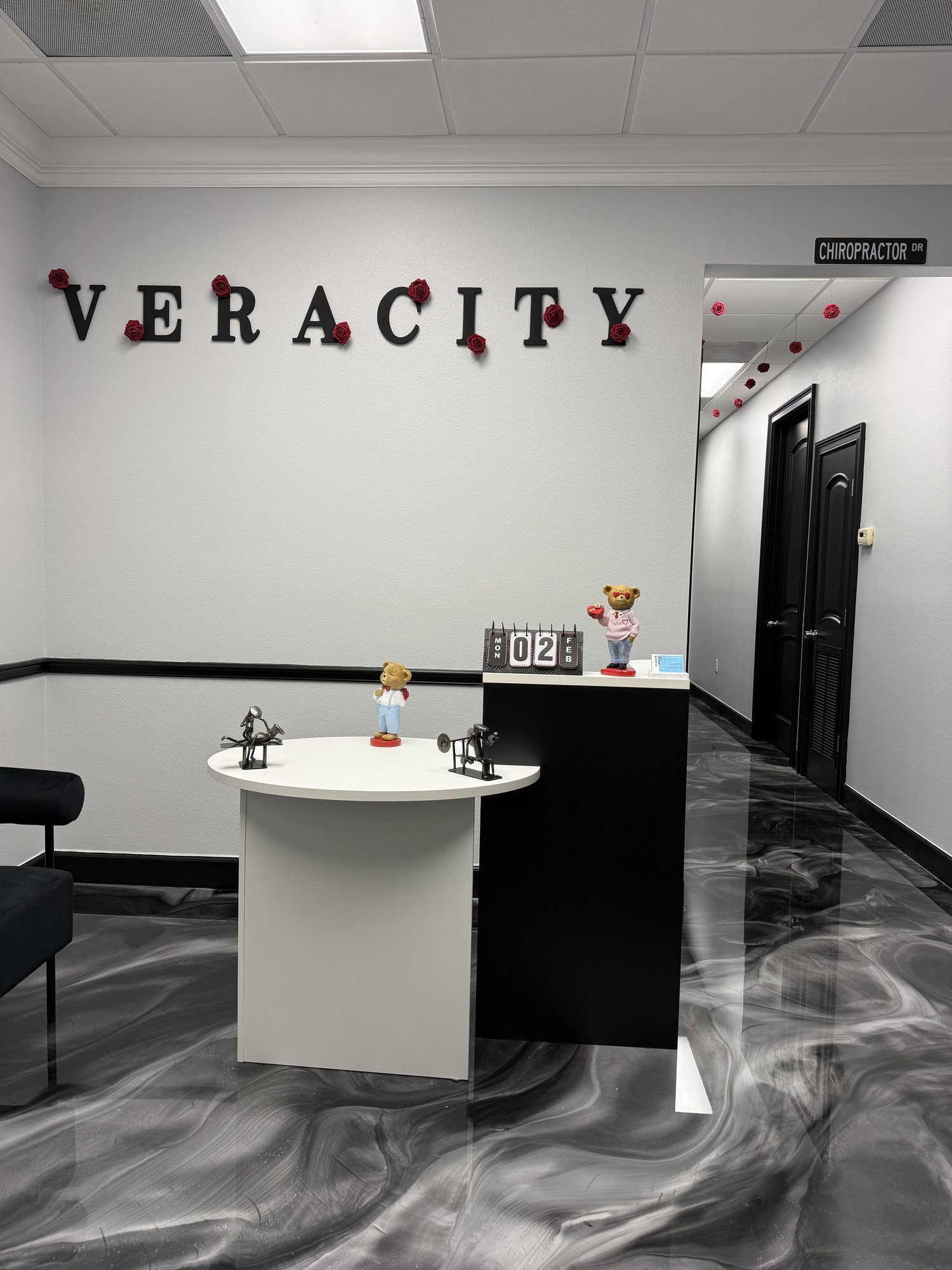
Foot traffic, rolling racks, and a floor customers look at before they look at anything else. This is where a metallic pour or a light flake blend earns its money, because the floor is doing display work as well as wear work. Cart wheels and heel marks are the real load, and a polyaspartic topcoat handles both without going dull down the main walkway.
Medical, dental and treatment rooms
Seamless is the whole point. No grout lines, no vinyl seams, and a coved base carried up the wall so the floor and wall meet in a curve that mops clean. It has to sit still under a rolling stool a hundred times a day and take disinfectant every evening without clouding.
Salons, kitchens and back-of-house
These floors get the worst of it: color chemicals, hot water, oil, and a wash-down routine that would strip a lesser coating in a season. Texture goes in on purpose because wet tile behind a counter is how people fall, and the drains get detailed properly rather than coated around.
Warehouse and service bays
Pallet jacks, hand trucks and the occasional forklift put point loads through a slab that a residential build would never see. The answer is a thicker body coat and a joint treatment that flexes, not a shinier topcoat.
Reading a North Port slab before anyone quotes it
North Port’s commercial stock is mostly newer inland construction, slab-on-grade poured in the last twenty years on sand over a high water table. That is a decent slab to work with and it comes with one standing problem: the concrete pushes vapor upward day and night.
Seal that in under a film-forming coating and you get blistering and delamination that cannot be repaired afterwards, only ground off and redone. So we take a moisture reading before quoting, and where the number comes back high a moisture-tolerant primer goes down first. That decision is made with a meter rather than with optimism.
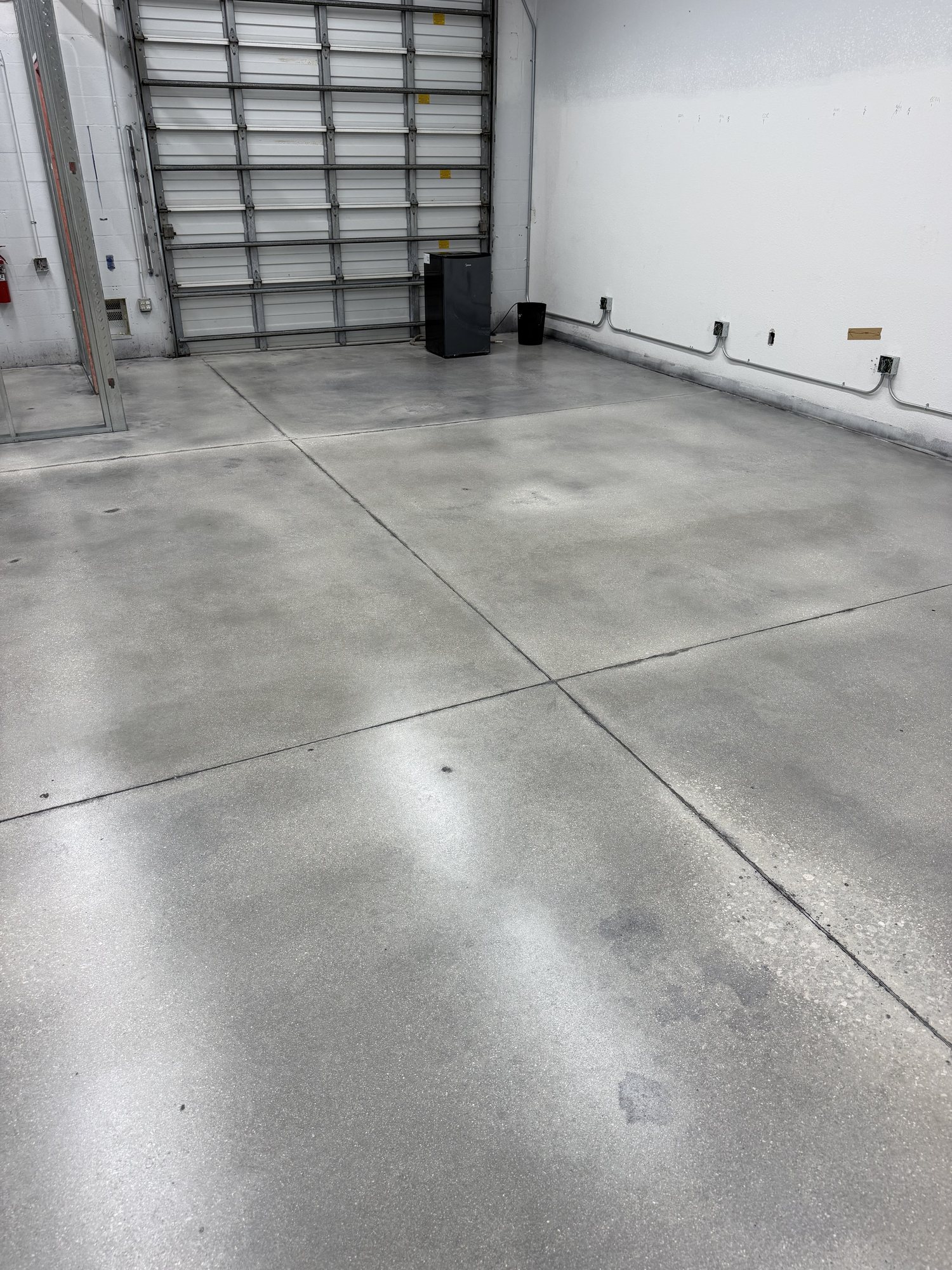
The second reading is what is already on the slab. Older suites have been through tenants, and under the current vinyl there is often adhesive, a sealer, or a thin coating somebody rolled on years ago. All of it comes off mechanically. Diamond tooling runs progressively across the surface until it is open enough for the coating to key into, with the dust going into a vacuum instead of into the space next door.
Cracks get chased out to a clean edge and filled rather than skimmed, and spalls and pop-outs get rebuilt. Only when the slab is sound, open and dry does anything get mixed. It is also why we occasionally tell a landlord the concrete needs repair before it needs a coating, because a crack that is still moving comes back through and then it carries our name.
Hours, phasing and what closure actually costs
Most commercial work we do runs nights and weekends, and polyaspartic is usually why it can. The cure window fits inside a closure, so a Friday night start hands the space back Monday morning on a suite of ordinary size.
Where a floor is too large for one closure we phase it. Half the space stays in service while we work the other half, then we swap. It takes longer overall and it keeps your doors open, which is the trade most owners would make every time.
- You get the dates in writing before we start: grind day, coat day, walk-on time and the hour furniture can go back.
- Overnight work is planned around your alarm, key and access arrangements, not assumed.
- Phased floors get a clean cut line at a doorway or a joint so the join is deliberate rather than wherever we stopped.
- If humidity or a storm moves the cure, you hear it from us that day.
The one thing we will not do is compress a floor into a closure it does not fit, then hand you a soft surface on opening morning. A polyaspartic that is walkable is not yet a polyaspartic that will take a pallet jack, and the difference matters most in the first week.
Records
What you get in writing, and who wants to see it
Commercial floors get inspected by people who were not there on the day. Insurers, franchisors, health inspectors and the next tenant’s contractor all ask the same question in different words: what is actually on this slab.
So we hand over the system specification, the product data sheets and the cure schedule for your records. If somebody asks what primer went down over a high moisture reading, the answer is on paper rather than in somebody’s memory.
Attention to detail and cleanliness is the whole pitch. On a commercial job that means the dust is contained, the edges are cut in properly, and the paperwork exists.
Maintenance is the other half of it. A resin floor lasts on a neutral cleaner and a flat mop, or an autoscrubber with a soft pad on a bigger space, and it fails early when a night crew improvises with degreaser or an acidic tile product. We leave written instructions so the routine survives a change of cleaning contractor.
And when something does go wrong, resin repairs in place. A damaged area gets ground back, rebuilt and blended. On a flake or quartz floor you will struggle to find the repair afterwards, which is not true of a lifted tile or a patched sheet of vinyl.
Other floors we pour around North Port
Epoxy Garage Floors
Hot-tire pickup, storm-season storage and a one-day install.
See the system →Flake Epoxy Flooring
Blends that hide sand and grit, with a cove base up the wall.
How it works →Metallic Epoxy Flooring
One pour, no undo, and a floor that reads like moving water.
What it suits →Pool Deck Coatings
Screened cage decks that stay cool underfoot and grip when wet.
Read the detail →Commercial Epoxy Flooring
The full system page, covering every county we run.
The whole system →Everything we do in North Port → · All of Sarasota County → · See the work → · Contact details →
Questions
What business owners ask us first
Can the floor go in over a weekend?
Often, yes, on a suite of ordinary size with a slab that is in decent shape. Polyaspartic cures fast enough that a Friday night start can hand you the space back on Monday. A slab carrying an old coating, a moisture problem or serious cracking needs more than two days, and we say that before you book anything around it.
What can a cleaning crew safely use on it?
A neutral cleaner and a flat mop, or an autoscrubber with a soft pad on a larger floor. What wrecks resin floors is a crew improvising with degreaser or an acidic tile product night after night. We leave written instructions so the answer does not walk out the door with whoever cleaned it last.
Will a seamless floor pass a health inspection?
A seamless floor with a coved base removes the grout lines and the wall joint that inspectors look at hardest, which is why kitchens and treatment rooms end up specified this way. We install what the system calls for and give you the data sheets, and the inspector makes the call on the space as a whole.
Does everything have to come out of the room?
The floor has to be clear where we are working, but the whole suite does not have to empty at once. On a bigger space we phase it and move your fixtures once rather than twice. Anything plumbed or bolted down is your contractor’s job to release, and we coordinate the dates with them.
Can you work while a tenant improvement is still going on?
Yes, and it is usually the cheapest time to do it, as long as we go in after the overhead trades are finished. A floor installed before ductwork and lighting gets dropped on it takes damage, so we ask to be sequenced late even when the slab is ready early.
What happens if part of the floor gets damaged later?
Resin floors repair in place. A damaged area gets ground back, rebuilt and blended, which is far less disruptive than lifting tile or replacing a section of vinyl. On a flake or quartz floor the repair is close to invisible; on a solid color it can be seen in raking light, so we keep the batch details on file.
Tell us the trade and the hours you can give us.
Square footage, what the space is used for, and when it can be closed. That is enough to come back with a system, a day count and the dates. If you are mid-buildout, send the schedule and we will slot in behind the overhead trades.
Pour this floor
Or call (941) 504-9132.