Poolside
Grip where wet feet come out of the water
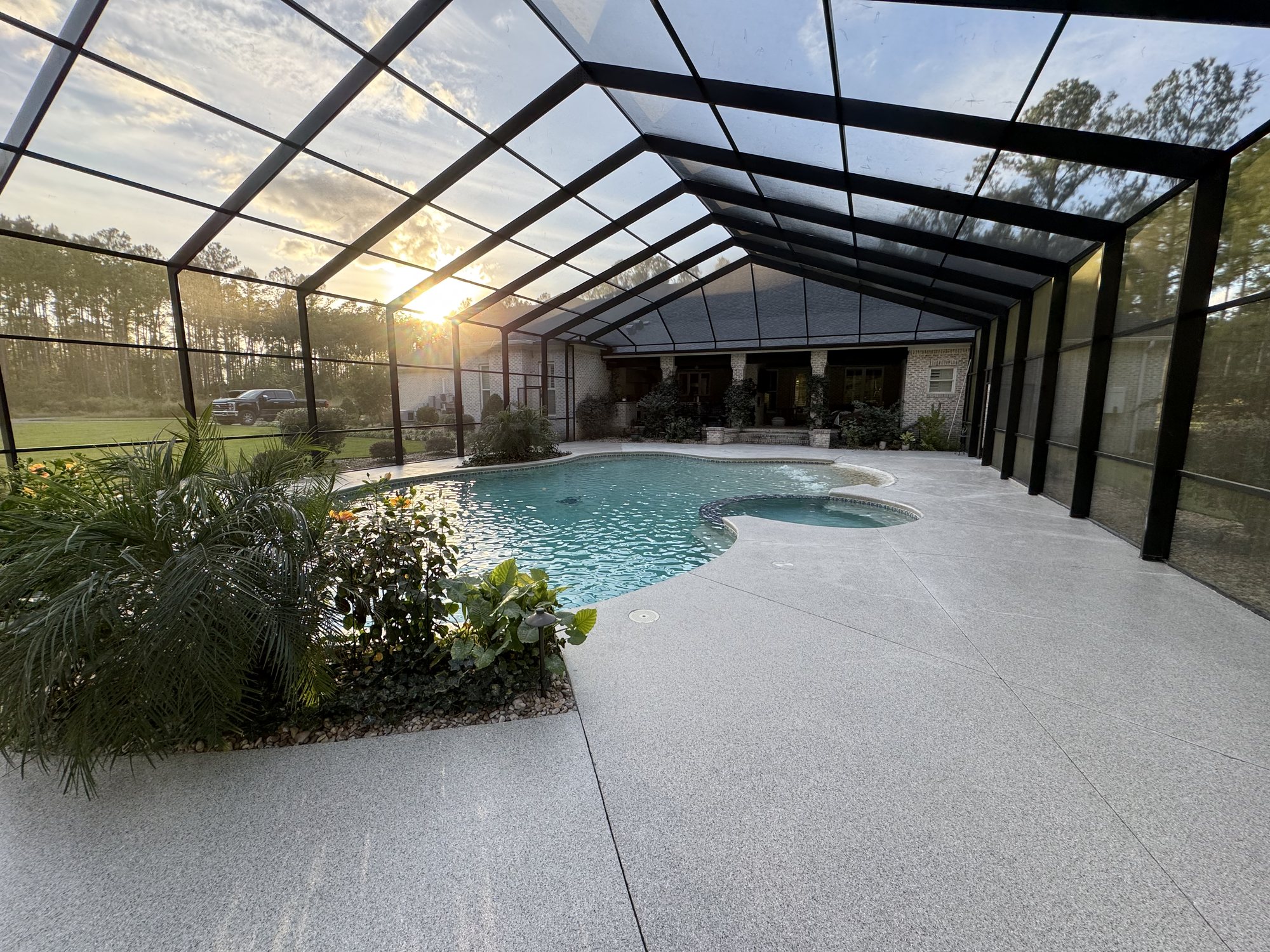
The riskiest stretch of any pool deck is the stretch by the ladder and the steps, where people climb out dripping and put their whole weight on one foot. We coat the entire deck, then build the texture so that stretch holds, without turning the rest into sandpaper you cannot sweep.
Ask about your deck
Rough size and who swims. Or call (941) 504-9132.
Grip
Where people actually slip
Watch a pool on a busy afternoon and the falls nearly all happen in the same few spots. The square yard beside the ladder gets soaked every time someone climbs out and never has a chance to dry. The coping takes hands, knees and wet heels as people sit on it and push off. The top step is where a foot leaves the water and lands on a surface it trusts.
So the texture is never spread evenly. We load more aggregate into the topcoat at those landing zones and taper it out toward the far edges of the deck, where people walk in sandals and drag lounge chairs. Done right, you cannot see the change. You feel it the second a wet foot lands.
The coping itself needs a conversation. Some copings are poured concrete and take the same system as the deck. Others are pavers or stone with a finish of their own, and we stop clean at that line rather than smear resin over a material it was never meant to grip.
Tell us who climbs out of that pool. An older parent who swims for their joints and a pack of kids doing cannonballs need a different grade than two adults swimming laps at dawn.
The trade between grip and a deck you can hose clean
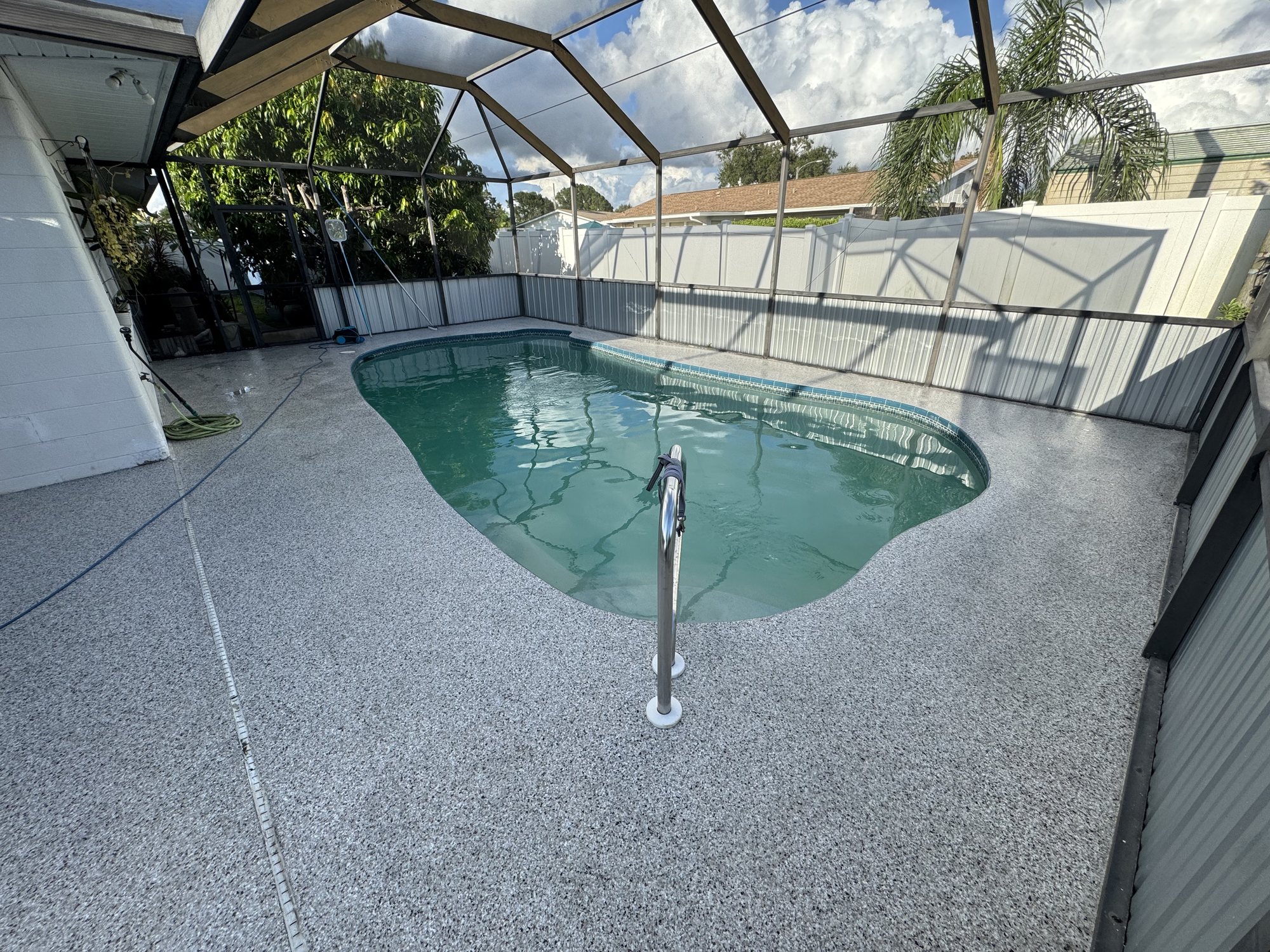
Texture works because it gives a wet foot something to bite into. The same peaks that do that also catch sunscreen, leaf litter and the gray film that builds up around any pool. A very aggressive profile grips beautifully for a month, then looks dirty in the low spots no matter how often you rinse it.
A gloss finish has the opposite problem. Nothing sticks to it, a hose clears it in a minute, and it is about as safe as a wet kitchen floor once somebody runs across it barefoot. Some of the decks we get asked about were finished that way on purpose because they photographed well.
Our answer sits between the two, and it is a real choice you get to make. We bring sample boards with different grades of grit rolled into the clear coat. You wet them, you stand on them, and you scrub one with a deck brush. Ten minutes on your own patio tells you more than any spec sheet ever will.
Gloss looks great in a listing photo. Texture is what keeps a guest upright on the steps.
Whatever grade you choose, the grit is mixed into the topcoat itself. Loose grit scattered over the surface wears off in the traffic lanes within a season, and those lanes are exactly where you need it most.
Joints that stay joints
A pool deck slab is cut or tooled into sections when it is poured. Those control joints are where the concrete is supposed to crack, neatly and out of sight, as it shrinks and moves with the heat. Coat straight over them and the crack still forms. It just forms through your new finish, in a ragged line, a few months later.
We carry every joint through. After grinding, each saw cut and expansion joint is cleaned out and the coating is cut back to it, so the line you see in the finished deck is the line the slab already had. Where a joint calls for it, a flexible sealant goes in that can move with the concrete instead of fighting it.
Random cracks get handled differently. A hairline that has opened across a section is chased out, filled and left to cure before anything goes over it, because a crack that is still moving will telegraph through any film laid on top. If a crack has stepped, with one side sitting higher than the other, the slab has a problem a coating cannot solve, and we say so up front.
Materials
Pale colors, chlorine and the garden hose
Color on a pool deck is mostly a temperature decision. Dark blends soak up sun and get hot enough that people hop across them on the way to the water. Lighter grays, tans and whites reflect a lot of that heat and stay walkable in the middle of the day, which is when most of the swimming happens.
Pool water is hard on finishes. Chlorine and salt-system splash dry into a crust along the edge, and acid and pool shock get spilled near the equipment pad. The topcoat we put down outside is a polyaspartic or polyurea, which shrugs off that chemistry and, unlike indoor epoxy, will not yellow or chalk under the sun. A chalky deck is a slick deck, so UV stability turns out to be a grip issue too.
Epoxy still earns a place underneath, as primer and body coat where no sunlight reaches it. The UV-stable layer sits on top doing the job epoxy cannot.
Rinse it with a hose, and now and then scrub the landing zones with a soft deck brush and mild soap. That is the maintenance.
What we would ask you to skip is a pressure washer on a tight fan held close to the surface. One pass does no harm. Years of it wear the texture down in exactly the places you need it, and that is the one kind of wear we cannot fix with a rinse.
What a barrier island adds to the job
Longboat Key sits on a barrier island in Sarasota County, and salt air and wind-driven rain reach every edge of a pool deck there.
Inland, the outer edge of a deck is an afterthought. Here it takes rain blown sideways under the screen and salt that settles on everything, so edges and transitions get more of our attention than the open middle of the slab. The coating is wrapped cleanly to the perimeter, and the line where the deck meets a screen base, a lawn or a planting bed is finished tight, with no lip for water to sit behind.
Underneath, the slab sits on sandy ground over a high water table, so moisture keeps rising into the concrete from below. We take a reading before quoting, and when it comes back high, a primer built for vapor goes down first. Resin sealed over a damp slab blisters.
Humidity and afternoon storms decide the cure, so you get dates worked out for your deck. The shop in Sarasota is a short drive away, which means sliding a day when the sky turns wastes nobody’s trip.
Lanai Floor Coatings
The screened room off the living room, with color picked against the floor inside.
Lanai work →Porch Floor Coatings
The entry slab at the front door, saw cuts kept and the door still in use.
Front entries →Decorative Epoxy Flooring
Marbled and metallic color pours for indoor rooms.
Indoor pours →Full Flake Garage Floor Coatings
Chip spread to refusal and coved up the wall, built for sand and salt.
Garage floors →Slip-Resistant Pool Deck Coatings
The full system page, for decks anywhere we work.
Every deck we coat →Everything we do on Longboat Key → · All of Sarasota County → · See the work →
Questions
Questions from the pool side of the house
How rough does the finish feel on bare feet?
Closer to fine sandpaper than to a sidewalk. You notice it when you go looking for it, and after a few laps you stop noticing it at all. We pick the grade with you on wet sample boards, so you know exactly how it feels before any of it goes on your deck.
Is a textured deck harder to keep clean?
A little, and it is worth being honest about that. Texture holds more grime than gloss, mostly in the landing zones by the steps and ladder. A hose handles everyday dirt, and a soft brush with mild soap every so often clears the film. Heavier grit means more brushing.
What happens to the joints in the slab?
They stay. Saw cuts and expansion joints get cleaned out, the coating is cut back to their edges, and a flexible sealant goes in where one is needed. The slab keeps moving where it was designed to move, so any crack forms inside the joint and leaves your new finish alone.
Do the steps and the coping get coated too?
Poured concrete steps and copings usually do, and they get the heavier texture because that is where people climb out. Paver or stone copings keep their own finish. We stop clean at that line instead of running resin onto a material it was never meant to bond with.
Will pool chemicals or a pressure washer hurt it?
Chlorine, salt-system splash and the odd spill of pool shock will not soften the polyaspartic or polyurea topcoat we use outside. A pressure washer held close on a narrow fan is the bigger risk. Over the years it wears the texture flat in the spots where you need it most.
Why take a moisture reading before quoting a deck?
Because the slab sits on sand over a high water table, and moisture keeps rising through it. Lock a damp slab under the wrong primer and the coating blisters. A high reading means a vapor-tolerant primer goes down first, and you hear about that before any work starts.
Show us the corner where everyone climbs out.
A photo of that spot, one of the whole deck and a rough size are enough for us to tell you the grade of texture, the system and how many days the deck is out of use. Mention any joints that have cracked and whether the coping is poured concrete or stone.
Ask about your deck
Or call (941) 504-9132.