Systems
Pick the blend that forgives the sand you track in
Chip broadcast into a wet base until the floor will not take another one, then sealed under clear. Eighteen blends, and the right one depends less on taste than on what walks across the floor every week.
Pour this floor
Tell us the space and rough size. Or call (941) 504-9132.
Blends
Sand, shell grit and the chips that hide them
Everybody who lives within reach of the Gulf brings some of it home. Sand in the tread, shell grit off the cooler wheels, a wet towel dropped in the bay while somebody hoses the boards. None of that hurts a coated floor. It just shows, and on the wrong blend it shows constantly.
Flake solves that visually rather than physically. The chips give the eye a pattern to read, so a scatter of pale grit across a mid-toned blend simply becomes part of the pattern. Put the same grit on a solid pale gray and you can see every grain from the doorway; put it on a solid charcoal and you can see it twice as well.
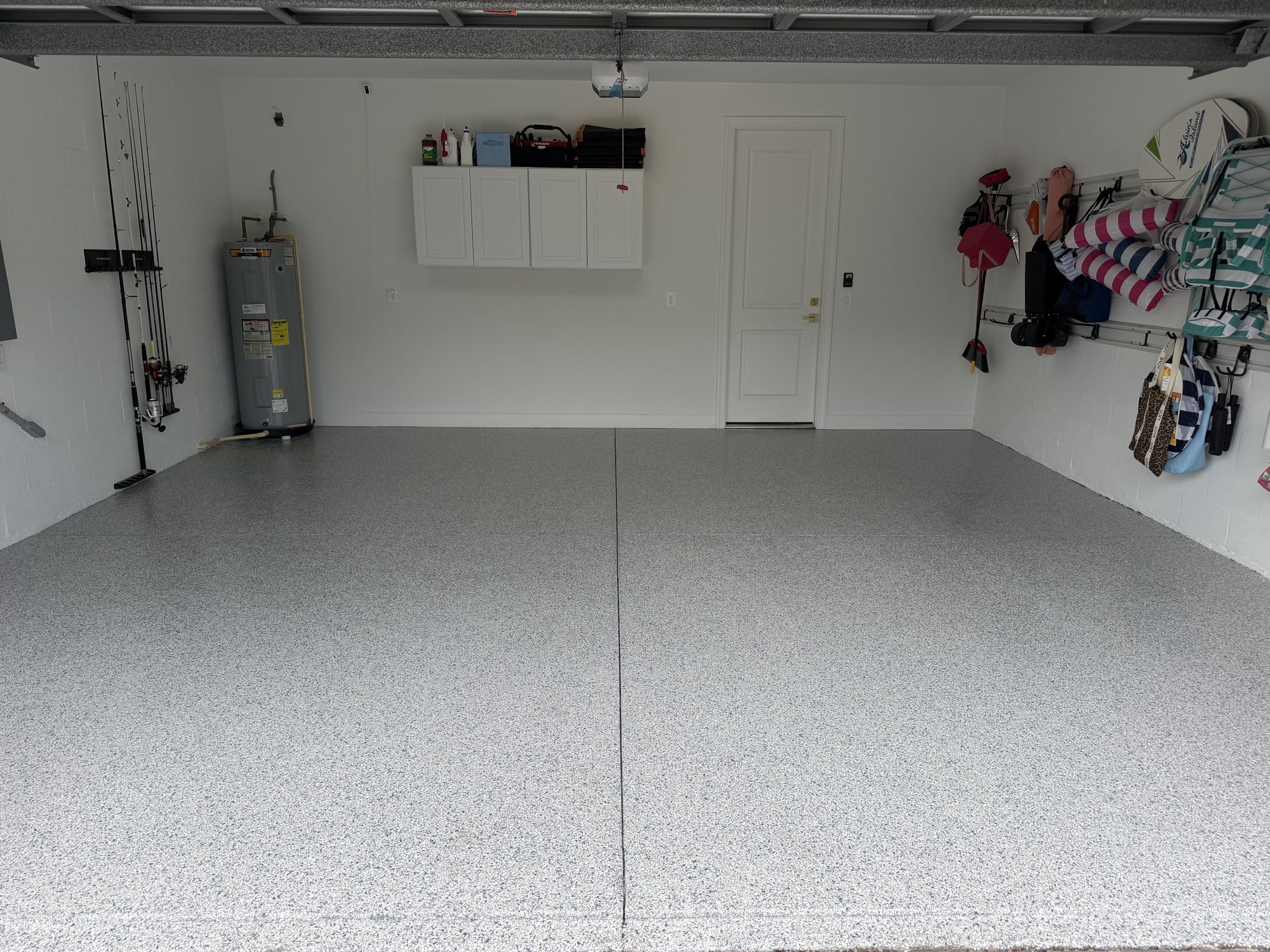
We carry eighteen blends, including Stargazer, Nightfall, Obsidian, Tidal Wave, Carbon, Coyote, Glacier and Shoreline. Some are near-neutral grays, some carry a strong color note, and they read very differently in daylight than under LED garage lights. That difference is the reason we bring physical samples and set them on your slab in your own light rather than asking you to choose from a screen.
For a bay that handles beach gear, the blends that do best carry both a light chip and a dark one. For a workshop where the concern is sawdust and dropped hardware rather than sand, the calculation flips and a darker blend often wins.
Coverage
Broadcast to refusal, and why partial is a different floor
Broadcast to refusal is the trade term for doing it properly. The installer keeps throwing chip into the wet base coat until the resin physically will not absorb another one, so when the excess is swept up the next day the base color has disappeared completely. Every square inch is flake.
Partial broadcast leaves the base showing between chips. It costs less because it uses a fraction of the material, and it gives a lighter speckled look that some people genuinely prefer in a laundry room. What it does not do is hide anything, because the base is still half of what you are looking at, and any unevenness in how the chip landed stays visible forever.
There is no way to top up a thin patch later. Once the base has cured, more chip has nothing to sit in. That is why we would rather over-order flake on a job than come up short in the last eight feet of a three-car bay.
Skimping on chip is the one shortcut in this trade you can see from the doorway for the life of the floor.
Cove base
Taking the coating up the wall
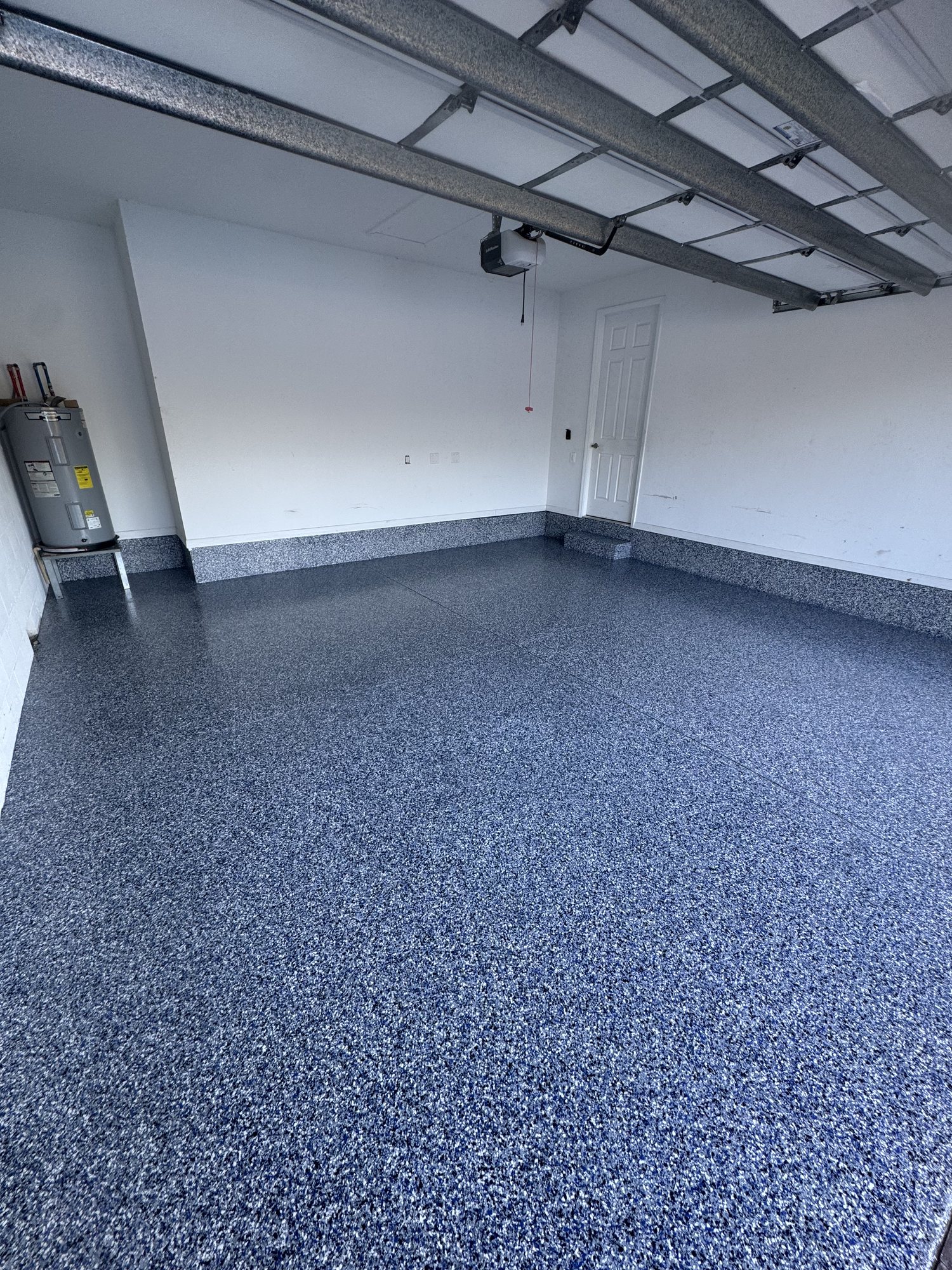
A coved base carries the flake system a few inches up the wall in a curve, so there is no seam where the floor meets the block. It is the detail in the photo at the top of this page, and it changes how a room gets cleaned.
In a laundry room it means a washer hose that lets go has nowhere to run under the drywall. In a workshop with a utility sink it means you can hose or mop straight up the edge instead of chasing a line of grime along a baseboard. In a garage bay it keeps the dirt that collects at the wall from packing into a joint you cannot reach.
Not every room needs it. A dry storage bay is fine with a standard termination at the wall. But anywhere water arrives on purpose, the cove is worth the extra day, and on a laundry or workshop conversion it is usually the first thing we suggest.
The same logic applies at the door line, where the coating meets the driveway. That edge takes sun, rain and tire load all at once, so it gets terminated cleanly rather than feathered out thin.
Topcoat
The clear is what decides how it ages
The flake layer is decorative. The clear over it takes every bit of the wear, which makes the choice of topcoat the most consequential thing after the grind.
On a bay where the door spends the afternoon open, the sun reaches several feet inside. Standard epoxy ambers and turns slick under ultraviolet light, so exterior-facing work gets a UV-stable polyaspartic instead. It is fast and UV stable, and gives you a gray that stays gray rather than going amber in the sun.
You also pick the sheen. A full gloss shows off the depth of the chip and bounces light around a dim bay. A satin hides dust between cleans and is easier on the eyes in a space with a lot of daylight. Neither is tougher than the other; they wear the same and simply look different.
Five summers on, what you should see is the blend you chose with a slightly softened gloss in the tire tracks. The chips themselves do not fade, because the color runs through the vinyl instead of sitting on top of it. If the sheen ever bothers you, the clear can be scuffed and recoated without disturbing anything below it.
Under it
None of it matters without the grind
Before anything else we measure what the concrete is doing. Slabs here sit on sand over a high water table and push moisture up through themselves day and night; seal that in under the wrong primer and the floor lifts within a couple of seasons. North Port's newer inland subdivisions are mostly slab-on-grade poured in the last twenty years, which usually means sound concrete that was still troweled far too smooth for resin to grip.
So the slab gets diamond ground until it is uniformly open, with the dust going into a vacuum rather than into the house. Cracks get chased out to a clean edge and filled, pop-outs get rebuilt, and anything previously coated comes off entirely. Then, and only then, does the primer go down.
We are based in Sarasota, a short drive up the coast. Most Sarasota County jobs get scheduled inside the same week. Send the room size and a photo of the slab and you get the system, the day count and the date you can park on it. Our contact details are here.
Garages
The full build for a two-car or three-car bay, including what hot tires actually do to a coating.
See the system →Metallic
Pigment worked by hand while the resin is open. The one people stop and stare at.
How it works →Pool decks
Flake outdoors, under a screen cage, with slip texture where wet feet land.
What it suits →Commercial
Back-of-house floors that pass an inspection and survive a rolling cart.
Read the detail →Flake epoxy in full → · See the work → · Everything we do in North Port →
Questions
What people ask before choosing a blend
Which blend hides beach sand and shell grit best?
Anything with a mid tone and a mix of light and dark chips. A blend that carries both reads as pattern, so a little sand across it disappears instead of standing out. Solid pale gray and solid dark charcoal are the two that show every grain, which is why we steer people away from them for a door that faces the water gear.
What is the difference between full broadcast and partial flake?
Full broadcast means chip goes into the wet base until it will not take another one, so the base color disappears entirely and the floor is all flake. Partial leaves the base showing between chips for a speckled look. Full costs more in material and hides far more, and it is what most garages here get.
Can you run the flake up the wall in a laundry or workshop?
Yes. A coved base carries the coating a few inches up the wall in a curve with no seam at the joint, so water has nowhere to sit and a mop runs straight up the edge. It is worth doing anywhere the floor gets wet on purpose, which is most laundry rooms and any bay with a utility sink.
The sun comes right into my garage. Will the floor go yellow?
Standard epoxy ambers and turns slick under ultraviolet light, so a bay with a lot of direct sun at the door gets a polyaspartic topcoat instead. It is UV stable, which means a gray that stays gray rather than drifting warm over a few summers.
How does a flake floor look after five summers here?
Like itself, with a slightly softened gloss where the tires sit. The chips do not fade because the color is through the vinyl rather than printed on it, and the clear takes the wear instead of the flake. If the sheen ever bothers you the clear can be scuffed and recoated without touching the layers underneath.
Does the texture make it hard to clean?
No, because we sand the surface back after the broadcast to knock down the sharp edges before sealing. What is left is enough grip that a wet car does not turn the bay into a skating rink, but smooth enough that a dust mop or a hose clears it in a few minutes.
We will bring the samples to your slab.
Rough size and a photo of the floor is enough to get a real number back. Then we set blends down in your own light so you are choosing from chips rather than from a photograph. No showroom visit, no pressure.
Contact details · Call (941) 504-9132 · Sarasota County coverage
Pour this floor
Or call (941) 504-9132.