Outdoor
Covered, attached, and the first floor anyone walks on
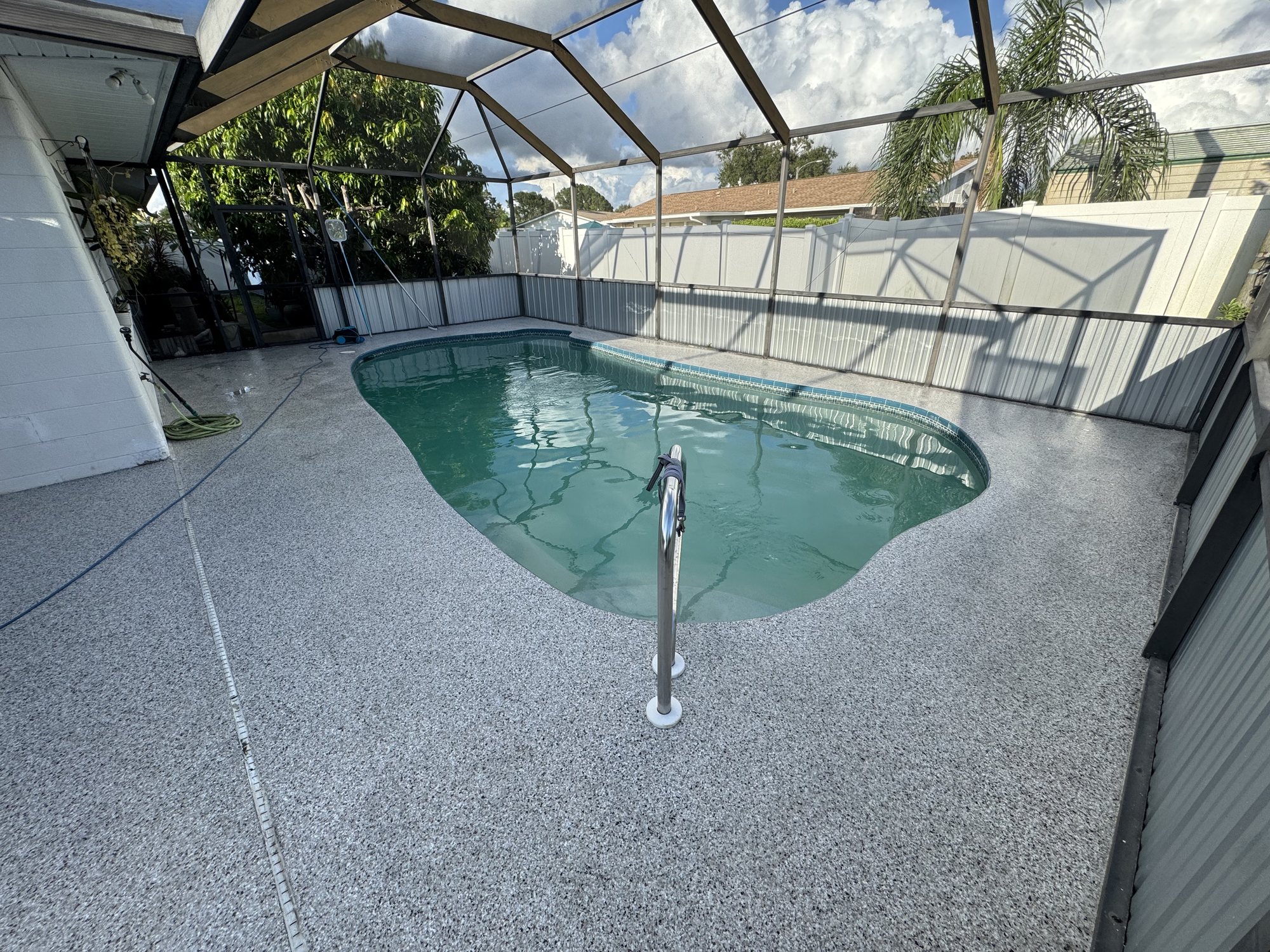
A porch is covered and it is attached to the house, and both of those change the job. It stays drier than a patio, so it wants a finer finish. It is joined to the building, so how water moves at that junction matters more than anywhere else outside. And it is the floor every visitor stands on before the front door opens.
Pour this floor
Tell us the space and rough size. Or call (941) 504-9132.
Detail
Covered does not mean protected
A roof keeps the direct rain off and it does not keep the weather out. Wind drives water sideways onto a porch during any real storm, the outer third of the slab gets soaked, and the section nearest the house stays dry. That split is why porch coatings often fail in a band rather than all over.
Low sun gets under the roof too. Morning or afternoon light comes in at an angle and lands on the floor for hours, which is enough ultraviolet exposure to amber an interior epoxy in the exact strip that catches it. We use UV-stable material on porches for that reason.
The upside of the cover is that a porch stays cleaner and drier overall, so we can run a finer texture and a slightly higher sheen than we would outdoors in the open. It looks more like an interior floor because it lives a gentler life.

The junction with the house
Where the porch slab meets the wall is the detail that matters most. Water running off the roof or blowing in has to move away from the building, and any coating that dams it at the wall creates a problem behind the finish rather than on it.
We check that the slab still falls away from the house before quoting. Porches settle, and one that has tipped back toward the wall over the years needs the fall corrected during repair rather than sealed in place.
Then there is the threshold at the front door, the step nosings and the edge where the slab meets the walkway. Those are all hand-detailed. Sloppy work at a nosing is at eye level for anyone climbing the steps and it is exactly where a coating starts to chip if the edge was not wrapped properly.
It is the first thing people see
A front porch is small enough that the finish can be more interesting than a driveway would justify. Metallic reads beautifully in the softer, indirect light under a roof, and a decorative flake blend picked up from the front door color or the trim ties the entry together.
Because the area is modest, upgrading the finish costs far less here than it would on a big open slab, and it is the square footage with the highest visibility on the whole property.
The other advantage of a small covered area is scheduling. A porch is usually a short job, we can keep working under the roof through a passing shower, and you are back to using your front door quickly.
Preparation
What happens before any resin comes out
Outdoor concrete in Florida takes ultraviolet light, standing water and constant vapor from below, so preparation matters even more here than it does inside.
Grinding comes first, always. Diamond tooling opens the surface so the coating has something to bite into, because a coating bonds mechanically rather than by sticking. The etching kit sold with retail epoxy does almost nothing to a slab that was power troweled smooth, which is most of them.
Moisture is the second reading. Concrete here pushes water vapor up through itself day and night, and a coating that seals it in will blister and let go regardless of what it cost. High numbers mean a moisture-tolerant primer goes down first, not that we carry on and hope.
Cracks get chased out to a clean edge and filled rather than skimmed over, spalls and pop-outs get rebuilt, and any previous coating comes off entirely. Only when the slab is sound, open and dry does anything get mixed.
The finish is what you see. The grind underneath it is what decides whether you are still happy in year eight, and it is where we spend the time other quotes save money.
It is also why we will occasionally tell someone their slab needs repair before it needs a coating. A floor that should be fixed structurally is not a floor we will put resin on, because the crack comes back through and then it is our name on it.
Related work
Epoxy Garage Floors
Epoxy earned its reputation twice over: once as the toughest thing you can put on a garage slab, and once as the…
See the system →Polyaspartic Floor Coatings
Polyaspartic is what you use when the space cannot be out of service for a week and when the floor is going to see…
How it works →Flake Epoxy Flooring
Flake is vinyl chip broadcast into a wet base coat until the floor will not take any more, then sealed under clear.…
Read the detail →Full Flake Garage Floor Coatings
A full flake floor is broadcast to refusal across the whole slab rather than scattered for effect. The result is a…
What it suits →Questions
Porch Floor Coatings questions
How much does porch floor coatings cost?
Price follows square footage, the condition of the slab and the system you choose. A sound slab that only needs grinding costs far less to prepare than one with cracks, old coating or a moisture problem. We look at the floor and give you a real number rather than a range that means nothing.
How long does porch floor coatings take?
Most residential work is two to four days on site depending on size and system. Commercial and industrial floors are scheduled around your hours and often run nights or weekends. You get exact dates before we start, including when you can walk on it and when you can put weight on it.
Do you grind the floor first?
Always. Diamond grinding is the only way to get a profile the coating can key into, and it is the single biggest reason floors either last or fail. We do not acid etch and we do not coat over a sealed slab.
What about moisture in the slab?
Florida slabs move water upward constantly, and vapor trapped under a coating is a guaranteed failure. We take a reading before quoting. If the numbers are high we specify a moisture-tolerant primer rather than pretending the problem is not there.
Can you match a color or a look I have seen?
Usually. We carry eighteen flake blends and mix metallic per floor, so bring a photo, a cabinet door or a paint chip and we will get close. We put samples down in your own light before you commit.
Do you work outside Sarasota?
Yes. We cover a 120-mile radius from Sarasota, which is twenty-four counties from Naples up to Ocala and across to Orlando. Check the service areas page or call and ask.
Send us the space. We will send back a number.
Rough size and a photo is enough to start. We cover Sarasota and twenty-four counties around it, so tell us where you are and we will tell you when we can get there.
Pour this floor
Or call (941) 504-9132.