
Garage
A garage floor that shrugs off beach sand
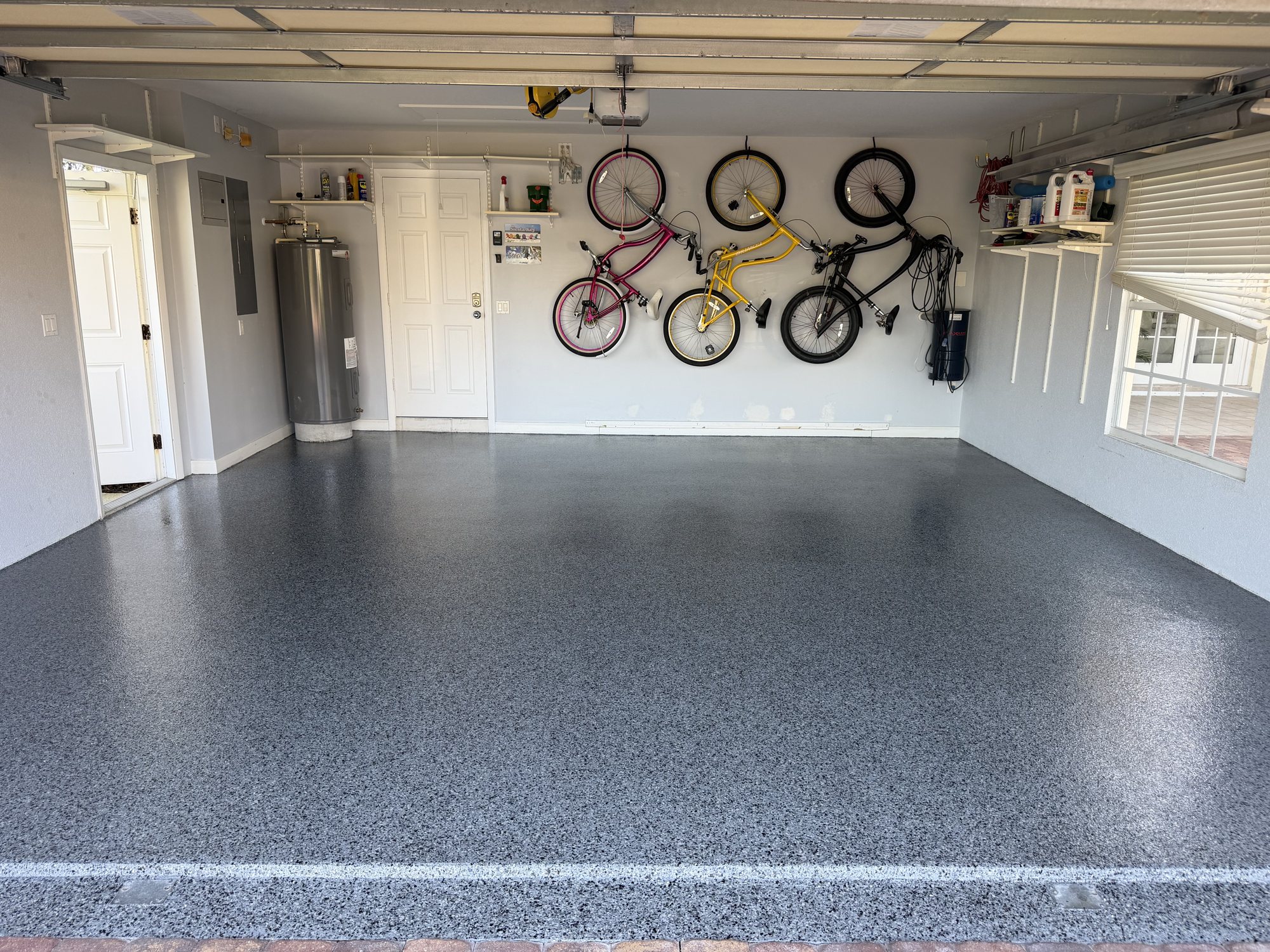
Beach chairs, a cooler, two or three bikes, fishing rods along the wall. On an island, the garage is where everything wet and sandy lands first. A flake floor is built for that life. The broadcast chips break up grit and the print of a wet flip-flop, so a floor swept on Sunday still reads clean on Thursday, and all of it sits on a slab we have ground open and tested for moisture.
What lives in your garage?
Give us a rough size and tell us what gets parked or stored in there. Or call (941) 504-9132.
Grit
What the island tracks in
Sand rides in on shoes, bike tires and the bottom of every cooler, and a garage this close to the water never runs short of it.
On bare concrete that sand acts like sandpaper underfoot. On a roll-on garage paint it scratches the finish until the gloss turns cloudy in the lanes you walk. A flake floor deals with it another way. The chips are set into the base coat while it is still wet and then locked under a clear topcoat, so the grit sits on a hard surface it struggles to cut, and the speckle hides it until you get around to the broom. Wet footprints dry off without leaving a shape you can pick out.
Salt is the other half of the story. Anna Maria is coastal and salt-exposed, and a garage door left up through a breezy afternoon lets that air drift in over the floor. Bare concrete takes salt into its pores and can go dusty at the surface over time. A sealed floor keeps the salt on top, where a hose and a squeegee clear it away. We finish island garages in a polyaspartic clear because it keeps its color in the band of sun that reaches past an open door.
Before any system gets a name, the slab gets a look
Every garage starts the same way, with the concrete bare and one of us on hands and knees studying it. What turns up there decides the primer, the grinding time and sometimes the system itself.
Moisture, read with a meter
A slab sitting over sand near the water can look dry and still pass vapor upward. We take a reading on the first visit. A normal number means the base goes straight onto ground concrete. A high one means a moisture-tolerant primer goes down first, so the vapor has somewhere to go besides lifting your new floor off the slab.
Oil where the car has always parked
Years of drips under an engine soak into concrete and stay there. Resin will not grab an oily surface, so we grind deeper in that patch and clean up whatever the grinder pulls loose. A stain that keeps weeping after all that gets pointed out to you before we commit to a start date.
Old paint and sealer
A painted or sealed garage floor has to come back to bare concrete, and that happens mechanically with diamond tooling. Coating over an old finish only glues the new floor to something already letting go. The grinder takes it off, the vacuum takes the dust, and the clean slab underneath is what we coat.
Blends
Choosing a flake blend on your own concrete
We carry eighteen flake blends, and a small sample card is a poor way to pick one. Color shifts with the light coming through the door, with the paint on your walls and with the gray of your own concrete showing between chips. So the samples go down on your slab, and you look at them standing where you normally park.
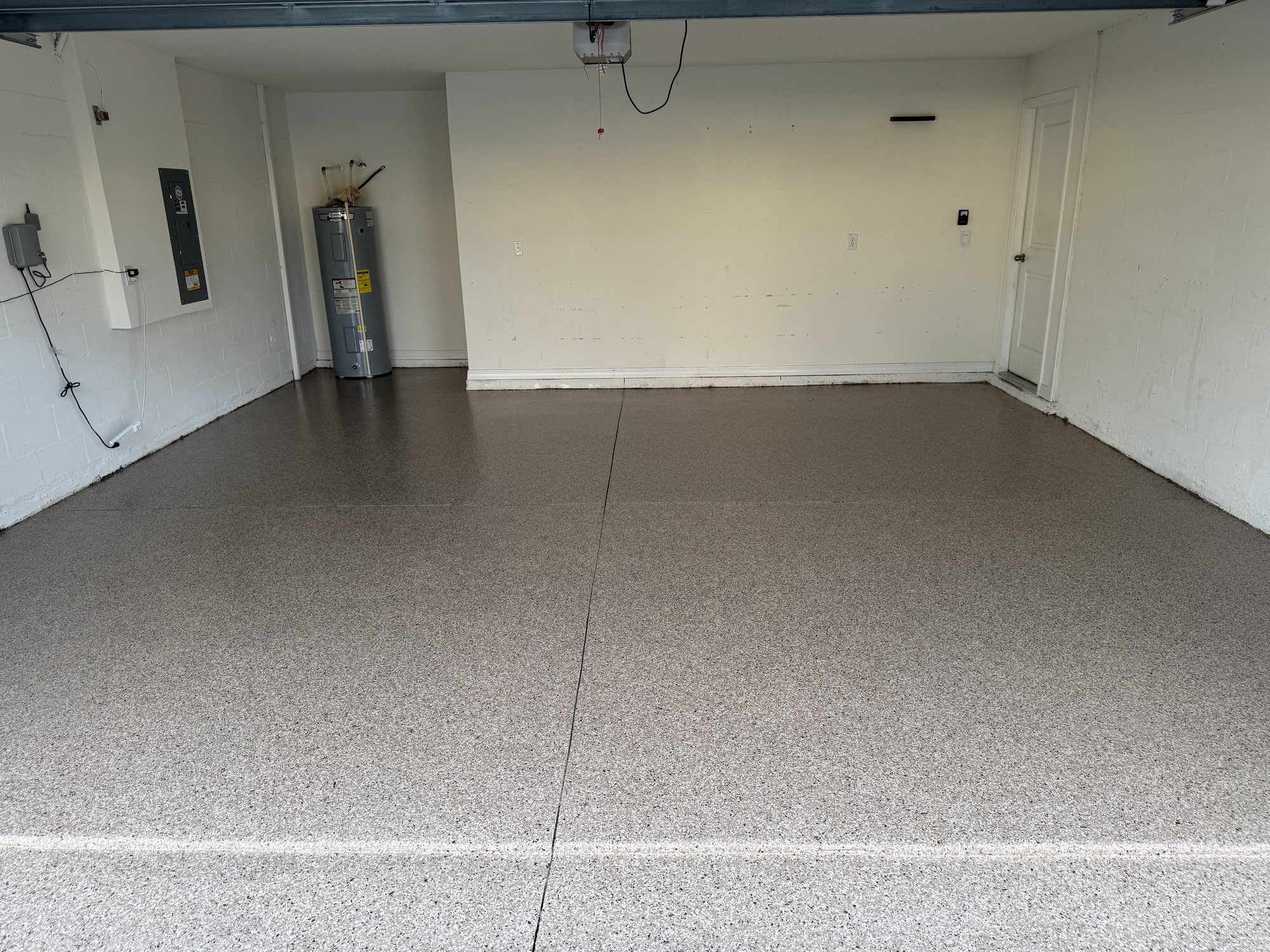
A blue-gray blend reads cool and crisp against white walls and pairs nicely with a painted stop line at the door. Tan and brown blends forgive more sand, since beach sand sits close to them in tone. A busier broadcast hides more, and a lighter scatter lets more of the base color show through. Full broadcast, where chips cover the base completely, is the version we suggest for a garage that sees sand every single day.
Edges get as much care as the middle of the floor. Around the water heater, along the walls and across the threshold, the coating is cut in by hand and the line kept straight. Attention to detail and cleanliness is what this business was started on, and the edge of a garage floor is where you can tell whether a crew meant it.
Control joints stay where the concrete put them. The saw cuts get cleaned out and coated into, so the slab can keep moving along its own lines without splitting the finish somewhere else.
Cure dates built around a humid afternoon
Coating chemistry runs on temperature and humidity, and an island afternoon brings plenty of both, often with a storm on the way. A slab that has started to sweat will not hold a bond. So a garage job gets scheduled around a weather window, and the work runs in this order:
- Grinding, crack and pinhole repair, then primer wherever the moisture reading asks for it.
- The base coat, with flake broadcast into it while it is still wet.
- Scraping and vacuuming off the loose chips once the base has set.
- The clear topcoat, rolled over the whole floor in one go.
Feet can go back on it the next day. The car waits four to five days after the clear goes down, longer if the air has been heavy.
The flake hides the sand. The grind underneath keeps the floor attached.
If a storm cell builds while the base is going down, we stop. Picking up again the next morning costs a day, and coating straight through it can cost the whole floor. You get the new date by phone, and everything that came out of the garage stays out a little longer.
The rest of the Anna Maria work
Garages often come with a patio or a lanai attached, and the prep under every one of them is the same. We coat garages in Holmes Beach and Bradenton Beach too.
Patio Floor Coatings
Pool patios and entry slabs with grip in the top.
Outdoor slabs →Outdoor Epoxy Flooring
Metallic and flake floors for lanais.
Decorative outside →Concrete Floor Coatings
Grind and seal, or a full coating build.
Sound slabs →Concrete Surface Preparation
The grinding and repair under every floor we pour.
Prep comes first →Garage Floor Coatings
Every garage system we install, laid out in one place.
All garage systems →Anna Maria · Manatee County cities · See the work · Contact us
Garage questions from island homeowners
Will sand scratch a flake floor?
Any floor shows some wear where traffic is heaviest, but the clear topcoat on a flake floor is far harder than bare concrete or garage paint. Sand mostly sits on top of it. Sweep or blow it out regularly and the gloss holds up much longer in the lanes you walk most.
Can I leave the garage door open after it is coated?
Once the clear has cured, yes. The polyaspartic topcoat we use on garages holds its color in sunlight, so the strip by the door does not turn yellow the way some epoxy finishes do. Salt air settles on the surface, and a rinse now and then keeps the floor clean.
How do you choose between flake blends?
We lay sample chips on your own slab so you see them in your light, next to your walls and your concrete. Blue-gray blends look crisp against white paint. Tan and brown blends hide sand better. Most people know which one is theirs within a few minutes of looking.
What if there is oil in the concrete?
We grind deeper where the car has sat and clean out what the grinder brings up. Most stains come out that way. If one keeps weeping oil after grinding, we tell you before setting a date, because resin laid over an active stain will not stay bonded to the slab.
How long until I can park in there again?
Walking on it is usually fine the day after the clear coat goes down. Give the car four to five days. Humid weather can stretch both, and we confirm your dates before grinding starts, so you can plan where the bikes, coolers and beach chairs will wait in the meantime.
Do you need to see the garage in person?
A photo and rough measurements get things moving, and from those we can usually name the system. Before a date is set, someone looks at the slab in person and takes the moisture reading. Anna Maria is about fifteen minutes from our shop, so that visit is easy to fit in.
Send a photo of the garage, sand and all.
Shoot the floor once from the doorway and once from the back wall, and give us a rough size. Point out oil stains, old paint or any crack you already know about. From that we can name the blend and system we would use, how many days the garage is out of action, and when the car can go back in. Same-week scheduling is normal on the island.
Ask about the blend
Or call (941) 504-9132.