Outdoor
Open sky, full sun, nothing overhead
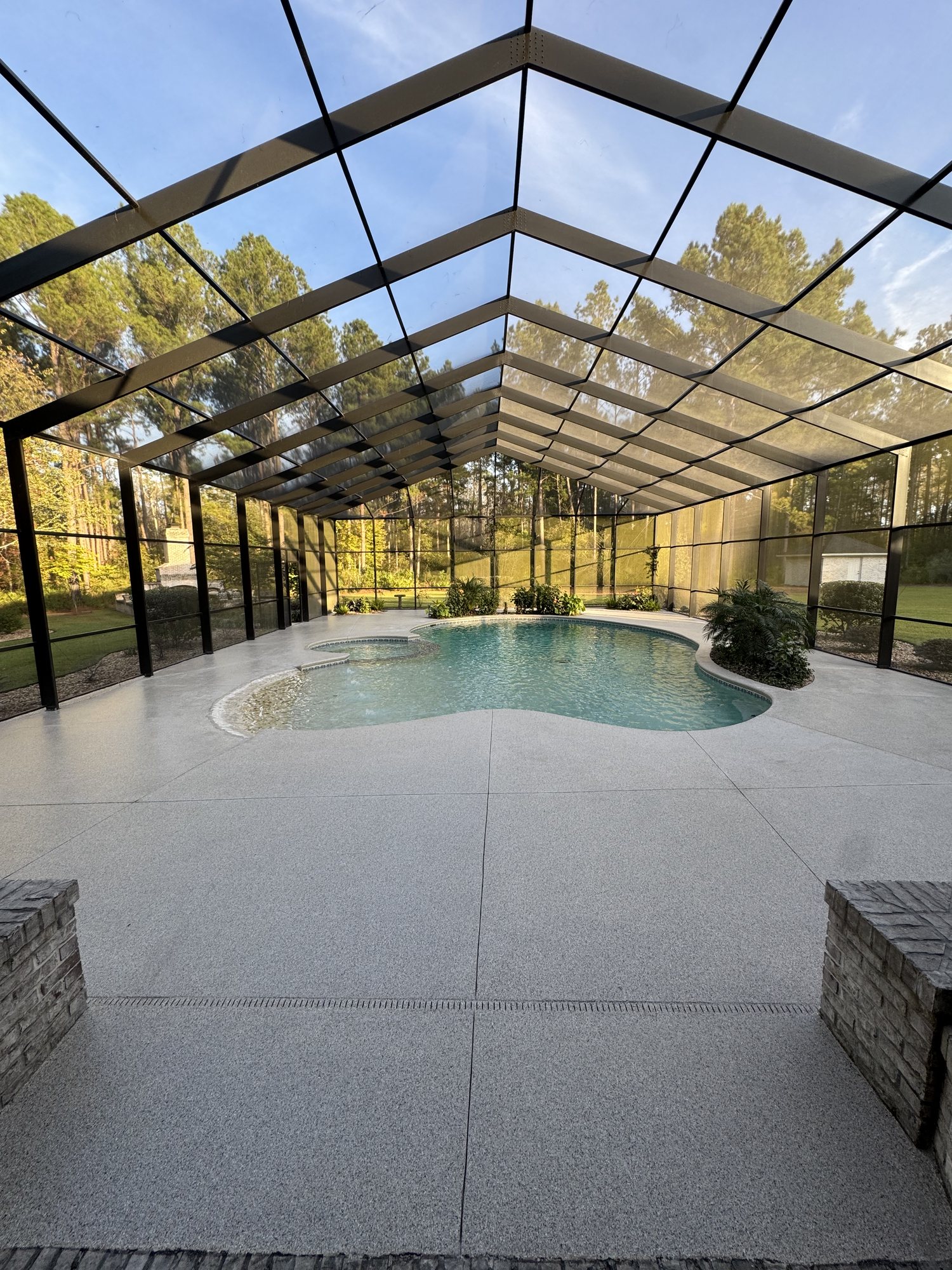
An open patio is the most exposed concrete on the property. No roof, no screen, nothing between it and the sun all day or the rain all afternoon. Whatever goes on it has to take the full weather load, which rules out most of what gets sold as patio coating.
Pour this floor
Tell us the space and rough size. Or call (941) 504-9132.
Detail
Full exposure changes the specification
A covered surface gets shade for part of the day. A patio does not. It takes direct ultraviolet light from morning to evening, and the slab itself can swing thirty or forty degrees between a July afternoon and a January night. The coating has to expand and contract with it without splitting.
That is a polyaspartic or polyurea job. Both hold color under sunlight and both stay flexible in the heat. Standard epoxy on an open patio ambers, chalks and goes brittle, and we get called out to strip a fair amount of it.
Rain is the other half of it. An afternoon storm can drop an inch of water on a patio in twenty minutes, and it drains across the surface rather than off a roof. Anywhere that holds a puddle after the sun comes out is a place we address before coating.
Texture, because it is going to be wet
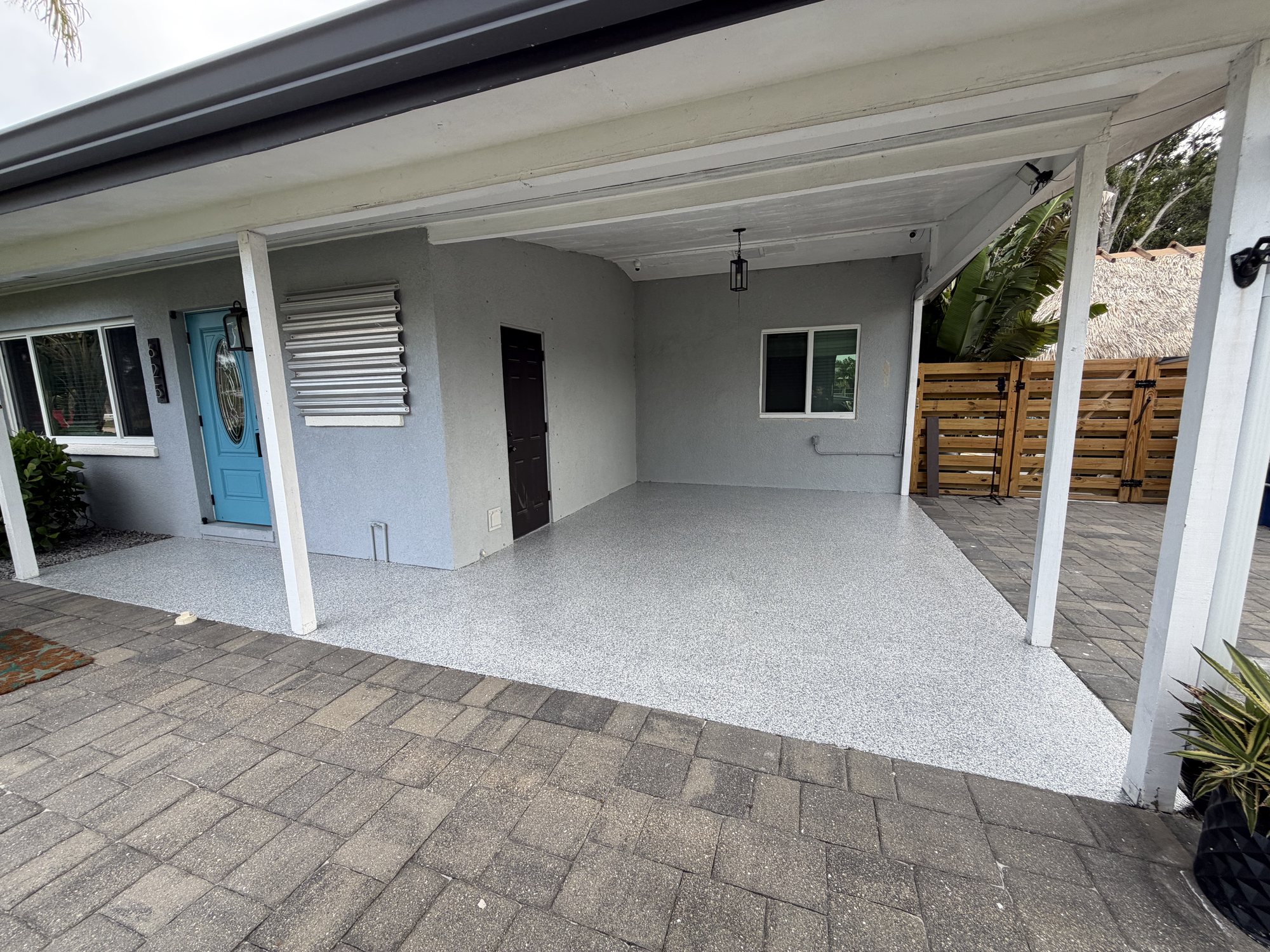
A gloss patio looks superb dry and is treacherous the moment it rains. Texture has to be built into the topcoat itself, mixed and broadcast while the material is open, so the bite is part of the floor rather than a layer sitting on it that wears off in the traffic path.
The grade gets matched to how the patio is used. A grill and dining area with chairs being dragged around wants a finer texture that sweeps clean. A slab that connects to a pool or a lawn, where people cross it wet and barefoot, wants something more aggressive.
We also keep the sheen down outdoors. A satin or low-gloss finish hides the fine dust and pollen that settles on any Florida patio between rinses, and it cuts the glare when the afternoon sun comes in at a low angle.
Choosing a color that survives the light
Direct sun washes color out visually. A blend that reads rich and detailed indoors can go flat and pale on an open patio, so we pick from the blends that hold their character in bright light rather than the ones that photograph well in a garage.
Heat matters as much as looks. Dark surfaces store it, and an open patio has no shade to recover in, so a black or deep charcoal slab stays hot well past sundown. Mid grays and warmer neutrals like Gravel, Safari and Outback stay usable and hide the sand and leaf litter that blows across between cleanings.
We put samples on your slab, outdoors, in daylight. It is the only way to judge an exterior color honestly.
Preparation
What happens before any resin comes out
Outdoor concrete in Florida takes ultraviolet light, standing water and constant vapor from below, so preparation matters even more here than it does inside.
The first day is the grinder. We work the slab with diamond tooling until it is uniformly open, vacuuming as we go so the dust stays out of the house. Skip this and you are relying on the resin to stick to a sealed surface, which is the reason so many coatings come up in sheets.
After grinding we measure what the slab is doing with water. Sandy subgrade and a shallow water table make vapor drive a constant in this climate, and it is the failure nobody sees coming because the floor looks perfect for the first season. We test before quoting so the system suits the slab.
Cracks get chased out to a clean edge and filled rather than skimmed over, spalls and pop-outs get rebuilt, and any previous coating comes off entirely. Only when the slab is sound, open and dry does anything get mixed.
The finish is what you see. The grind underneath it is what decides whether you are still happy in year eight, and it is where we spend the time other quotes save money.
It is also why we will occasionally tell someone their slab needs repair before it needs a coating. A floor that should be fixed structurally is not a floor we will put resin on, because the crack comes back through and then it is our name on it.
Related work
Polyaspartic Floor Coatings
Polyaspartic is what you use when the space cannot be out of service for a week and when the floor is going to see…
See the system →Flake Epoxy Flooring
Flake is vinyl chip broadcast into a wet base coat until the floor will not take any more, then sealed under clear.…
How it works →Full Flake Garage Floor Coatings
A full flake floor is broadcast to refusal across the whole slab rather than scattered for effect. The result is a…
Read the detail →Metallic Epoxy Flooring
Metallic is the reason this company exists. Reflective pigment suspended in clear resin, then moved with air and…
What it suits →Questions
Patio Floor Coatings questions
How much does patio floor coatings cost?
Price follows square footage, the condition of the slab and the system you choose. A sound slab that only needs grinding costs far less to prepare than one with cracks, old coating or a moisture problem. We look at the floor and give you a real number rather than a range that means nothing.
How long does patio floor coatings take?
Most residential work is two to four days on site depending on size and system. Commercial and industrial floors are scheduled around your hours and often run nights or weekends. You get exact dates before we start, including when you can walk on it and when you can put weight on it.
Do you grind the floor first?
Always. Diamond grinding is the only way to get a profile the coating can key into, and it is the single biggest reason floors either last or fail. We do not acid etch and we do not coat over a sealed slab.
What about moisture in the slab?
Florida slabs move water upward constantly, and vapor trapped under a coating is a guaranteed failure. We take a reading before quoting. If the numbers are high we specify a moisture-tolerant primer rather than pretending the problem is not there.
Can you match a color or a look I have seen?
Usually. We carry eighteen flake blends and mix metallic per floor, so bring a photo, a cabinet door or a paint chip and we will get close. We put samples down in your own light before you commit.
Do you work outside Sarasota?
Yes. We cover a 120-mile radius from Sarasota, which is twenty-four counties from Naples up to Ocala and across to Orlando. Check the service areas page or call and ask.
Send us the space. We will send back a number.
Rough size and a photo is enough to start. We cover Sarasota and twenty-four counties around it, so tell us where you are and we will tell you when we can get there.
Pour this floor
Or call (941) 504-9132.