
Garage
Heavy vehicles, steel wheels, working bays
An industrial garage is not a big residential garage. Trucks, plant, trailers and forklifts put loads through a slab that no car ever will, and the coating has to be built for point loads, dragged steel and fluids rather than for looks.
Pour this floor
Tell us the space and rough size. Or call (941) 504-9132.
Detail
Point loads and dragged steel
A car spreads its weight over four soft contact patches. A jacked trailer leg, an outrigger, a steel-wheeled trolley or a dropped bucket concentrates a large load into a few square inches, and thin films simply fail under that.
Dragging is the other half. Steel skids, pallets and equipment pushed across a floor gouge a coating that would happily take a rolling load all day. Where dragging is routine, the build goes up in thickness and gets aggregate through it so the wear happens against filler rather than resin.
So the specification here starts from the worst thing that happens on that floor, not the average thing. The average is easy; the outlier is what breaks it.
Fluids, and cleaning up after them
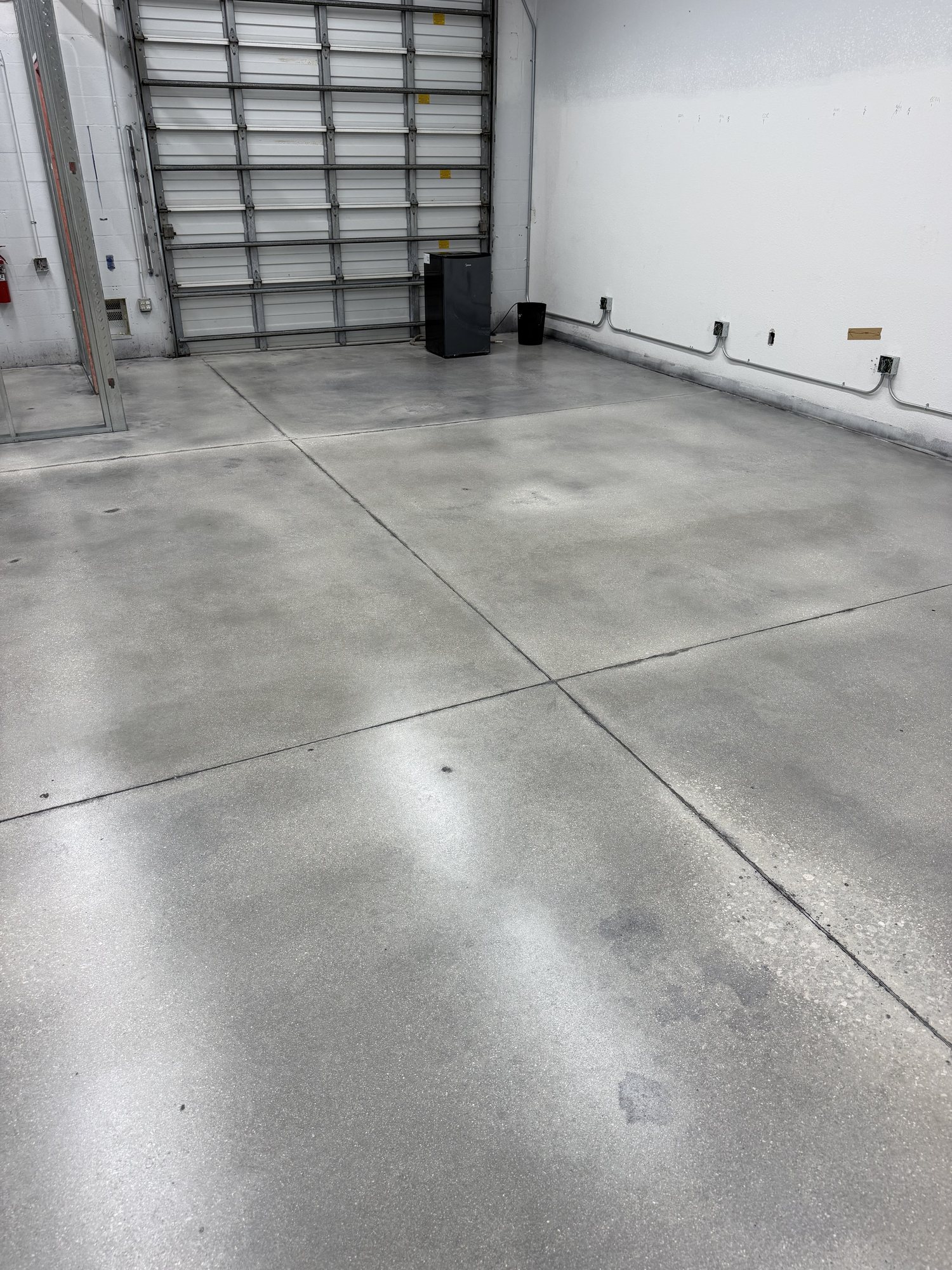
Diesel, hydraulic oil, coolant and degreaser are the daily reality. Hydraulic oil in particular finds every weakness in a coating, and a hydraulic line letting go is a large spill in seconds, not a drip.
A sealed floor turns that from a permanent stain into a clean-up. Bare concrete absorbs it, keeps the smell, and slowly degrades where oil has soaked in. Coated concrete holds it on the surface until somebody deals with it.
Grip has to work with oil present, which is a harder ask than water. An oily patch on a smooth floor is genuinely dangerous around heavy machinery, so texture through the working bays is a safety item rather than a preference.
Prep on a slab that has already lived a life
Industrial slabs come with history: old coatings, oil soaked deep into the concrete, spalling at the joints, patches from previous repairs. Prep is a bigger share of the job here than anywhere else we work.
Oil-contaminated concrete has to be degreased and often ground back further than a clean slab would need, because resin will not bond to oil no matter how good the product is. Where contamination runs deep, that area gets cut out and rebuilt.
We shot blast or diamond grind depending on what the slab needs, repair the joints and spalls, then coat. Skipping any of that on an industrial floor produces a coating that looks right on handover day and delaminates in patches within the year.
Preparation
What happens before any resin comes out
A garage slab is usually the worst-prepared concrete on a property: hard-troweled smooth when it was poured, then twenty years of tire rubber, oil and road salt on top of it.
The first day is the grinder. We work the slab with diamond tooling until it is uniformly open, vacuuming as we go so the dust stays out of the house. Skip this and you are relying on the resin to stick to a sealed surface, which is the reason so many coatings come up in sheets.
After grinding we measure what the slab is doing with water. Sandy subgrade and a shallow water table make vapor drive a constant in this climate, and it is the failure nobody sees coming because the floor looks perfect for the first season. We test before quoting so the system suits the slab.
Cracks get chased out to a clean edge and filled rather than skimmed over, spalls and pop-outs get rebuilt, and any previous coating comes off entirely. Only when the slab is sound, open and dry does anything get mixed.
The finish is what you see. The grind underneath it is what decides whether you are still happy in year eight, and it is where we spend the time other quotes save money.
It is also why we will occasionally tell someone their slab needs repair before it needs a coating. A floor that should be fixed structurally is not a floor we will put resin on, because the crack comes back through and then it is our name on it.
Related work
Solid Color Epoxy Flooring
Solid color is the plainest thing we install and it is not the cheapest thing to install well. There is nowhere to…
See the system →High-Performance Floor Coatings
High performance is not a product, it is a specification. It means the system was chosen against the actual loads,…
How it works →Chemical-Resistant Floor Coatings
There is no coating that resists everything. Resistance is specific: a resin that laughs off battery acid can soften…
Read the detail →Slip-Resistant Floor Coatings
Every coated floor can be given grip. The real question is how much, because texture and cleanability pull in…
What it suits →Questions
Industrial Garage Floor Coatings questions
How much does industrial garage floor coatings cost?
Price follows square footage, the condition of the slab and the system you choose. A sound slab that only needs grinding costs far less to prepare than one with cracks, old coating or a moisture problem. We look at the floor and give you a real number rather than a range that means nothing.
How long does industrial garage floor coatings take?
Most residential work is two to four days on site depending on size and system. Commercial and industrial floors are scheduled around your hours and often run nights or weekends. You get exact dates before we start, including when you can walk on it and when you can put weight on it.
Do you grind the floor first?
Always. Diamond grinding is the only way to get a profile the coating can key into, and it is the single biggest reason floors either last or fail. We do not acid etch and we do not coat over a sealed slab.
What about moisture in the slab?
Florida slabs move water upward constantly, and vapor trapped under a coating is a guaranteed failure. We take a reading before quoting. If the numbers are high we specify a moisture-tolerant primer rather than pretending the problem is not there.
Can you match a color or a look I have seen?
Usually. We carry eighteen flake blends and mix metallic per floor, so bring a photo, a cabinet door or a paint chip and we will get close. We put samples down in your own light before you commit.
Do you work outside Sarasota?
Yes. We cover a 120-mile radius from Sarasota, which is twenty-four counties from Naples up to Ocala and across to Orlando. Check the service areas page or call and ask.
Send us the space. We will send back a number.
Rough size and a photo is enough to start. We cover Sarasota and twenty-four counties around it, so tell us where you are and we will tell you when we can get there.
Pour this floor
Or call (941) 504-9132.