Outdoor
Grip that does not shred the soles of your feet
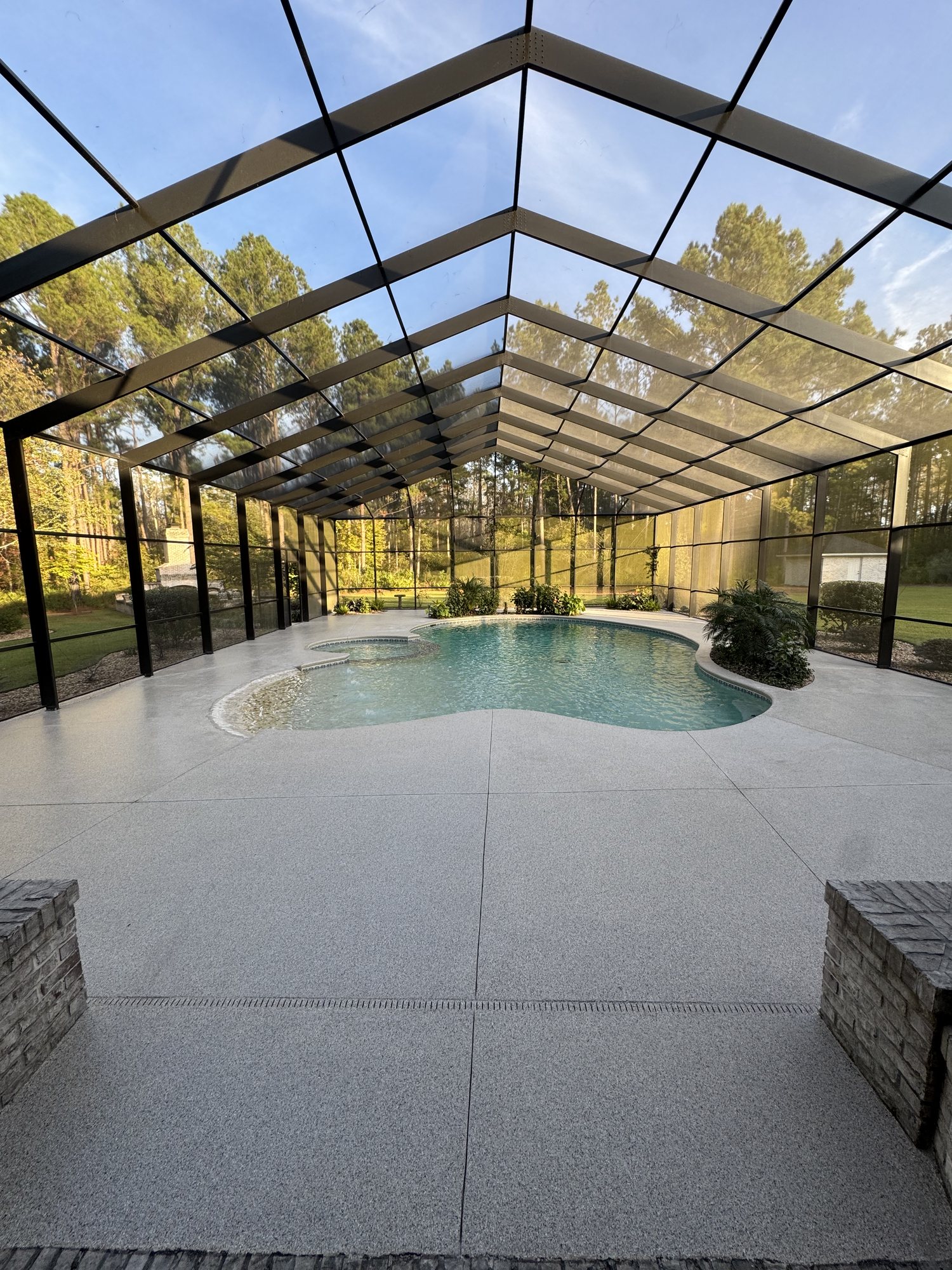
Anyone can make a floor grippy. Throw enough sand in the topcoat and nobody will ever slip on it, and nobody will ever walk on it barefoot either. The craft in a pool deck is finding the texture that holds a wet foot without feeling like pavement, and that comes down to aggregate grade and how it is broadcast.
Pour this floor
Tell us the space and rough size. Or call (941) 504-9132.
Detail
Aggregate grade is the whole decision
The grip in a coating comes from graded aggregate suspended in the topcoat, and the grade is a real measurement, not a marketing word. Coarse aggregate gives you enormous traction and a surface that abrades skin, which is why commercial kitchen texture would be miserable around a residential pool.
Fine aggregate feels smooth and cleans easily and does very little once the surface is wet and soapy with sunscreen. The useful range sits between those two, and it shifts depending on the deck: a sloped section, a step tread or a spa surround wants more bite than an open lounging area.
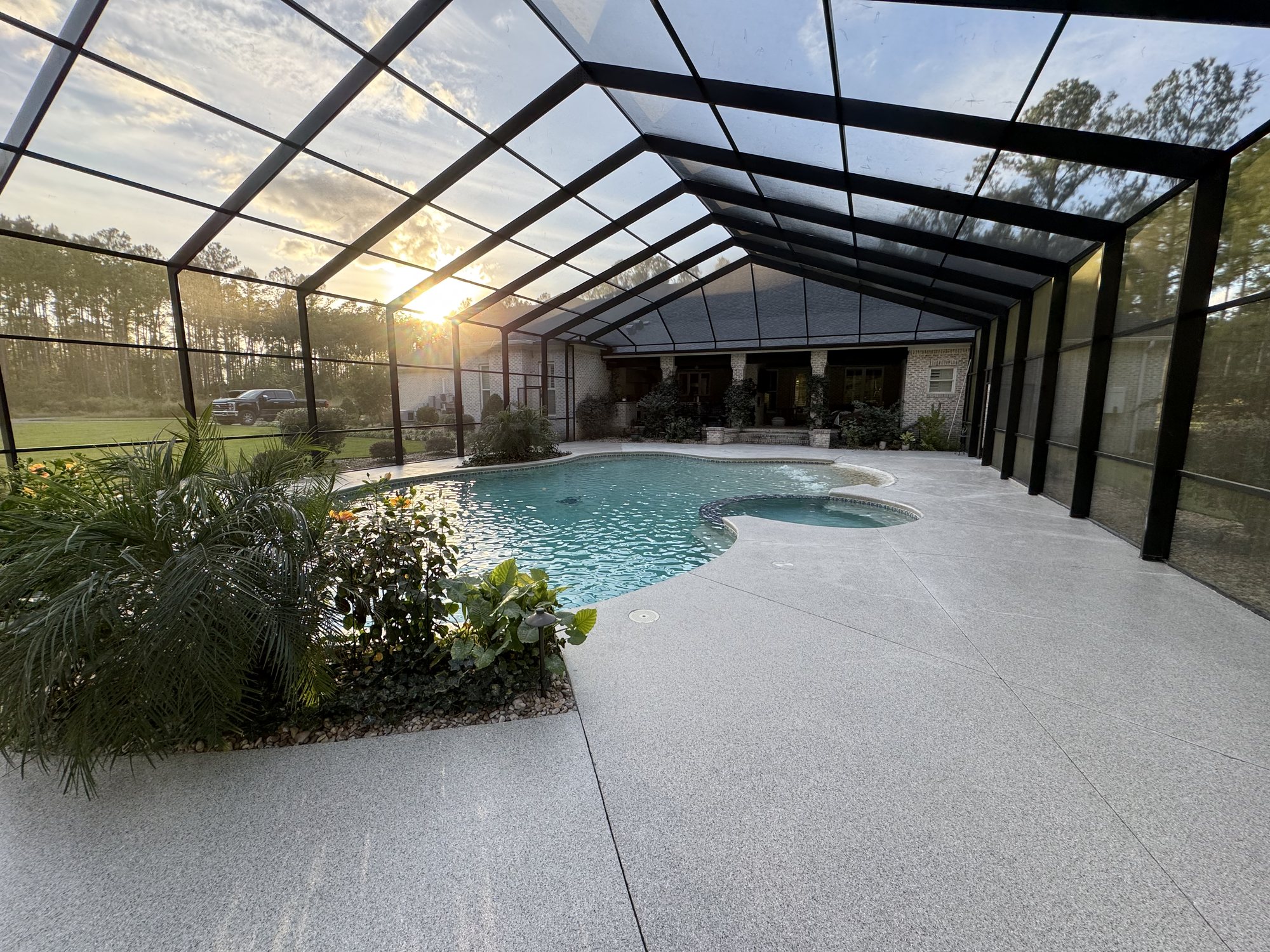
We specify by zone rather than blanketing one texture across the whole deck. The perimeter within a meter or so of the water, the steps and any slope get the more aggressive grade. The furniture area, where people stand around and chairs get dragged, gets a finer one that still holds when wet.
Barefoot comfort is a design constraint
The test we care about is a wet child running from the pool to the house, which is the exact moment a deck has to work, and the same child lying on the deck a minute later. Texture that solves the first and ruins the second is a failed floor.
Two things make aggressive texture bearable. The first is how the aggregate is broadcast and then sealed: encapsulating the particles in the topcoat leaves a rounded profile rather than exposed sharp edges, so the surface reads as grippy instead of abrasive.
The second is heat, and texture works against you here. Adding profile increases the surface area soaking up sun, so a textured deck runs warmer than a smooth one in the identical color. That is an argument for spending the heat budget on grip and taking it back on the blend, which is why the aggressive zones on a deck are the last place we would put a Carbon or an Obsidian.
Cleaning, algae and keeping the grip
Textured surfaces trap more than smooth ones. Sunscreen residue, sand off the beach, pollen and organic matter all settle into the profile, and a slick film on top of a textured deck is more dangerous than a clean smooth one because people trust it more.
Sealed texture cleans with a garden hose and a soft-bristle brush, and shaded sections want doing more often because that is where the algae starts. We would rather you rinsed regularly than pressure washed occasionally, because a pressure washer held close will eventually erode the very profile that provides the grip.
Do not wax or add a gloss sealer over a slip-resistant deck. Every year somebody brightens theirs up with a product from a hardware store and fills the texture in, and that is a genuinely dangerous surface around water. If the deck ever looks tired, call us on (941) 504-9132 and we will look at recoating it properly.
Preparation
What happens before any resin comes out
Outdoor concrete in Florida takes ultraviolet light, standing water and constant vapor from below, so preparation matters even more here than it does inside.
The first day is the grinder. We work the slab with diamond tooling until it is uniformly open, vacuuming as we go so the dust stays out of the house. Skip this and you are relying on the resin to stick to a sealed surface, which is the reason so many coatings come up in sheets.
After grinding we measure what the slab is doing with water. Sandy subgrade and a shallow water table make vapor drive a constant in this climate, and it is the failure nobody sees coming because the floor looks perfect for the first season. We test before quoting so the system suits the slab.
Cracks get chased out to a clean edge and filled rather than skimmed over, spalls and pop-outs get rebuilt, and any previous coating comes off entirely. Only when the slab is sound, open and dry does anything get mixed.
The finish is what you see. The grind underneath it is what decides whether you are still happy in year eight, and it is where we spend the time other quotes save money.
It is also why we will occasionally tell someone their slab needs repair before it needs a coating. A floor that should be fixed structurally is not a floor we will put resin on, because the crack comes back through and then it is our name on it.
Related work
Patio Floor Coatings
An open patio is the most exposed concrete on the property. No roof, no screen, nothing between it and the sun all…
See the system →Lanai Floor Coatings
A screened lanai is its own environment. The cage cuts the sun and the bugs and it also cuts the airflow, so humidity…
How it works →Outdoor Concrete Coatings
Walkways, entries, side yards, equipment pads, dock approaches and the path around to the trash cans are all…
Read the detail →Driveway Coatings
A driveway is the hardest exterior coating job on any property. It carries vehicle weight, it takes hot tires, it…
What it suits →Questions
Slip-Resistant Pool Deck Coatings questions
How much does slip-resistant pool deck coatings cost?
Price follows square footage, the condition of the slab and the system you choose. A sound slab that only needs grinding costs far less to prepare than one with cracks, old coating or a moisture problem. We look at the floor and give you a real number rather than a range that means nothing.
How long does slip-resistant pool deck coatings take?
Most residential work is two to four days on site depending on size and system. Commercial and industrial floors are scheduled around your hours and often run nights or weekends. You get exact dates before we start, including when you can walk on it and when you can put weight on it.
Do you grind the floor first?
Always. Diamond grinding is the only way to get a profile the coating can key into, and it is the single biggest reason floors either last or fail. We do not acid etch and we do not coat over a sealed slab.
What about moisture in the slab?
Florida slabs move water upward constantly, and vapor trapped under a coating is a guaranteed failure. We take a reading before quoting. If the numbers are high we specify a moisture-tolerant primer rather than pretending the problem is not there.
Can you match a color or a look I have seen?
Usually. We carry eighteen flake blends and mix metallic per floor, so bring a photo, a cabinet door or a paint chip and we will get close. We put samples down in your own light before you commit.
Do you work outside Sarasota?
Yes. We cover a 120-mile radius from Sarasota, which is twenty-four counties from Naples up to Ocala and across to Orlando. Check the service areas page or call and ask.
Send us the space. We will send back a number.
Rough size and a photo is enough to start. We cover Sarasota and twenty-four counties around it, so tell us where you are and we will tell you when we can get there.
Pour this floor
Or call (941) 504-9132.