
Concrete
Sound concrete, finished the way the room gets used
Plenty of concrete under an island home is in decent shape already. A garage slab with no oil soaked into it, or a living-area floor poured flat and left bare, can be ground and sealed and look clean, or built up with color and flake if the room asks for more. On Anna Maria jobs we read the slab for moisture before naming any system, and that reading usually narrows the choice quickly.
Garage, great room or something else?
Name the room and roughly how big it is. Or call (941) 504-9132.
Slabs
Two floors that started as plain gray slabs
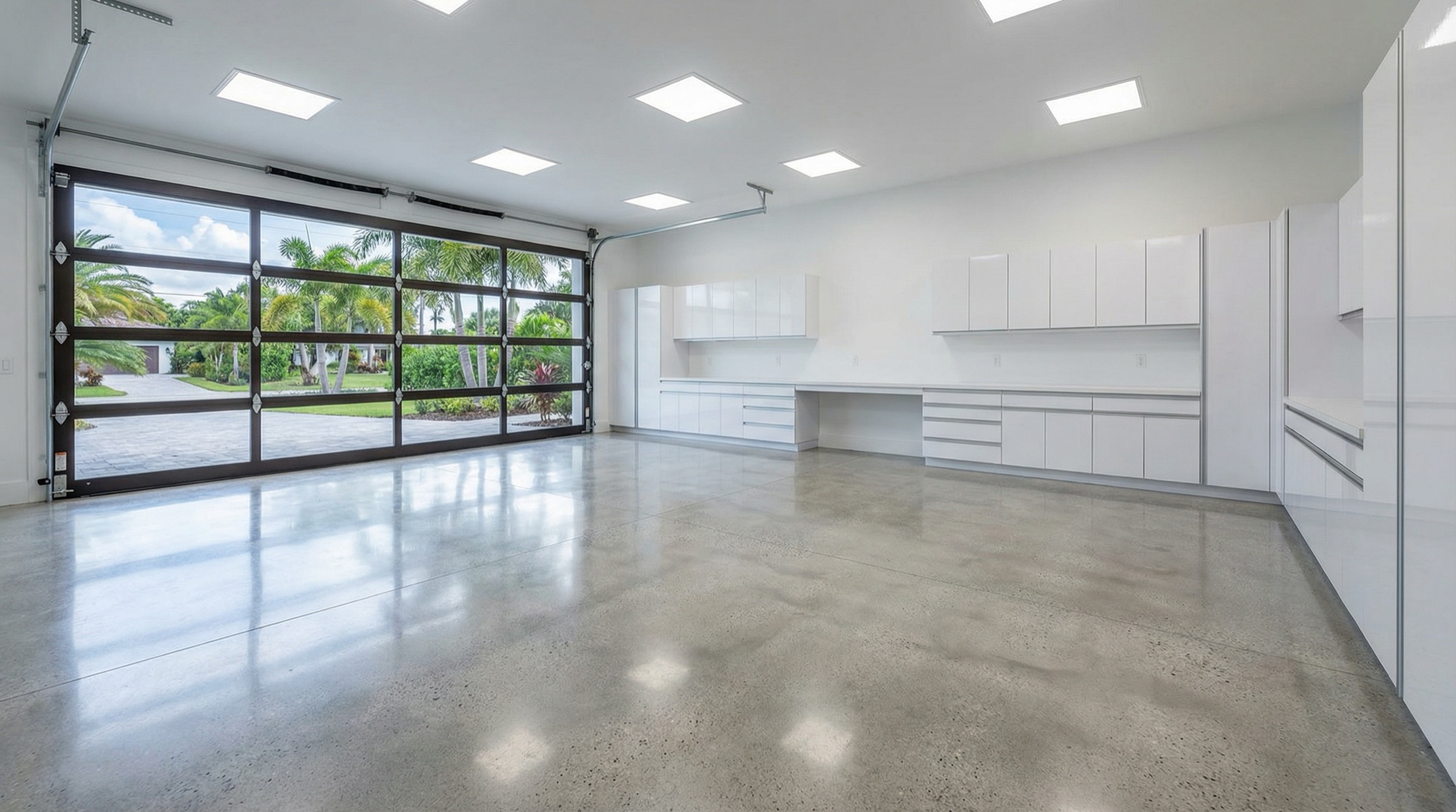
The garage at the top of this page never got a colored coat. The slab was diamond ground and then sealed, and the soft gloss under those ceiling lights comes from a clear sealer over ground concrete.
It works because that slab was in good shape to begin with: flat, free of soaked-in oil, with no old paint lifting at the edges. The white cabinets along two walls sit on a floor that sweeps clean and stops shedding dust onto whatever is stored on the shelves. Nothing hides under a film there, because nothing needed hiding.
The second photo, further down, is a living room with glass doors looking out to a canal and a boat dock. Same idea in a bigger room. The grinding opened that slab evenly from wall to wall, so the sealer had a consistent surface to sit in and the floor reads calm instead of patchy.
A lot of island homes reach this question the same way, when tile comes up in a great room or a garage finally gets emptied out. What you find underneath decides the next step. Clean, even concrete gives you the choice of keeping it visible. Stained or patched concrete usually makes that choice for you, and the coating build further down this page is where it leads.
When grind and seal is all a slab needs
Of the four systems we install, this one leaves the least on top of the concrete.
What the work involves
Diamond tooling runs across the whole floor to take off the weak top layer and open the pores. The crew vacuums the slab, takes the moisture reading, and puts down a clear sealer. There is no colored base and no flake. You see the concrete, its aggregate and whatever marks the original finisher left behind.
Slabs it suits
A floor that is flat, fairly even in color and free of oil fits it well. So does a room where you like the look of concrete and mostly want it dust-free and easy to mop. Plenty of tidy garages land here, and so do open living areas where the slab came out of the old flooring in good condition.
What it will not do
It hides nothing. An oil shadow, a patched corner or the outline of old tile adhesive stays visible under the clear, and the sealer adds gloss to all of it. If those marks bother you on the bare slab today, they will bother you more once the floor is shiny. That is the moment to talk about a coating instead, and we would rather say so before anything gets sealed.
Options
Reasons to build a coating on top instead
A coating build bonds a base coat into the ground surface, adds a broadcast or a decorative pour, then finishes with a clear. It takes more steps than a seal, and it earns them on slabs like these:
- The concrete carries oil stains, patches or adhesive you want out of sight.
- The garage sees hot tires, dropped tools and spilled chemicals a thin sealer cannot shrug off.
- You want color, from a flake blend to a metallic pour shaped while it is wet.
- The floor gets wet often and would be safer with texture in the topcoat.
Clean, even concrete can stay on show; stained or patched concrete usually wants covering.
Flake is the usual answer in a garage. There are eighteen blends, and we lay samples on your own slab so you judge the color in your own light instead of on a screen. Metallic belongs in a room where people stand around and look at the floor. The garage floor coatings page for Anna Maria covers the flake side in more detail.
Either way, the work under the finish matches a grind and seal job step for step. The choice is about looks and wear, and none of it is about skipping a stage.
Sand underneath, water close by
Florida concrete is usually laid on sand over a high water table, and a coastal lot on Anna Maria Island gives us no reason to expect anything different. Vapor moves up through a slab like that all the time. The surface can feel dry under your palm and still be pushing moisture toward whatever you put on it.
That is why the meter comes out before we name a system, on a bare garage and a finished living room alike. A low reading leaves every option open. A high reading does not rule a floor out. It changes the primer, which goes down as a moisture-tolerant layer before the base coat or the sealer, so vapor pressure has nothing to push off.
Salt air is the other thing island properties bring. It settles on any surface near an open garage door, which is one more reason the final vacuum and clean-down happen right before primer and never the day before.
The reading and the surface together point to the system. Our full concrete floor coatings page explains how each one compares.

Other floors for the same island property
Most homes have more than one slab worth looking at once we are on site.
Garage Floor Coatings
Flake for a garage that sees sand and wet flip-flops.
The garage floor →Patio Floor Coatings
Pool patios and covered entry slabs at ground level.
Outside the back door →Outdoor Epoxy Flooring
Decorative finishes for a screened lanai.
Color outdoors →Concrete Surface Preparation
The grinding, filling and moisture work under every floor.
What happens first →Concrete Floor Coatings
Sealed and coated concrete across every county we cover.
The full system list →Anna Maria page · Holmes Beach · Every Manatee County city · See the work
Concrete floor questions from island homeowners
Is grind and seal the same as polished concrete?
They are close cousins. Both start with diamond grinding. Polished concrete keeps going through finer and finer tooling until the slab itself shines, while grind and seal stops earlier and lets a clear sealer carry the sheen. Which one fits depends on the slab, and we tell you after seeing it.
Will a sealer hide the oil stain in my garage?
No. A clear sealer darkens and glosses whatever is in the concrete, stains included. Grinding and a degreaser pull some oil out, and deep stains often stay. If the marks bother you, a flake coating covers them, and the extra cleaning is part of the prep either way.
Can you do a living room as well as a garage?
Yes. An interior living area gets the same grinding and the same moisture reading as a garage. What changes is the protection the room needs, so we plan dust extraction and masking around baseboards, doors and any furniture that cannot be moved out before we start.
Why take a moisture reading on a slab that looks dry?
Looks tell you nothing about vapor. Concrete sitting on sand with water close below can pass moisture upward while the top feels dry, and a sealed or coated floor traps it. One reading before we name a system decides whether the primer has to be moisture tolerant.
How soon can we use the floor again?
On a coated garage, walking usually comes back the next day and the car four to five days after the clear coat. Humid weeks can stretch both. A grind and seal job has fewer layers, and either way we confirm your exact dates before any grinding starts.
Do you come out to Anna Maria Island for smaller jobs?
Yes. Anna Maria is in Manatee County, inside the 120-mile radius we cover from our Sarasota shop, and same-week scheduling is normal there. Size does not change the steps. A single room gets the same grind, reading and primer as a three-car garage.
Send a photo of the room and the slab in it.
One wide shot of the floor and one close shot of the surface tell us most of what we need: whether there is oil, patching or old paint, and how even the concrete looks. Add a rough measurement and say whether it is a garage or a living space. From that we can usually tell you if grind and seal will do or a coating build makes more sense, and how many days the work takes from the first grind to the last coat.
Tell us about the floor
Or call (941) 504-9132.