Outdoor
Every slab outside the house, one coherent job
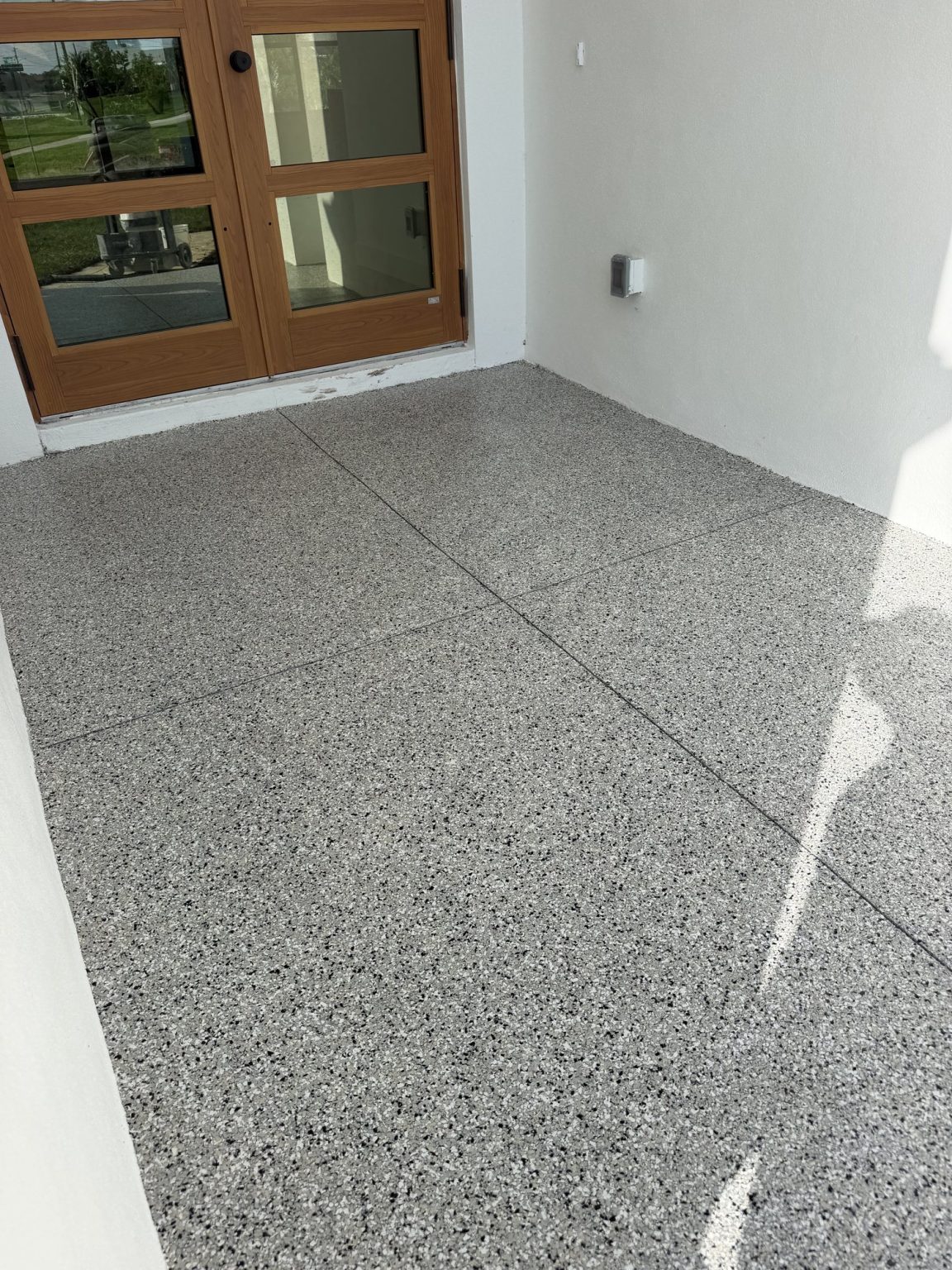
Walkways, entries, side yards, equipment pads, dock approaches and the path around to the trash cans are all concrete, and they all get treated as an afterthought until they start looking rough. Coating them together is cheaper than coating them one at a time and it is the only way the colors end up related.
Pour this floor
Tell us the space and rough size. Or call (941) 504-9132.
Detail
What outdoor concrete has to survive here
Ultraviolet light is constant, so the chemistry has to be UV stable or the finish yellows and chalks. That is the non-negotiable part and it is why we use polyaspartic and polyurea outdoors rather than the epoxy that works so well in a garage.
Water is the second load. Afternoon storms flood these surfaces, sprinklers hit them daily, and anywhere near the coast the salt in the air settles on everything and dries there. Salt is patient and it finds any pinhole in a finish.
Movement is the third. Sandy subgrade settles unevenly, especially where a downspout has been washing soil out from under a path for a few years. Rigid coatings crack when the slab moves. Flexible ones ride it.
The last one is growth. Anything shaded or north-facing goes green given a wet month, and a sealed surface is the difference between rinsing that off and scrubbing it out of open pores.
Prep on exterior slabs
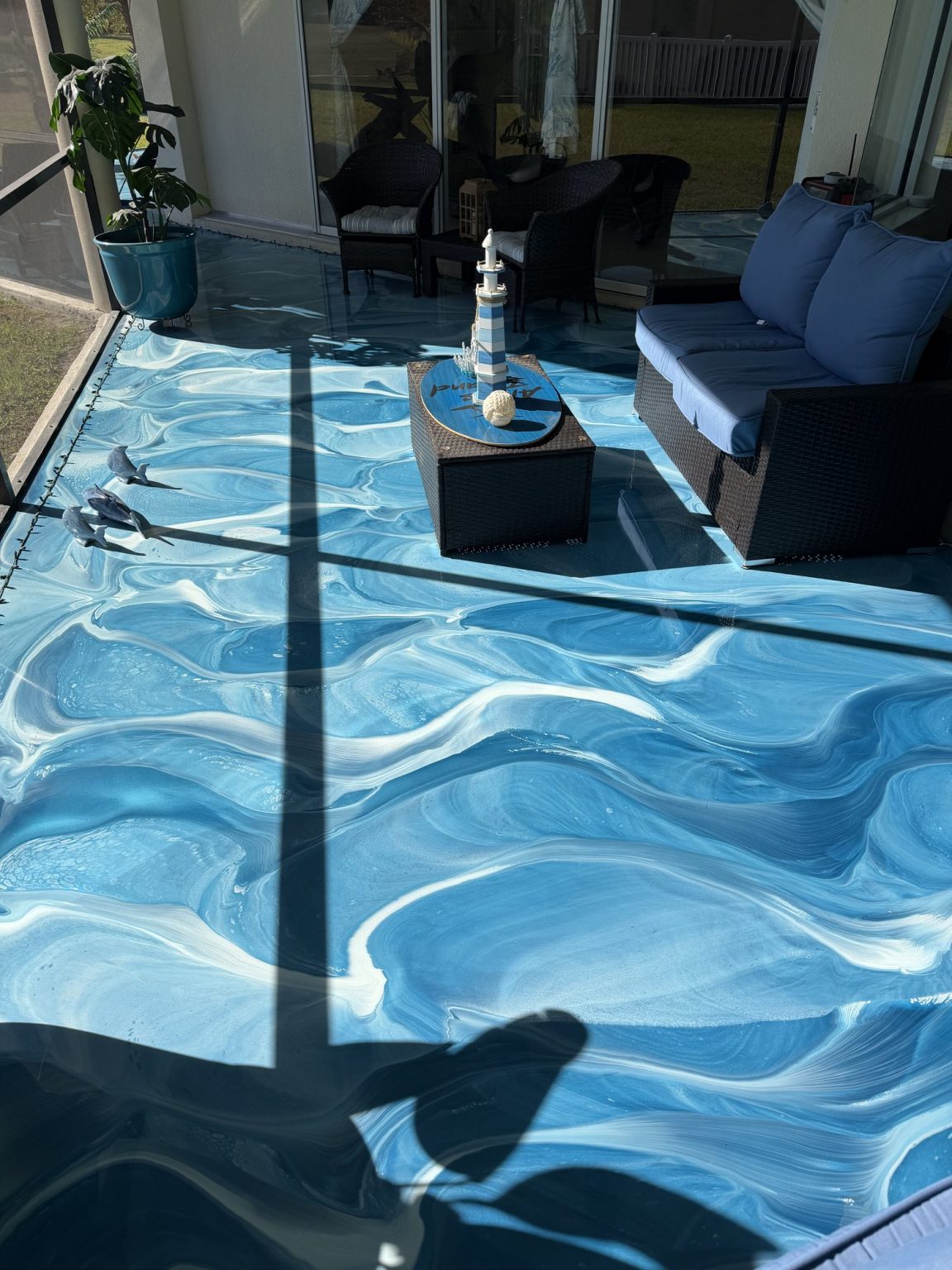
Outdoor concrete is usually broom finished, which sounds like it would be easy to bond to and often is not. Years of sprinkler minerals, sealer residue, tire rubber and organic growth build a film that a coating will happily stick to instead of sticking to the slab.
We diamond grind exterior surfaces the same way we grind a garage, vacuuming as we go. It removes the contamination, opens the pores and gives a consistent profile across concrete that may have been poured at different times by different crews.
Cracks get routed and filled with flexible polyurea, and expansion joints stay as joints. Filling a working joint solid just moves the crack a few inches over and puts it somewhere you did not plan for.
Sequencing the work with the weather
From June onward the afternoon storm is close enough to a daily appointment that you can plan around it. We start early, aim to have material down and past its water-sensitive window before the sky changes, and we watch the dew point as closely as the forecast because moisture on a slab at first light will ruin a bond just as thoroughly as rain will.
Hurricane season adds a scheduling layer. Nobody wants a fresh coating going down while a system is spinning up in the Gulf, so we work the calendar around the tracking and pick up when it has passed. It is easier to move a start date than to redo a floor.
Doing several surfaces in one mobilisation saves real money. The grinder is already here, the containment is already up, and material gets used efficiently instead of opening a fresh kit for each little pad.
Preparation
What happens before any resin comes out
Outdoor concrete in Florida takes ultraviolet light, standing water and constant vapor from below, so preparation matters even more here than it does inside.
We diamond grind every floor. Progressively finer diamond tooling runs across the slab until the surface is opened to a profile the coating can key into mechanically, with the dust going into a vacuum rather than into the house. Acid etching, which is what most retail kits instruct, barely touches a hard-troweled slab.
Then we read moisture. Florida slabs sit on sand with a high water table and move vapor upward continuously; trap that under a film-forming coating and you get bubbling and delamination that can only be ground off and redone. Where the numbers come back high we specify a moisture-tolerant primer instead of pretending the problem is not there.
Cracks get chased out to a clean edge and filled rather than skimmed over, spalls and pop-outs get rebuilt, and any previous coating comes off entirely. Only when the slab is sound, open and dry does anything get mixed.
The finish is what you see. The grind underneath it is what decides whether you are still happy in year eight, and it is where we spend the time other quotes save money.
Now and then that inspection ends with us telling a customer the slab needs fixing before it needs a coating. Resin will not hold a moving crack together. Coat over it and the crack shows back through, and the floor carries our name when it does.
Related work
Shot Blasting
A shot blaster fires small steel beads at the floor at high velocity, fractures the surface, then vacuums the shot…
See the system →Epoxy Removal
Somebody laid epoxy on this floor and it did not hold. Now it is lifting in sheets, or bubbling, or peeling wherever…
How it works →Old Coating Removal
Not everything on an old floor is epoxy. Cure and seal from the day it was poured, deck paint somebody rolled on in…
Read the detail →UV-Resistant Floor Coatings
Put a standard epoxy in Florida sunlight and it will amber. Not maybe, and not slowly. Ultraviolet light breaks down…
What it suits →Questions
Outdoor Concrete Coatings questions
How much does outdoor concrete coatings cost?
We do not quote from a chart. Send us the rough size and a photo of the slab and we can usually tell you which system fits. The firm number comes once we have checked the concrete for cracks, old coatings and moisture, since that prep is where the cost moves most.
How long does outdoor concrete coatings take?
Most residential work is two to four days on site depending on size and system. Commercial and industrial floors are scheduled around your hours and often run nights or weekends. You get exact dates before we start, including when you can walk on it and when you can put weight on it.
Do you grind the floor first?
Grinding is the first step on the job. It takes the slab down to fresh concrete, removes whatever sealer or residue is sitting on it, and leaves a texture the primer can bite into. Coating without it is how floors fail early.
What about moisture in the slab?
Florida slabs move water upward constantly, and vapor trapped under a coating is a guaranteed failure. We take a reading before quoting. If the numbers are high we specify a moisture-tolerant primer rather than pretending the problem is not there.
Can you match a color or a look I have seen?
Usually. We carry eighteen flake blends and mix metallic per floor, so bring a photo, a cabinet door or a paint chip and we will get close. We put samples down in your own light before you commit.
Do you work outside Sarasota?
Yes. We cover a 120-mile radius from Sarasota, which is twenty-four counties from Naples up to Ocala and across to Orlando. Check the service areas page or call and ask.
Send us the space. We will send back a number.
Rough size and a photo is enough to start. We cover Sarasota and twenty-four counties around it, so tell us where you are and we will tell you when we can get there.
Pour this floor
Or call (941) 504-9132.