Garage
Full broadcast, wall to wall
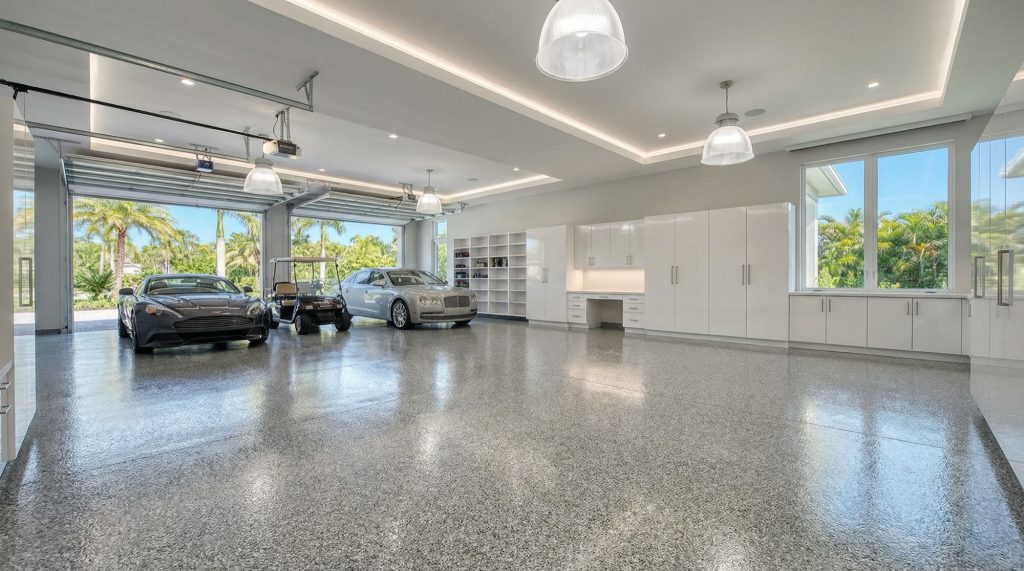
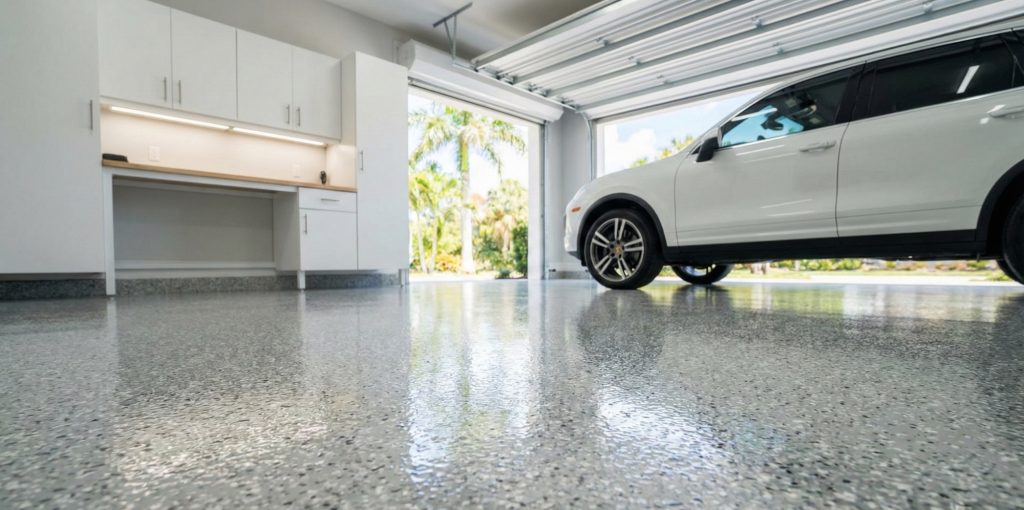
A full flake floor is broadcast to refusal across the whole slab rather than scattered for effect. The result is a continuous chip surface with no thin spots, and it is the toughest residential finish we offer.
Pour this floor
Tell us the space and rough size. Or call (941) 504-9132.
Detail
Full broadcast versus partial
A partial or accent broadcast uses less flake and lets the base color show through. It costs less and it looks lighter. A full broadcast covers completely, which means the base coat color barely matters and the chip blend is doing all the visual work.
The practical difference is thickness and uniformity. A full flake floor is measurably thicker, wears more evenly, and has no thin regions where the base is doing the work alone.
Why it costs more
Material, mostly. A full broadcast uses several times the flake of an accent job, and the sanding stage takes considerably longer because there is far more chip edge to knock down before sealing.
It is worth it on a floor that is going to see jack stands, toolboxes on castors and daily vehicle traffic. On a garage that stores holiday decorations, a standard flake build is plenty.
Edges and transitions
The tell on a cheap flake job is the perimeter. We carry the coating up a small cove at the wall where the detail allows, and we cut clean lines at the door threshold so there is no ragged edge where the garage meets the driveway.
Preparation
What happens before any resin comes out
A garage slab is usually the worst-prepared concrete on a property: hard-troweled smooth when it was poured, then twenty years of tire rubber, oil and road salt on top of it.
We diamond grind every floor. Progressively finer diamond tooling runs across the slab until the surface is opened to a profile the coating can key into mechanically, with the dust going into a vacuum rather than into the house. Acid etching, which is what most retail kits instruct, barely touches a hard-troweled slab.
Then we read moisture. Florida slabs sit on sand with a high water table and move vapor upward continuously; trap that under a film-forming coating and you get bubbling and delamination that can only be ground off and redone. Where the numbers come back high we specify a moisture-tolerant primer instead of pretending the problem is not there.
Cracks get chased out to a clean edge and filled rather than skimmed over, spalls and pop-outs get rebuilt, and any previous coating comes off entirely. Only when the slab is sound, open and dry does anything get mixed.
The finish is what you see. The grind underneath it is what decides whether you are still happy in year eight, and it is where we spend the time other quotes save money.
That checking sometimes turns up a slab that should be repaired first. When it does, we tell you, even though it means a longer job or a pause. A crack with a structural cause comes back through a coating, and we are not putting our name on that.
Related work
Industrial Floor Coatings
Industrial floors fail from abrasion, impact and chemistry, usually all three. The coating has to be thick enough to…
See the system →Concrete Floor Coatings
Bare concrete looks tough and is not. It is porous, so it drinks oil and wine and rust, and it dusts constantly as…
How it works →Concrete Coatings
Garage, lanai, pool deck, driveway, walkway and patio are all concrete, and they all want different chemistry. We…
Read the detail →Polyurea Floor Coatings
Polyurea is the elastic member of the resin family. Where epoxy cures rigid and glass-hard, polyurea keeps a degree…
What it suits →Questions
Full Flake Garage Floor Coatings questions
How much does full flake garage floor coatings cost?
We would rather give you one honest number than a wide range. To get there we check the slab, because cracks, old coatings and moisture all change how much prep the job needs, and prep is where the cost moves. Size and system round it out.
How long does full flake garage floor coatings take?
It depends on two things, the size of the floor and the system going down. Residential work typically takes two to four days on site. If you run a business, we plan around your hours and often work nights or weekends. Weather can shift cure times, so dates are confirmed up front.
Do you grind the floor first?
Always. Diamond grinding is the only way to get a profile the coating can key into, and it is the single biggest reason floors either last or fail. We do not acid etch and we do not coat over a sealed slab.
What about moisture in the slab?
Florida slabs move water upward constantly, and vapor trapped under a coating is a guaranteed failure. We take a reading before quoting. If the numbers are high we specify a moisture-tolerant primer rather than pretending the problem is not there.
Can you match a color or a look I have seen?
Usually. We carry eighteen flake blends and mix metallic per floor, so bring a photo, a cabinet door or a paint chip and we will get close. We put samples down in your own light before you commit.
Do you work outside Sarasota?
Yes. We cover a 120-mile radius from Sarasota, which is twenty-four counties from Naples up to Ocala and across to Orlando. Check the service areas page or call and ask.
Send us the space. We will send back a number.
Rough size and a photo is enough to start. We cover Sarasota and twenty-four counties around it, so tell us where you are and we will tell you when we can get there.
Pour this floor
Or call (941) 504-9132.