
Decks
Taking a worn pool deck back to sound concrete
Pool deck resurfacing starts with whatever has gone wrong on the old deck around your Bradenton pool. Cracks get opened up and filled, broken edges at the coping get rebuilt, and a coating that is lifting comes off completely. The new flake surface only goes down once the concrete under it is sound again.
What is the deck doing?
Cracking, peeling or crumbling at the edge. Or call (941) 504-9132.
Findings
What an older deck usually shows us
Most decks we are asked to resurface have been coated before, sometimes more than once. Walking one, the same problems come up again and again.
The edge at the coping tends to go first. Splash water lands there, the concrete stays wet longer than anywhere else on the deck, and the top layer pops off in flakes and patches. A spalled band along the coping is rough under bare feet, and it lets more water into the slab every time it rains.
Cracks come next. A thin shrinkage crack that has sat still for years is a filling job. A crack where one side has dropped lower than the other tells us the slab has moved, and we look at that one a lot harder before saying anything about a coating.
Then there is the old finish. Painted decks peel in sheets. Knockdown textures go chalky and let go. An epoxy somebody rolled on outdoors has usually yellowed and started lifting at the edges. None of it gets coated over.
We point all of it out at the walkthrough and walk the deck with you, so you see what we are seeing. That list becomes the order of work, and it is how you know nothing gets skipped to keep the job moving.
Stripping the old surface off by machine
Nothing new holds well to a coating that is already letting go, so removal is where the work starts.
Grinding down to concrete
Diamond grinders take the paint, texture or old resin off and keep going until there is clean, open concrete across the whole deck. Chemical strippers and pressure washing leave residue in the pores, and a new coat sitting on that residue fails the same way the last one did. The grinder also shows us what the old finish was hiding, which is often a crack or two nobody knew was there.
Rebuilding what was lost
Cracks are chased out into a clean V and filled with a flexible polyurea filler that gives a little with the slab, so it does not split straight back open on the same line. Spalled patches and the broken band along the coping get a cementitious repair mortar, feathered out and ground flat again so the new surface reads as one plane. Where water has been standing in a low spot, we build it up so it runs off toward the edge or the drain.
Then the new surface
Once the repairs have cured, a moisture reading goes on the concrete and decides the primer. A base coat goes down with flake broadcast into it, the loose flake is swept off, and a clear topcoat with a fine texture mixed through it goes over everything so wet feet have something to grip. The saw-cut control joints stay open through all of it, because filling them solid only sends the next crack somewhere you did not choose.
Enclosures
Working beside a full pool inside a cage
Many decks here sit inside a screen enclosure, and the pool stays full while we work. That means the whole job is set up around keeping dust, chips and resin out of the water. The pool edge gets covered while we grind and broadcast, dust is vacuumed as it comes up, and loose flake is swept up away from the water’s edge.
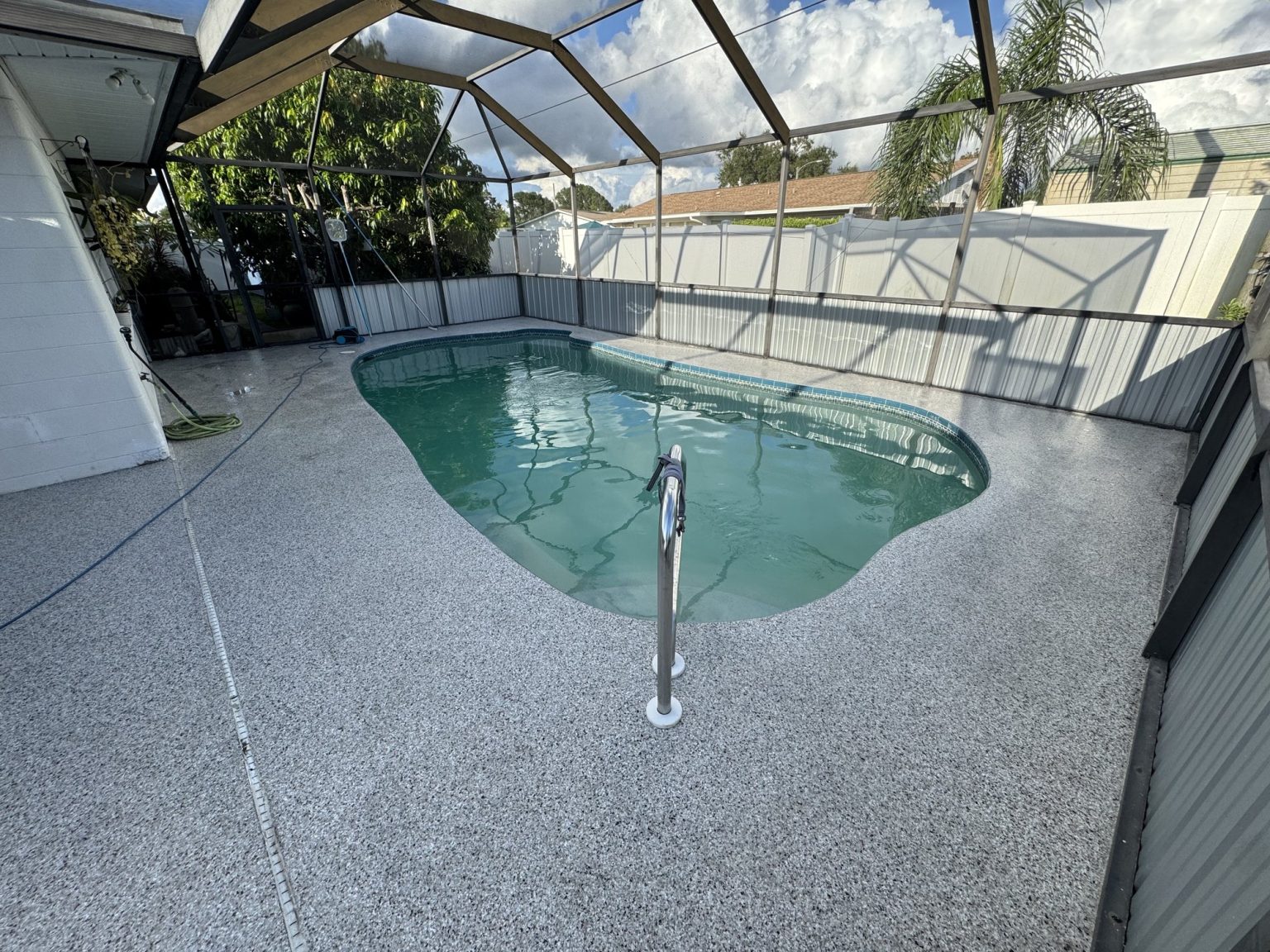
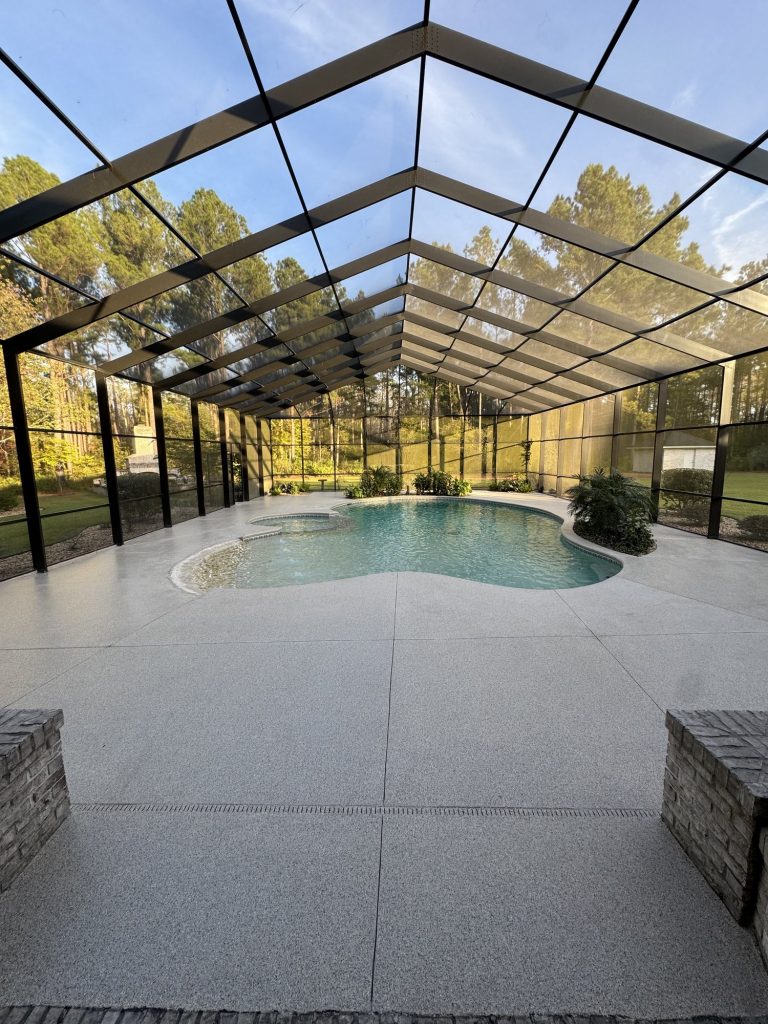
Enclosures with corrugated metal panels along the bottom of the screen walls, like the one at the top of this page, need careful cut-in work at the base of each panel so the coating stops in a clean, straight line. A long deck under a tall gabled cage, like the one beside this text, with planter walls, a trench drain and a spa, means more edges to detail and more drain lines to keep clear, and we plan the days to suit.
A screened enclosure is still a sun floor, so the clear that goes over the flake is a UV-stable one. Any epoxy layer stays buried under it where the light never reaches.
Our shop is about fifteen minutes from Bradenton, and same-week scheduling is normal here. The prep is the same as on any floor in Manatee County: grind, repair, moisture reading, primer. Older decks and brand new ones both pass vapor in this climate, so the reading happens on every job.
When we tell you to hold off on resurfacing
Resurfacing fixes a surface. It cannot fix a slab that is still moving underneath it, and we would much sooner say that at the first visit than on the morning the grinder shows up. These are the things that stop us:
- A section of deck that has dropped or lifted so it no longer lines up with the slab beside it.
- A crack running the full width of the deck that keeps opening wider.
- Concrete that crumbles well below the surface once the grinder gets into it.
- A deck that has tipped back so rain runs toward the house instead of away from it.
Any of those is a concrete problem first. A resin system laid over a slab that is still settling follows the movement and cracks along with it, and the new deck ends up looking like the old one inside a season or two. In that case the slab needs dealing with, and then we come back and put the surface on.
Coat over a moving slab and you have paid twice for the same crack.
Weather sets the outdoor calendar. Humidity and afternoon storms slow curing, so you get real dates before we start, and they move if a storm moves them. Attention to detail and a clean site matter more beside a pool than anywhere else we work, because whatever we leave behind ends up in the water.
Past the pool, more of our Bradenton work
Concrete Crack Repair
The repair half of a resurface, on any slab.
How it works →UV-Resistant Outdoor Floor Coatings
Topcoats that hold color on a lanai or entry walk.
Read the detail →Polyurea Floor Coatings
A flexible base for a slab that moves in the heat.
What it suits →Polyaspartic Floor Coatings
Fast-setting garage floors that come back into use sooner.
See the system →Pool Deck Resurfacing
How we rebuild a failed deck, in every county.
The whole system →Everything we do in Bradenton · Manatee County cities · Pool decks in the gallery · Get in touch
Before your deck gets ground
Does the pool have to be drained?
Usually not. On a resurface the pool stays full, unless a repair at the coping or the tile line needs the water dropped below the work. We cover the edge while we grind and broadcast flake, vacuum the dust as it comes up and sweep loose flake away from the water. Anything that does land in the pool gets skimmed out before we pack up for the day.
Can old Kool deck or knockdown stay under the new surface?
It all comes off. Those textures chalk and loosen as they age, and anything bonded to them only holds as well as they do. We grind them away down to bare concrete, then repair whatever that uncovers before any primer goes on the deck.
What happens to the broken concrete along the coping?
Loose concrete at the edge is cut back to sound material and rebuilt with a repair mortar, then ground flush so the new surface runs cleanly up to the coping. If any coping stones themselves look loose, we point them out before the job starts so they can be reset first.
Will the filled cracks show through the new deck?
A filled shrinkage crack normally disappears under the flake. A crack that is still moving can come back as a fine line, which is why we read each one before starting and tell you which ones we expect to stay quiet and which we are keeping an eye on.
Can the family use the pool while the deck is being done?
Not while we are working, since the edge is covered and the deck is either freshly ground or wet. Foot traffic is usually fine the day after the clear coat goes on, and you get the dates for getting back in the water before the job begins.
Does the screen enclosure have to come down?
The cage stays up. We work inside it with the screens in place. The metal lower panels get masked so the coating stops in a straight line, and if a torn screen or a loose panel needs fixing first, we tell you at the walkthrough.
Send us a photo of the worst part of the deck.
The cracked corner, or the patch that peels when you scuff it with a shoe. That photo and a rough size of the deck tell us whether it is a resurface or a slab problem, what has to come off first, and roughly how many days the pool area is closed to you.
Show us the deck
Or call (941) 504-9132.