
November 2026
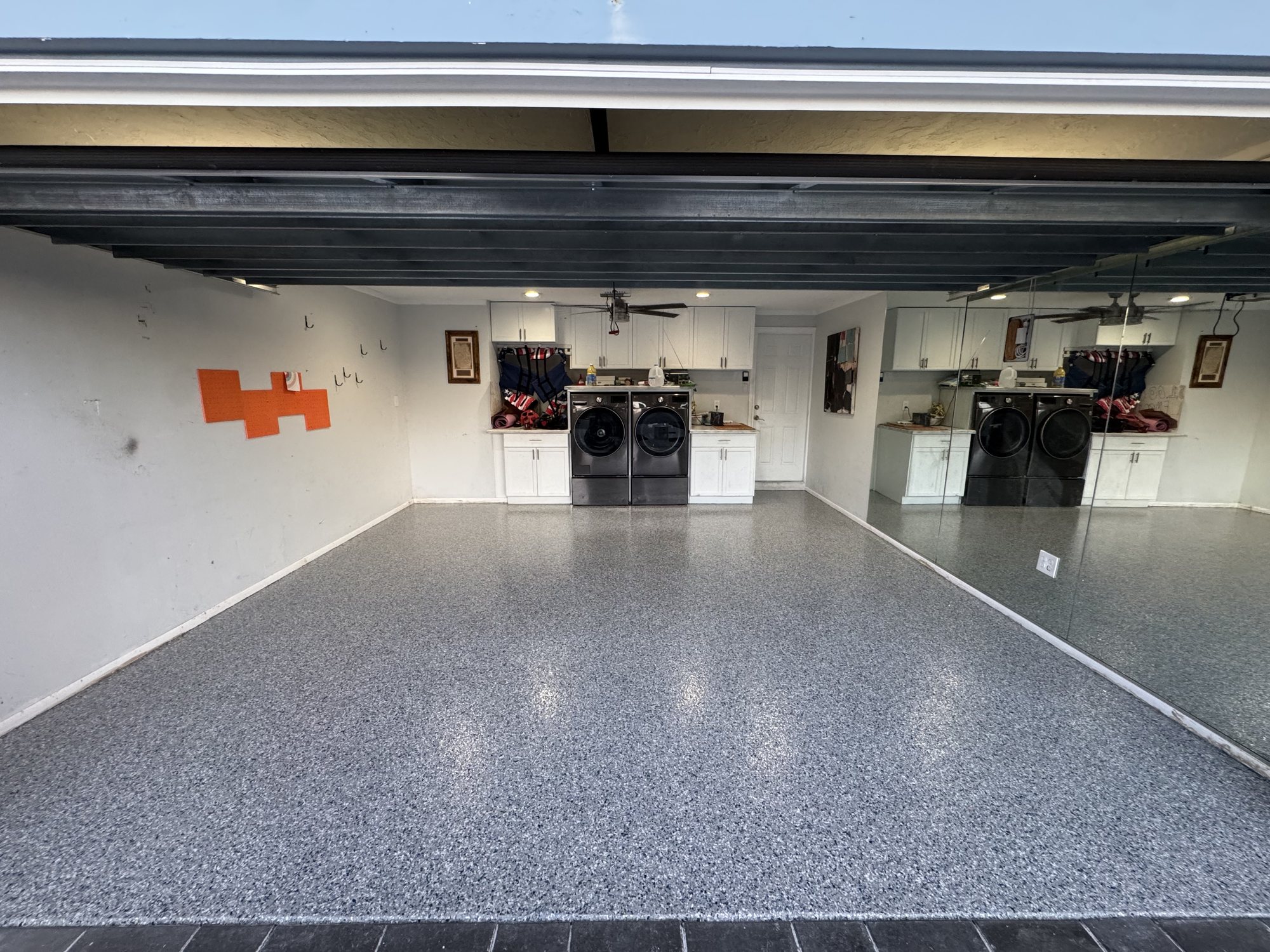
Plenty of garages carry a second job. The washer and dryer sit against the back wall, a cabinet of detergent sits beside them, and the floor in front of the machines sees more water than any other part of the room. A coating in a space like that has two kinds of water to deal with: the spills and drips that land on top, and the moisture that rises through the slab from underneath. The second kind is the one that ruins floors. This post covers how we build the floor in a laundry garage, from the bottom layer up.
Water from above: drips, hoses and the odd overflow
A washer leaks eventually. Supply hoses age, a drain line pops loose, a heavy load walks the machine out of place. Wet laundry gets carried across the floor in a basket. On bare concrete that water soaks in, leaves a dark ring and dries slowly. On a coated floor it sits on top, and a towel or a squeegee takes it away.
Water from above finds edges, though. If the coating was cut in around the machines instead of running under them, there is a seam at the base of each one, and that seam is where water gets in.
So the washer and dryer come out before we start. The floor runs continuous under where they stand, right up to the wall, and the machines go back on a finished surface once it has cured. Cabinets that sit on the floor get the same thinking: the floor runs under them if they can be moved, and gets cut in cleanly by hand where they cannot.
A gray flake like the one in the photo also hides water spots and lint between sweeps, which counts for something in a room where both turn up every week.
Water from below: a slab is never fully dry
Florida concrete sits on sand over a high water table, and vapor climbs through it all year. You cannot see it, and a slab that looks bone dry can still be passing a steady amount of moisture. Older slabs and new ones both do it.
Seal that vapor in under a film-forming coating and it has nowhere to go. It collects at the bond line and pushes up as bubbles, and the coating lets go in patches. No amount of good resin fixes that after the fact.
That is why a moisture meter goes on every floor before a system is chosen. In a laundry garage the reading matters twice over, because the patch in front of the machines has often taken years of spills on bare concrete before any coating arrives. If the reading comes back high, a moisture-tolerant primer goes down first.
The reading is taken on the spot. You hear the number and what it means for the primer before anything is booked, so the choice is made on your slab and never on a guess.
A base coat that bonds and gives a little
The layer that does most of the work is the one you never see. On a laundry garage we often build the floor on a polyurea base coat. It bonds hard into the ground concrete and stays slightly flexible once cured.
Flexibility matters because a slab is never completely still. It warms and cools through a Florida day and moves a little with the heat. A brittle base cannot follow that movement, so a hairline crack in the concrete tends to telegraph through as a thin line in the finished floor. A base that gives a little rides over small movement instead of splitting along it.
The flake goes into that base coat while it is wet, broadcast to cover the floor edge to edge. Once it sets, the loose chip is scraped and vacuumed, and the floor gets its clear.
The details of the system, and how we use it on garages around town, are on the polyurea floor coatings page for Bradenton. If you are weighing it against the other floors we put down locally, the Bradenton page sets them side by side.
Edges: the mirror wall, the cabinets and the door
A laundry garage tends to have more edges than a plain one. In the photo there are white cabinets either side of the machines and a mirrored wall down the right side, and each of those is a line where the floor meets something else.
At the walls, the coating can be carried a few inches up as a coved base. That turns the corner between floor and wall into one continuous surface, so a mop or a spill has no crack to get into. Along a mirrored or finished wall the edge is cut clean by hand, and the wall is covered during the grind so dust and splatter stay off it.
The door is the other edge. In the photo a dark paver apron meets the garage at the door line. Pavers are a separate surface, so the coating stops at the edge of the slab with a clean, straight line and leaves the apron alone.
None of these details take long. They are also exactly where a laundry garage starts to look tired first when they get skipped, which is why the crew slows down for them.
Polyurea under, polyaspartic over
Most laundry garages end up as a layered floor: a polyurea base for bond and give, and a polyaspartic clear on top for wear and color stability. What you notice as a homeowner is fairly simple. The floor feels like one hard, smooth surface. Water beads and wipes up. The color holds near the open door. And the room is back in use sooner than it would be with a traditional epoxy system.
The days still depend on the weather. Humidity and afternoon storms change cure times, so we plan the coating days around a window and give you real dates for your job. Foot traffic usually comes back the day after the clear coat, and cars wait about four to five days after it, depending on humidity. The day the machines can go back in is on the same written schedule.
Plan the laundry around it. A few loads at a laundromat or at a relative’s house is the usual answer, and it is easier to arrange once the dates are in writing. Same-week scheduling is normal for us in Bradenton, so the wait to start is usually short.
Laundry garage questions
Will a leaking washer damage a coated floor?
Water sitting on top of a sound, fully bonded coating is a cleanup job. Wipe it up, dry the area and carry on. The trouble spots are seams and edges, which is why the machines come out and the floor runs continuous under them. A hose that keeps leaking should still be fixed at the hose, since that water can reach the walls and cabinets.
Do the washer and dryer have to come out?
Yes. They need to be disconnected and moved out of the garage so the floor can be ground and coated under where they stand, with no cut-in line around their feet. Leaving them in place means a seam at the base of each machine, and seams are where water gets in. They go back on the date we give you with the rest of the schedule.
Why test for moisture if the floor looks dry?
The moisture we worry about comes up through the slab, and you cannot see it. Florida concrete sits on sand over a high water table, and vapor climbs through it all year. Sealed under a coating, it bubbles and lifts the floor. A meter reading on the day tells us whether a moisture-tolerant primer has to go down first.
Send a photo of the laundry side of the garage and a rough size through the contact page, or call (941) 504-9132 to book a pour in a week that suits the laundry. Finished garages are in the gallery.