
November 2026
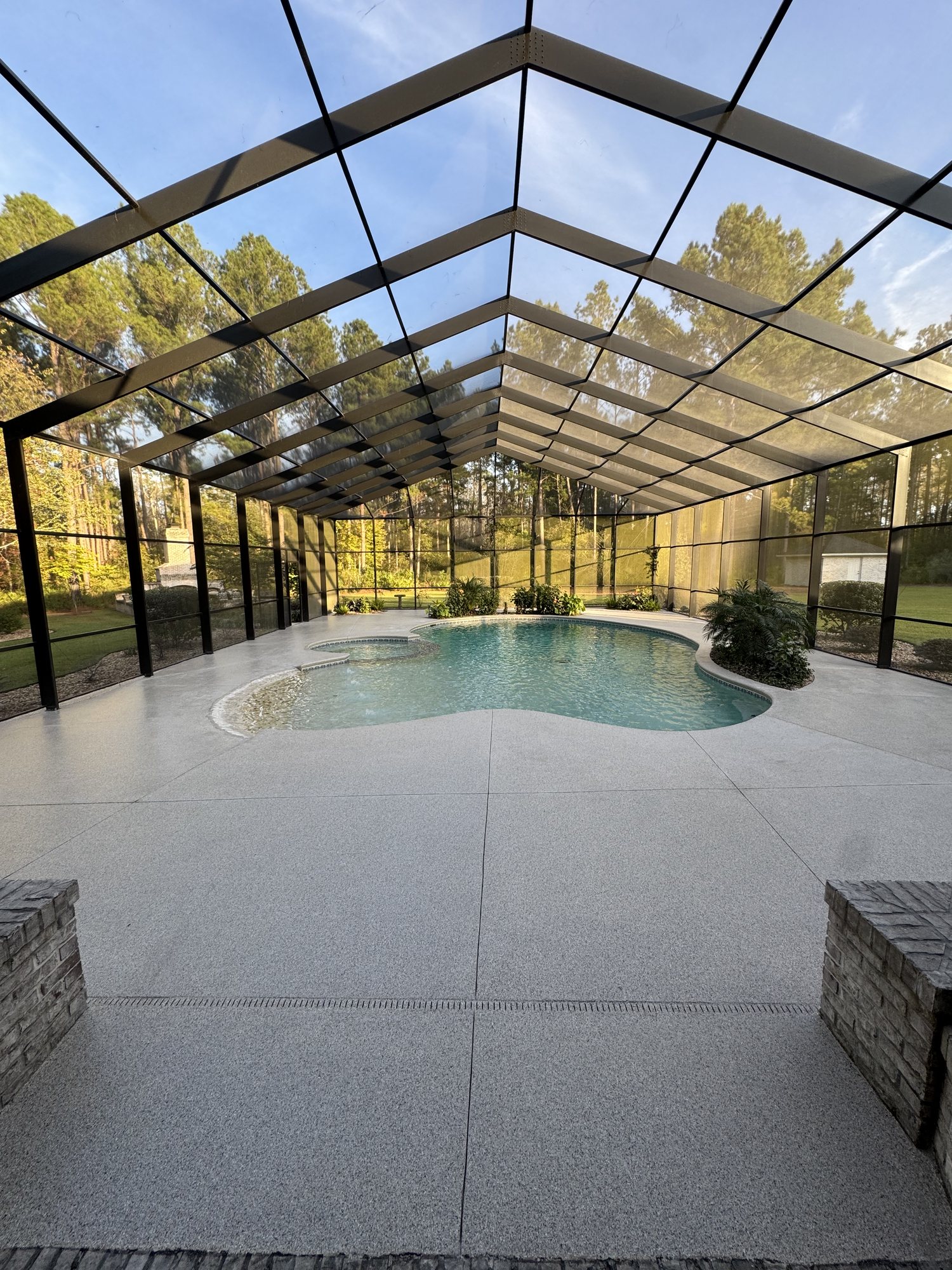
A pool deck that has been coated before can usually be coated again. Whether it should be is another question. Some decks need a cleanup and a fresh topcoat. Others have reached the point where another coat only hides the problem for a season or two, and the right job is to take the deck back to bare concrete and build it up again. Telling the two apart is mostly a matter of looking closely at a few places on the deck. Here is what we check on an older deck, and what each finding usually means.
Start at the coping and work outward
The coping, the edge around the pool, is where trouble shows first. It takes splash, pool chemicals, sun and every swimmer climbing out. On an older deck, look along the line where the deck meets the coping. Spalled edges, where pieces of the concrete surface have broken away, are common there. So are open gaps where the joint between deck and coping has failed.
Spalling is a concrete problem, and a coating does not fix it. A new coat over a spalled edge follows the broken shape and starts lifting at the same spot. That edge has to be cut back to sound concrete and rebuilt before anything goes on top.
Then walk out across the deck. Note the cracks: hairlines running at random, cracks that follow the saw cuts, and any crack with a step in it. Look at the drains too. On a deck like the one in the photo, with a trench drain running through it, the drain edges are another place where water gets under an old coating.
A deck with a few hairlines and sound edges is usually a recoat candidate. A deck with spalling, open cracks and a coating lifting at the edges is pointing at resurfacing.
An old coating that is letting go
The other thing to read is what is already on the deck. Many older decks carry a painted finish or a textured coating, and both age in a recognizable way. The color fades and chalks in the sun. Then the coating starts to peel in flakes, lift in sheets near the water, or sound hollow when you tap it with a key.
That hollow sound is the giveaway. It means the coating has lost its bond to the concrete in that area, even where it still looks intact. Press a thumb around the edge of a peeling patch. If more lifts easily, the bond has gone over a wider area than you can see.
A new coat on top of that bonds only as well as the layer underneath it. It never reaches the concrete, so it inherits every weak spot in the old finish. That is the reason a failing deck coating cannot simply be rolled over. It has to come off.
If most of the old coating is still firmly bonded and the only issue is fading, the conversation changes. That is a recoat, and a much smaller job than the one this post is about.
Back to bare concrete, then built up again
Resurfacing starts with removal. A deck that has been sealed or painted needs that finish removed mechanically before a new coating will bond, so we grind it off, down to sound concrete.
With the bare slab exposed, the real repair work begins. Cracks are chased open and filled, spalled edges are cut back and rebuilt, and pitting is filled and ground flush. Saw-cut joints are cleaned out and honored, so the deck can keep moving along them. The trench drain stays open and working.
Then a moisture reading, because a deck slab sits on the same sand and water table as everything else here and passes vapor all year. The primer is chosen by that reading.
On top comes the new surface: a base coat with a flake broadcast into it, and a textured UV-stable clear so wet feet have grip. The deck in the photo carries that kind of finish, a light flake with the joints and the drain kept.
The pool deck resurfacing page for Bradenton walks through the system, and the Bradenton page lists everything else we install in town.
Working around a full pool under a big cage
Plenty of decks sit inside a screened enclosure, sometimes a tall gabled cage like the one in the photo, and the pool usually stays full while the work goes on. That shapes how the job runs.
Grinding makes dust, and a pool is a large open surface that catches it. So the pool edge is protected before the grinders start, and the crew vacuums as it goes. Debris that does reach the water is netted out before it settles.
The cage helps in one way. It keeps leaves and wind-blown debris off a coating while it cures, which is a real advantage outdoors. It does nothing about the weather, though. Humidity and afternoon storms still change cure times, cage or no cage, which is why outdoor work gets planned around a weather window and you get real dates for your deck instead of a generic promise.
Planters like the stone walls in the foreground of the photo get masked at the base so the coating meets them cleanly. Furniture, hoses and pool equipment come off the deck before we start and go back once it has cured.
When the deck itself has moved
Sometimes the deck is the problem. A section that has settled away from the pool, a slab that has heaved and left a raised edge, or a crack with one side sitting higher than the other all point to movement in the concrete or the ground under it.
A coating cannot correct that. Resurfacing gives the deck a new top, and that top follows the shape of the slab underneath. Coat over a settled section and the step stays, and the crack opens through the new surface the next time the slab moves.
A trip edge on a pool deck is also a safety problem, which is reason enough to deal with it properly. If the slab has moved, the concrete needs repair or replacement first, and that is a different trade. We tell you that when we see the deck, before any coating is quoted.
Plenty of older decks have not moved at all. They have tired surfaces, failing coatings and damaged edges, and those are exactly what resurfacing is for.
Before you book a resurfacing
Can you put a new coat over my old deck coating?
Only if the old coating is still firmly bonded and the issue is fading or wear. If it is peeling, lifting near the water or sounds hollow when tapped, a new coat would sit on a layer that is already letting go. In that case the old coating comes off mechanically and the deck is rebuilt from bare concrete.
Does the pool need to be drained?
Usually not. The pool stays full, the edge is protected before grinding starts, and dust is vacuumed as the crew works. Any debris that reaches the water is netted out. If the coping or the pool edge itself needs repair beyond the deck surface, that can change, and we tell you when we see the job.
How soon can we walk on the deck again?
Foot traffic usually comes back the day after the clear coat, depending on humidity. Outdoor work is planned around a weather window, since afternoon storms and humidity change cure times. You get the walk-on date for your deck in writing before work starts, and if the weather moves it, we call you that day.
Send a wide photo of the deck, a close one of the worst edge and a rough size through the contact page, or call (941) 504-9132 and talk it through before anything is booked. Finished decks are in the gallery.