
October 2026
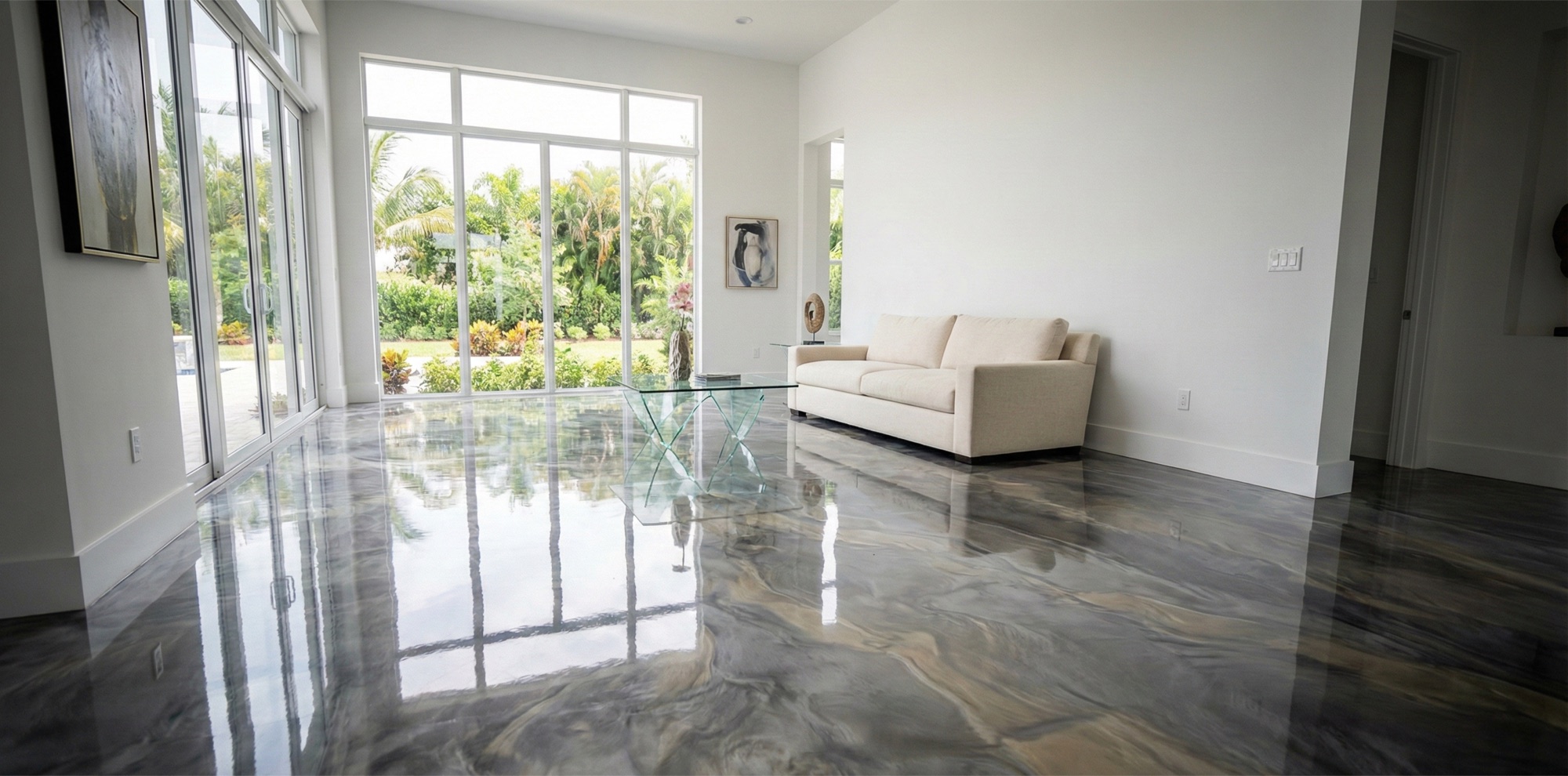
Most metallic floors we pour inside a house replace something. Usually it is tile that has started to crack or carpet that has seen better days, and the owner wants one continuous floor in its place. The pour itself gets the attention, but the days before it decide how the floor turns out. Whatever comes up has to come up completely, the slab underneath has to be brought back to sound concrete, and the room has to be ready to sit empty for a stretch.
Everything on the slab comes up first
A metallic bonds to bare concrete and nothing else. That means the old floor and everything holding it down has to go. With tile, that is the tile itself plus the thinset mortar under it, which is often left behind in ridges where the trowel combed it. With carpet, it is the carpet, the pad, the tack strip nailed around the edges, and sometimes a layer of glue from a sheet floor somebody laid before that.
Who pulls up the old flooring is worth settling early, since the answer changes how many days the room is out of use. Either way, we see the bare slab before the pour gets scheduled, because the surface tile or carpet was hiding is the one we will be working on.
Expect surprises at this stage. Tile can hide a crack that runs the length of the room. Carpet can hide an old patch, a painted section, or a spot where a pet stain soaked into the concrete. None of that is unusual, and all of it gets dealt with before any resin is opened.
Grinding back to sound concrete
Once the room is bare, the diamond grinder takes over. Thinset ridges come down first, then adhesive residue, then whatever sealers or paint were under the old flooring. The goal is a clean, open surface across the whole room, with no leftover film anywhere for the primer to sit on instead of soaking in.
The grinders run to a vacuum, which matters inside a lived-in house. Dust gets collected at the tool, and the doorways to the rest of the home get closed off while we work.
Grinding also shows what kind of shape the slab is in. Cracks that were under tile get chased out to a clean edge and filled. Tack strip leaves a ring of nail holes around the room, and each one gets filled so it does not show as a dot through the finish. Hollow-sounding patches get cut out and rebuilt.
Then the moisture reading. A slab that spent years under carpet or tile can be holding more vapor than it appears to, and the meter tells us whether the primer needs to be a moisture-tolerant one before anything else is decided.
Keeping the old tile layout from ghosting through
A mirror gloss shows everything under it. That is the appeal of a metallic, and it is also its biggest demand. If the slab under a tiled room still carries faint ridges of thinset or slight dips where the tile sat, light raking across the finished gloss can pick them up as a faint grid. The old layout ends up showing through a brand new floor.
Preventing that is a matter of flatness. After grinding, we check the surface by eye and by hand, looking for any trace of the old pattern. Low spots get filled and ground flush. Where the slab is uneven across a wider area, the fix can take more than one pass of repair and grinding.
It is slow, careful work, and it is the part of the job nobody sees once the floor is finished. That is the point. A room with big windows, like the one in the top photo, throws light low across the floor for much of the day, and a mirror finish over a flat, well-repaired slab is what keeps that light looking like a reflection and not a map of the old tile.
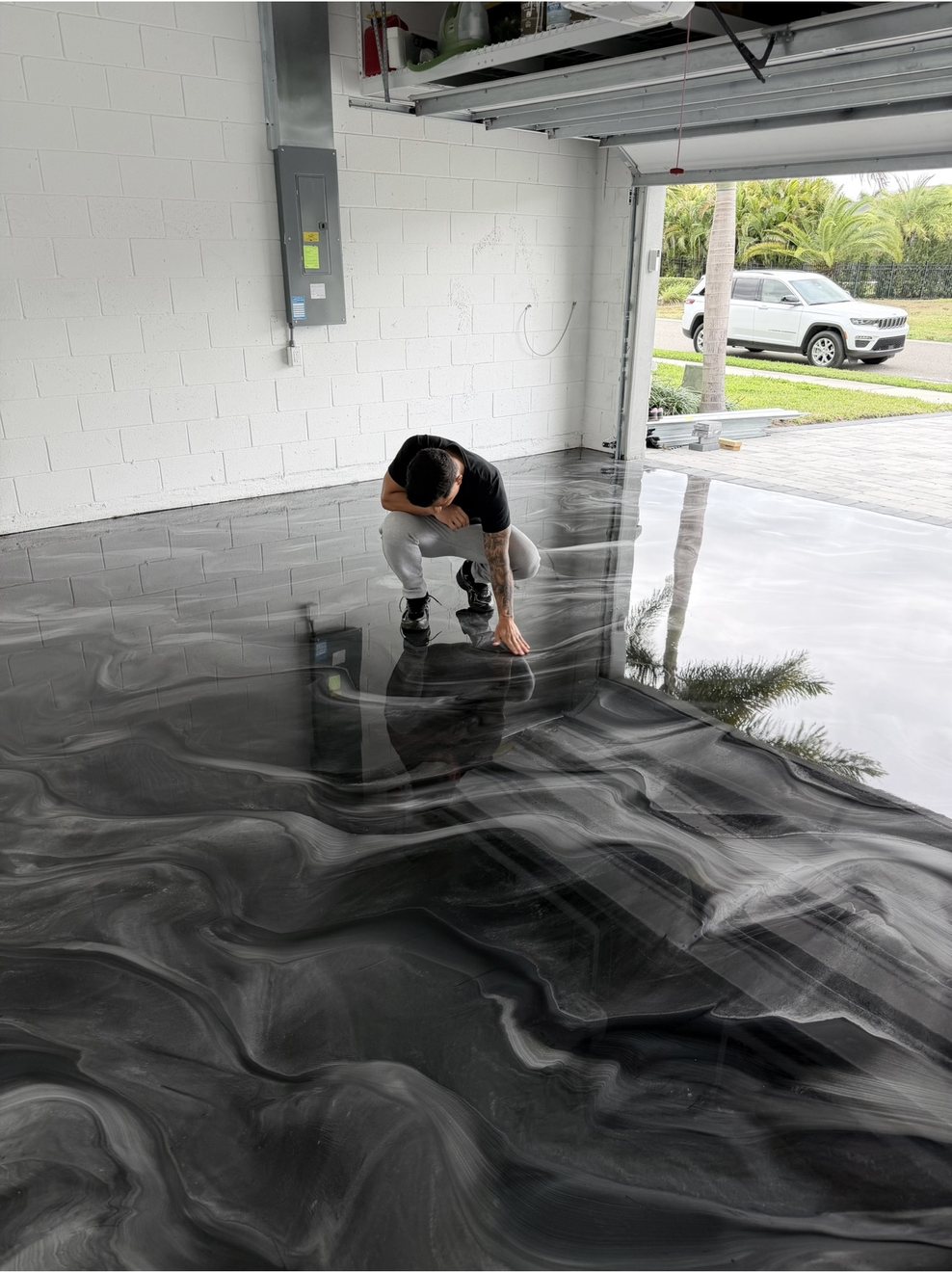
The day the color goes down
With the slab flat and primed, the pour itself moves fast. Metallic pigment is moved by hand through the wet resin to build depth and veining, and a clear coat goes on afterward to seal the finished look. The design happens while the resin is open, which is why the whole room has to be ready at once. Every edge, every doorway and every corner gets poured in the same working window.
The photo above is a garage floor in the same black and white family, with the installer down at floor level reading the gloss. During a pour, that close look happens over and over while the color can still be moved and another pass can still be made. Once the resin starts to set, the chance to change it is gone.
That is also why the room has to stay sealed off. Dust, a pet, a door opened at the wrong moment: anything that touches the wet surface becomes part of the floor. The baseboards stay off until the clear coat has cured, so the pour can run all the way to the wall and the trim can sit back down on top of the finished edge.
Planning the days without the room
The part owners most often underplan is the furniture. Everything in the room comes out before grinding and stays out until the floor can take it. For a living room that might mean the sofa, the rug, the television stand and every lamp, so it is worth deciding early where all of it will sit for those days.
You can usually walk on the floor in socks the day after the clear coat. Furniture comes back later, on a date we give you in writing before work starts. Humidity and afternoon storms can stretch cure times, and if that happens you hear about it from us. When the furniture does go back, felt pads go under every leg, because chair feet dragged across a fresh gloss leave marks that show for years.
Our page on metallic epoxy flooring in Venice covers the pour and the topcoat choices, and the Venice service page has everything else we do in town.
Changeover questions from tile and carpet rooms
What if the slab under the carpet turns out to be cracked?
Most are, at least a little. A crack gets chased out with the grinder and filled solid before primer, so it does not show through the gloss. If a crack is still moving, or one side sits higher than the other, we tell you before the pour is scheduled, because a metallic finish will show that line again if it keeps shifting.
Can the metallic run straight into the next room?
It can, as long as both rooms are poured in the same working window and the slab is prepared the same way throughout. Where the floor changes to another material, like tile in a kitchen, the line lands at a doorway or under a threshold so the change looks planned. We mark those lines together before any tape goes down.
Will the room smell while it cures?
Some odor is normal during the pour and for a short while after. Keeping the doors between that room and the rest of the house shut helps. By the time the floor is ready for foot traffic, most people find the smell has faded. If anyone in the house is sensitive to it, mention that early and we will plan around it.
Send a photo of the room as it is now and a rough size, along with a picture of a metallic you like. Use the contact page, call (941) 504-9132, or see the work in the gallery before you decide.