
October 2026
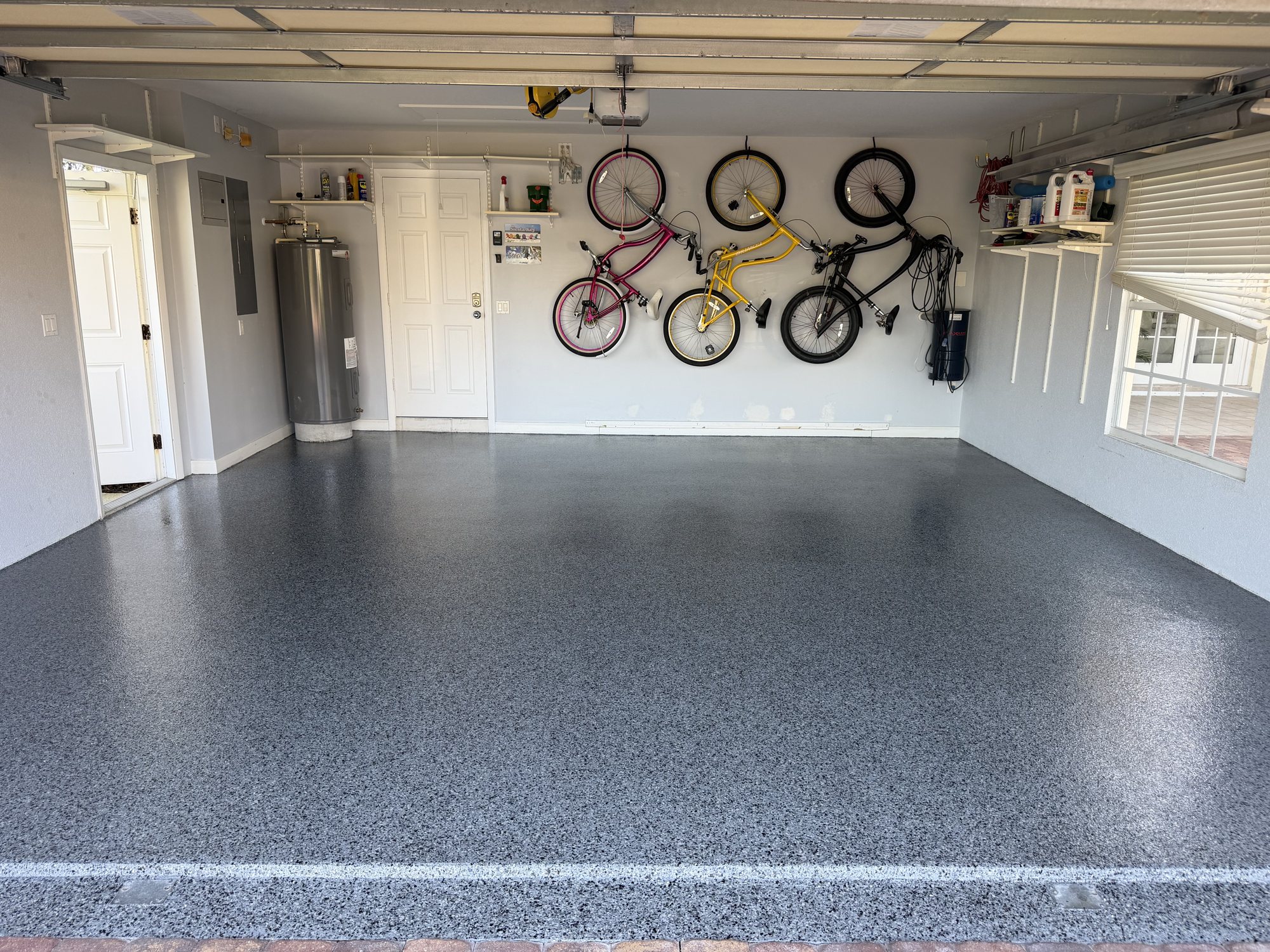
Picking a flake blend is the one part of a garage floor that is entirely up to you. The grind, the repairs and the primer follow whatever the slab needs. The chips on top are a matter of taste, and the trouble is that taste gets tested in the wrong place. A small sample in a showroom, or a picture on a phone, tells you surprisingly little about how a blend will look spread across a whole garage. We carry eighteen blends, and we lay them out on your own slab so you can judge them where they will live.
A chip card is too small to judge from
A sample card holds a few square inches of flake. Your garage holds hundreds of square feet of it, and a pattern behaves differently once it repeats that many times. Tones that stand out on a card settle into one overall color when you see them from the doorway. A blend that looks busy in your hand can read almost plain across a full bay, and one that looks quiet on the card can turn out darker than expected because the deepest chip in the mix gets repeated thousands of times.
Distance matters too. Most of the time you see a garage floor from the house door or the driver’s seat, which means from several feet away and at a low angle. At that distance the individual chips fade and the floor reads as a single shade with some movement in it. So the real question to ask is what that shade will be, and the only way to answer it is to stand back from a sample sitting on the concrete it is meant for.
Look at it from where you actually stand
When the samples come out, we set them in more than one spot. One goes near the door to the house, since that is where you see the floor most. One goes near the garage door, where daylight lands. If there is a corner where the light is poor, a third goes there.
Then look at them more than once. Garage lighting is its own thing. The garage in the next photo has a tray ceiling with lights set into it, and a gray blend reads cleaner under that light than it would under a single bare bulb. A yellow bulb warms everything up. Daylight through an open door cools it back down.
If you can, take a second look in the evening with the cars back in. A white car or a dark one parked over the floor changes how it reads, and so does the clutter that collects along the walls. The blend you still like after a day of living with it is usually the right one.
It also helps to bring whoever else uses the garage into the decision early. The person who parks there every night and the person who uses the workbench on weekends often see the floor from different spots, and a blend that suits both views is worth more than one that wins a vote on looks alone.
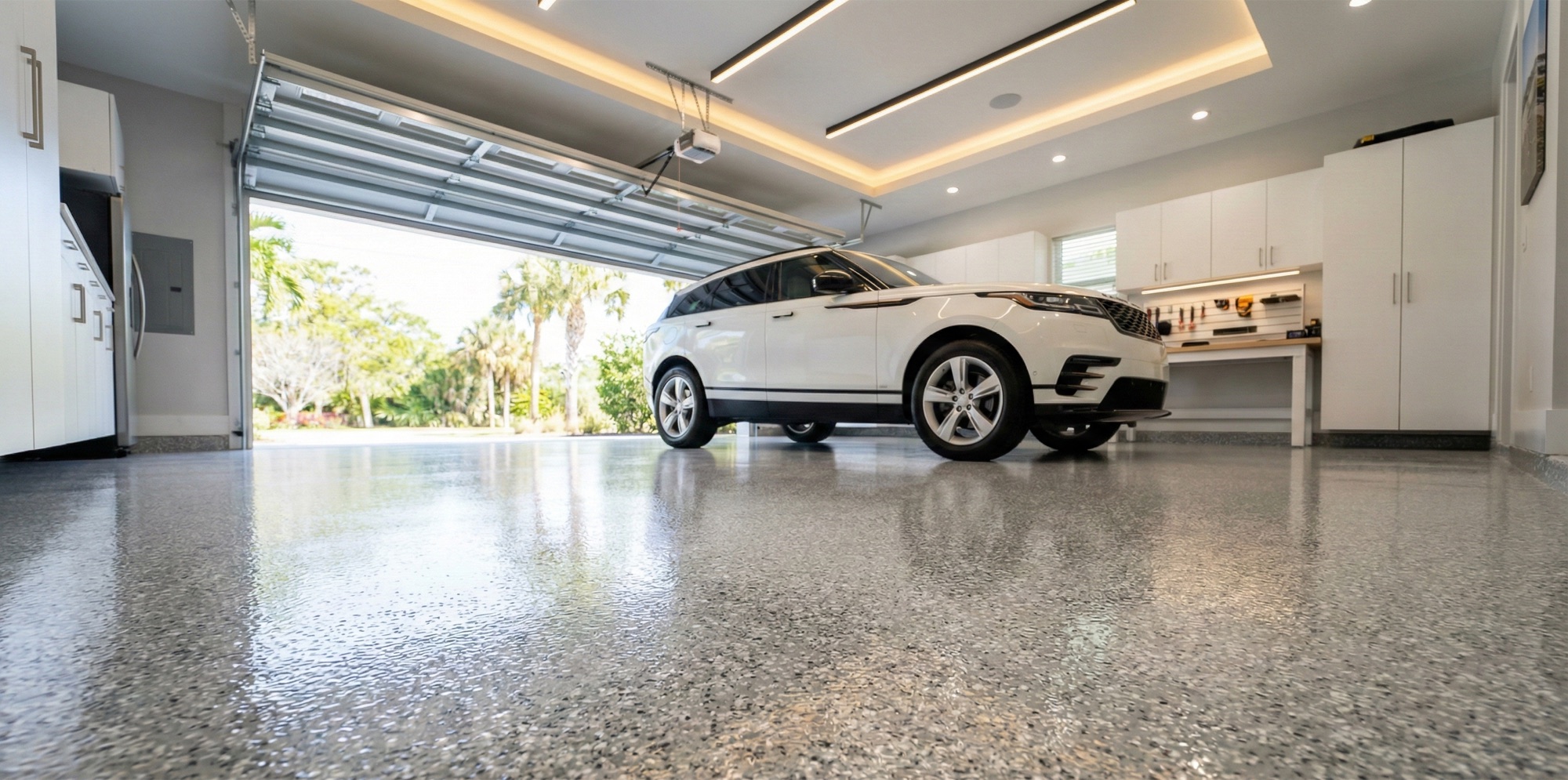
White cabinets and the floor beside them
Plenty of garages now have a wall of white cabinets, like the one in that photo. That changes the choice more than people expect. A light gray blend next to white cabinets makes the room feel continuous and bigger, and the line where cabinet meets floor almost disappears. A darker blend does the opposite. It frames the cabinets and makes them look sharper, and it makes the floor the heavier half of the room.
Both can look good, so it helps to think about what you want the eye to land on. If the cabinets were the expensive part of the project, a darker floor shows them off. If the room is on the small side, a lighter floor gives it some breathing space.
Wall color plays in too. Painted block, bare drywall and a feature wall all pull a blend in different directions. Set the samples close to the wall and the cabinet base, because that strip where floor meets wall is the one you will see every time you open a drawer.
What a flat color would show you
The case for flake is easiest to make by picturing the same garage with a single flat color. Bikes come in with grit on the tires and leave it in short lines across the floor. Cars carry in sand and road film. Somebody walks in from the lawn. On a flat color, every one of those marks sits on a plain background and shows the day it lands.
A broadcast chip floor gives those marks nowhere to stand out. The eye takes in the pattern and passes over a light film of dust that would be obvious on a solid finish. The blue-gray floor in the top photo is a good example. With three bikes on the wall and a water heater in the corner, that garage sees regular traffic, and the floor still reads clean.
Flake also leaves a little texture under the clear, which gives a wet tire or a wet shoe something to grip. We agree on the amount of grip with you before the clear is mixed.
The chips can also go down two ways. A full broadcast buries the base in flake so only chips show under the clear, while a partial broadcast scatters them over a colored base that shows between them and lets a little more dust read through.
Our page on flake epoxy flooring in Venice covers the system under the chips, and the Venice page has the rest of what we install around town.
Blend questions we hear on the slab
Does the clear coat change how the blend looks?
A little. The clear deepens the chips and gives them the look they have when wet, so colors read slightly richer than on a dry sample. If you want to preview that, splash a bit of water on the sample sitting on the concrete. It is not exact, but it gets you closer to the finished floor than the dry card does.
Should the garage blend match the floors inside the house?
It does not have to. A garage is a separate room with its own light, and trying to match a wood or tile floor inside usually ends up close but slightly off. Most people do better choosing a blend that suits the cabinets and walls in the garage itself, and letting the door to the house be the change.
How long do I have to make up my mind?
As long as you need before the base coat goes down. Most people narrow eighteen blends to two quickly and then take a day or two over the final choice. Once the base is wet, the chips go in within minutes, so the choice needs to be settled before that morning starts.
Send a photo of the garage with the cabinets and walls in frame, plus a rough size. Use the contact page, call (941) 504-9132 to book a pour, or browse finished flake floors to narrow the field first.