
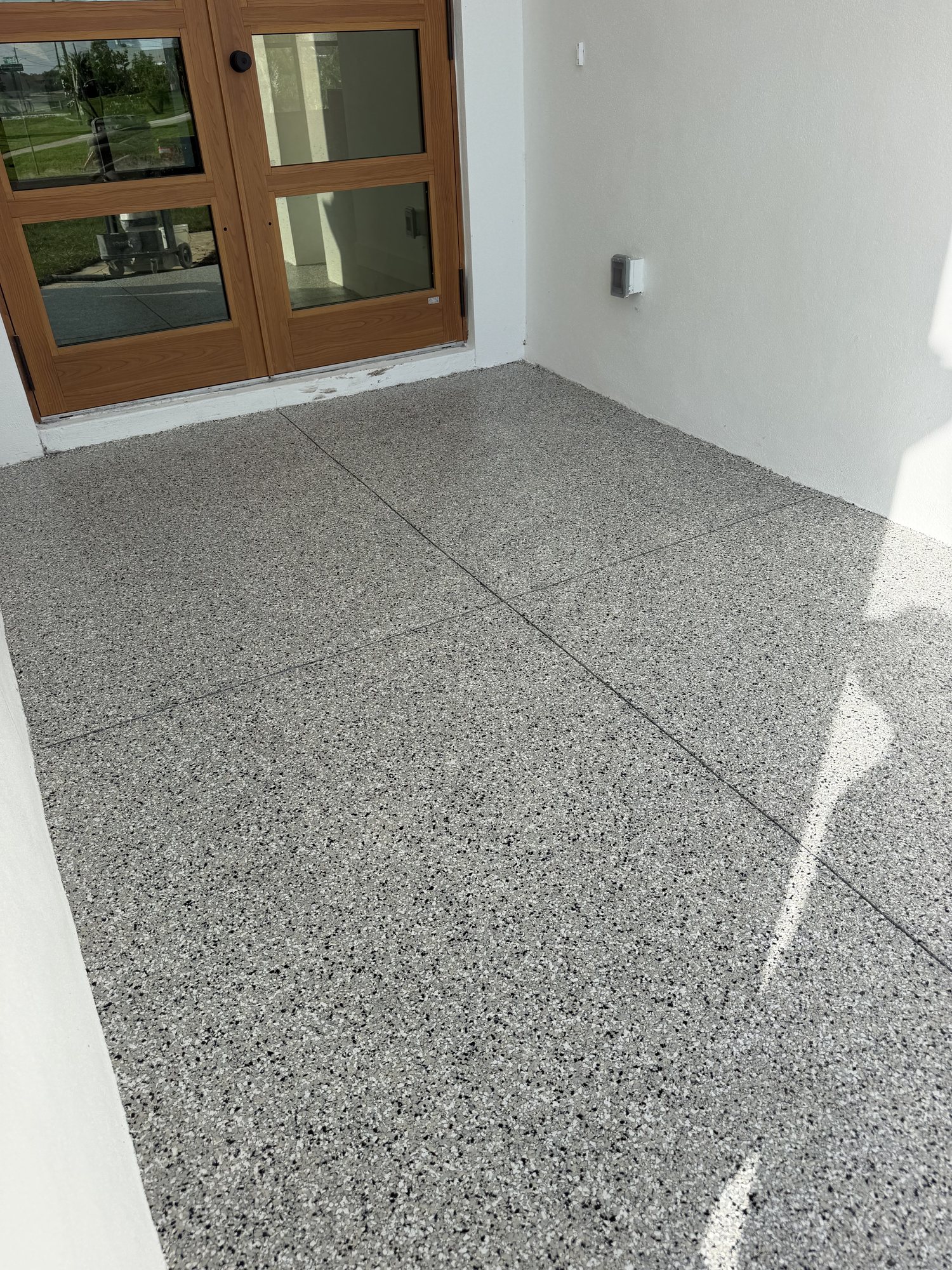
Entry
The first floor anyone walks on
Before anybody sees your kitchen, they stand on the slab outside your front door, usually holding something and often in wet shoes. We coat that entry so it grips, keeps the saw cuts it was poured with, and never leaves you without a usable way into the house.
Tell us about the entry
A photo from the driveway helps. Or call (941) 504-9132.
Arrival
Guests read this slab before they ring the bell
A garage floor can hide behind a closed door. A front entry cannot. It is the floor in every delivery photo, the one neighbors pass on an evening walk, and the first thing a buyer steps onto if the house ever goes on the market. Stained, chipped or patched concrete there sets the tone for everything behind the door.
It is also a small slab doing a hard job. Shoes come straight off the driveway carrying sand and grit. Rain blows in under the roof edge. Packages get dropped, planters get dragged, and somebody always leaves a wet umbrella in the same corner.
None of that calls for a showpiece. It calls for a coating that grips, takes weather on the open side, rinses clean with a hose and looks deliberate. Most of the entries we do get a flake system with a UV-stable clear on top, in a blend chosen to sit well with the front door and the color of the house.
We care about that look more than you might expect from a floor company. It shows in a sharp line at every edge, and not a drop of resin left on the door frame.
What we look at on an entry
- Every saw cut, traced so it stays open
- The threshold, and whether water runs back to it
- The open and the covered parts of the slab, read separately
- A moisture reading before any number
- A way in and out of the house every night of the job
Saw cuts stay where the concrete put them
Look closely at most entry slabs and you will see straight lines cut a short way into the surface, often running from the door toward the steps. Those are control joints. Concrete shrinks as it cures and keeps moving with the heat, and the cuts give it somewhere to crack neatly instead of wandering across the slab.
Plenty of coatings bury them. The installer fills the cuts, rolls straight across, and hands over a floor that looks unbroken on day one. Within a season or two the slab moves the way it always meant to, and a crack opens through the new finish right on top of the old joint, only now it is jagged.
We keep them. Each cut is ground clean, the flake and clear coat are carried down to its edges, and the line stays visible and crisp in the finished floor, the way it does in the photo at the top of this page. Where a joint needs one, a flexible sealant goes in that can give with the slab.
A visible joint is the slab working as designed. A crack across a brand new coating is the slab ignoring you.
Cracks that already run outside the joints get chased out, filled and cured before any coating goes down. A crack that has lifted on one side is a concrete repair first, and we will tell you so before we talk about color.
The threshold, and rain that runs back toward the door
The most important inch of a porch is the one under the door. On a barrier island, wind-driven rain blows in under the roof and across the slab, and if the entry pitches even slightly the wrong way, that water heads for the threshold and sits there.
A coating cannot change the slope of a slab. What it can do is avoid making things worse. We look at where water pools before we quote, finish tight to the threshold with no ridge for water to dam behind, and keep resin off the door sill and the weatherstrip entirely. Where water already stands against the door, you hear that first, because it may need a fix to the concrete or the door before any coating makes sense.
Edges and transitions matter more out here than they do inland. The line where the porch meets the front walk, the face of each step, the base of any post: those are the places salt air and blown rain work on first, so they get finished by hand with a brush and a steady eye.
Texture goes into the topcoat across the whole entry, a touch heavier right at the door and on the steps, where wet soles land before anything else.
Sunlight
Sun on the open half, shade under the roof
Most porches are two floors pretending to be one. The part under the roof stays shaded and holds damp longer after a storm. The part beyond it, out toward the steps, takes full sun all afternoon. Indoor epoxy on that open half yellows and chalks within a couple of seasons, and a chalky surface turns slippery the moment it gets wet.
So the top layer is a UV-stable polyaspartic or polyurea across the entire slab, sunny side and shady side alike. It holds the color you chose, stays flexible as the concrete heats and cools, and cures fast enough that we can work around the weather rather than wait on it.
Color earns its keep twice on an entry. Lighter blends stay cooler for bare feet on the open half and hide the sand that gets tracked up from the driveway. Pick it standing outside, with samples laid on your own slab next to the front door.
Choose the porch color on the porch, in the afternoon light you actually come home to.
Under the topcoat, the slab still gets its moisture reading. The island’s sandy ground and high water table keep pushing moisture up into an entry slab from below, and sealing a damp one under the wrong primer ends in blisters. A high reading means a vapor-tolerant primer goes down first.
One stage a day, and the door stays usable
Your front door is not optional, so an entry job is planned around keeping it open.
We break the porch into stages that follow the cure. Grinding and crack work come first. Then the base and flake go down, often half the slab at a time, split along a control joint so the seam disappears into a line that was already there. A dry path to the door stays open while the other half sets. The clear coat comes last, timed so you still have a way in each evening, even if that means a side door for one night you knew about well in advance.
Humidity and afternoon storms set the pace, so each stage carries a real date, and if the forecast turns we move it and call you first. We come out from Sarasota, a short drive up the coast, so shifting a stage by a day is easy.
Lanai Floor Coatings
The step down from the sliding doors and a topcoat that handles sun through the screen.
Screened rooms →Slip-Resistant Pool Deck Coatings
Texture where people climb out of the water, joints carried through.
Pool decks →Decorative Epoxy Flooring
One-off metallic and marbled pours, indoors only.
Color pours →Full Flake Garage Floor Coatings
Full broadcast that hides tracked-in sand and tire marks.
Garages →Porch Floor Coatings
Our full porch page, covering entries anywhere we work.
All porch work →More from Longboat Key → · Sarasota County coverage → · See the work →
Questions
Asked at the front door
Can we still use the front door while you work?
Yes. We stage the job so there is a dry route to the door every evening, usually by coating half the slab at a time and splitting it along a control joint. On clear coat day you may need a side or garage door for one night, and you will know that well ahead.
Why keep the saw cuts instead of filling them flat?
Because the slab is going to move there whatever we do. Filled and buried, the joint cracks back through the coating in a ragged line. Kept open and finished crisply to its edges, it stays a straight, deliberate line, and the rest of the floor stays intact around it.
Will rain end up trapped against the threshold?
Not because of the coating. We finish tight to the threshold with no ridge and keep resin off the sill and the weatherstrip. If water already pools at the door, the slope of the slab is the cause, and we point that out before quoting rather than coating over it.
Does the covered part need the same coating as the sunny part?
We put one UV-stable topcoat across the whole entry. Light still reaches under a porch roof, and two systems on one small slab would age differently and leave a visible line between them. One system keeps the color even from the door all the way out to the steps.
How slippery is it in wet shoes?
Wet shoes get a hold on it. Grip comes from texture rolled into the topcoat, with a little more at the door and on the steps where wet soles land first. You stand on a wet sample before choosing, so the amount of texture is your call, made with your own feet.
What happens if a storm rolls in partway through?
We stop before it reaches the slab. Resin needs a dry surface and dry hours to cure, so every outdoor stage is booked into a weather window. If the sky turns, that stage moves to the next good day and you get a call from us, so nothing about it comes as a surprise.
Stand in the driveway and take one photo of the door.
That shot, a close-up of the joints and a rough measurement tell us most of what we need. Add whether the porch is covered, open or both, and where water sits after a storm. You get the system, the stages and the dates back.
Tell us about the entry
Or call (941) 504-9132.