
Garage
Chips to the walls, and sand with nowhere to sit
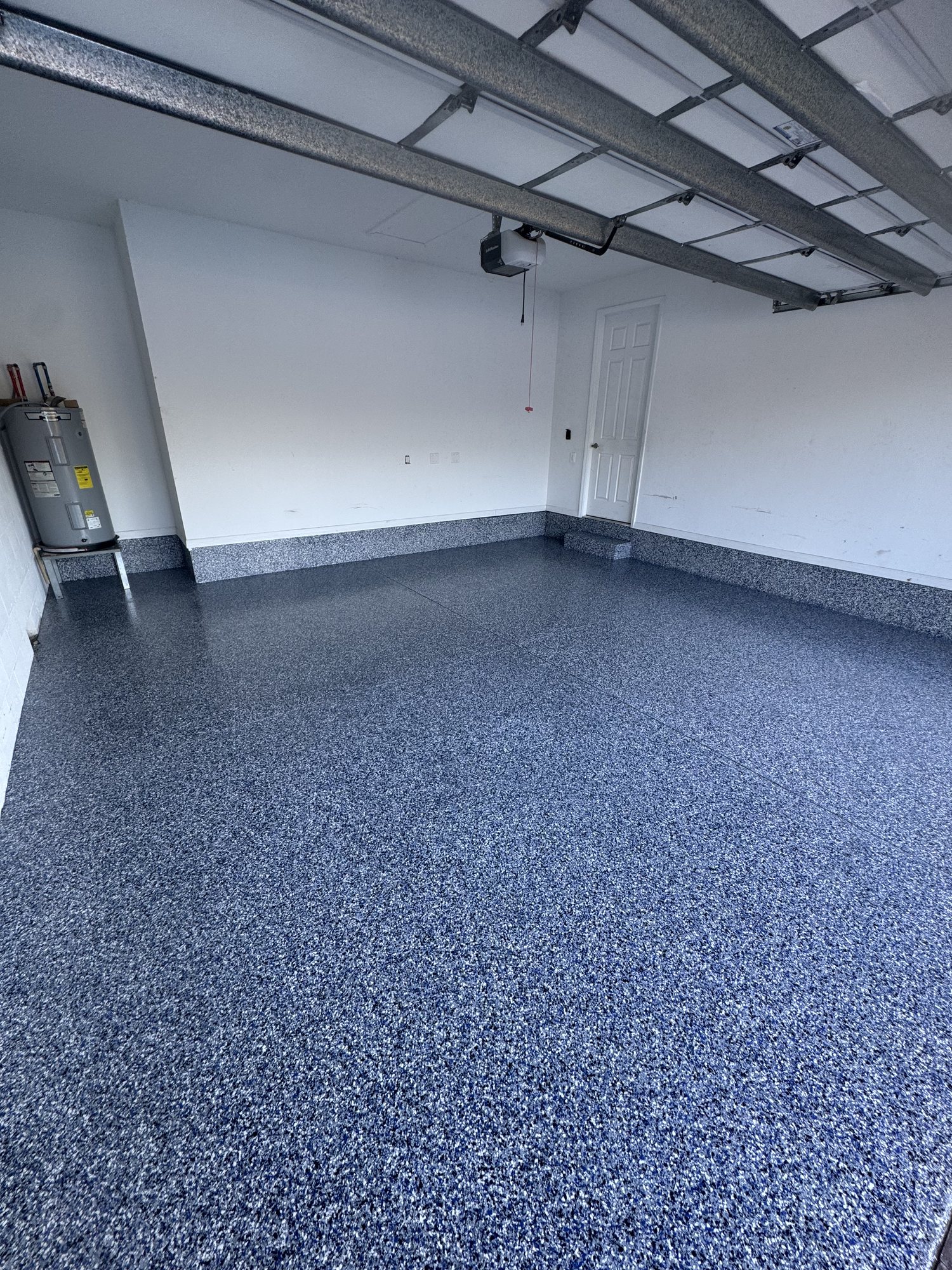
On an island, the garage takes sand off the beach gear, salt off the car and hot tires every afternoon of the summer. A full flake floor handles that better than anything else we install. The chips go down until the resin will not hold another one, and the floor turns up the wall at the base so water has no seam to sit in.
One car, two or three?
Give us the garage size and what else lives in there. Or call (941) 504-9132.
Coverage
Full broadcast or a light sprinkle?
There are two ways to put flake on a garage floor, and from the driveway they look like completely different jobs.
A light sprinkle scatters chips over a colored base coat, so the base shows between them. A full broadcast keeps throwing chips into the wet resin until it will not take any more, which installers call broadcasting to refusal. Once it sets, the loose flake gets swept up, the floor is scraped smooth, and the clear goes on over the top.
We pour full broadcast on almost every garage, for practical reasons. A floor that is all chip hides sand, dust and tire marks, while a solid base with a scatter of flake shows every one of them in the gaps. Full coverage also leaves a slight texture underfoot, which helps when you come in off a wet driveway in a storm. And the build is thicker, so a dropped wrench has more coating to get through before it finds concrete.
A partial broadcast still has its place, usually in a workshop corner where someone wants a particular base color to show through. On a garage that parks cars and collects sand, it is simply the harder floor to keep looking clean.
The cove line and the step nosing are the two spots where a rushed garage floor gives up first.
There are eighteen blends, and we look at them with you on your own slab rather than on a screen. On a blue, gray and white mix like the one at the top of this page, beach sand simply disappears into the pattern between sweeps. Darker blends hide grease better. Lighter ones brighten a garage that has one small window and a single bulb.
Edges
Coving, the house step and the water heater
The joint where a garage floor meets the wall is where water, sand and salt end up. On a floor cut flat at the wall it becomes a dirt line you cannot mop out, and the bottom of the drywall soaks up whatever sits there.
So we cove it. The flake floor curves up the wall as a base a few inches high, and floor and wall meet in a rounded joint with nothing for water to sit in. Hosing out the garage then pushes everything toward the door instead of into a crack along the wall.
At the big door, the coating stops on a straight, ground edge just inside the door seal, where the driveway concrete takes over. Wind-driven rain pushed under the door lands on coating, with no raw joint for it to work into.
The step at the house door
The step up into the house gets its tread and riser coated with the floor, with a clean edge on the nosing. That edge takes a knock every time someone carries groceries or a cooler in, so it gets the same build as the floor.
The water heater stand
We do not disconnect or move a water heater. The floor and the cove run up to the stand and around its legs, and the wall behind it gets coved as far as we can reach.
Laundry and storage
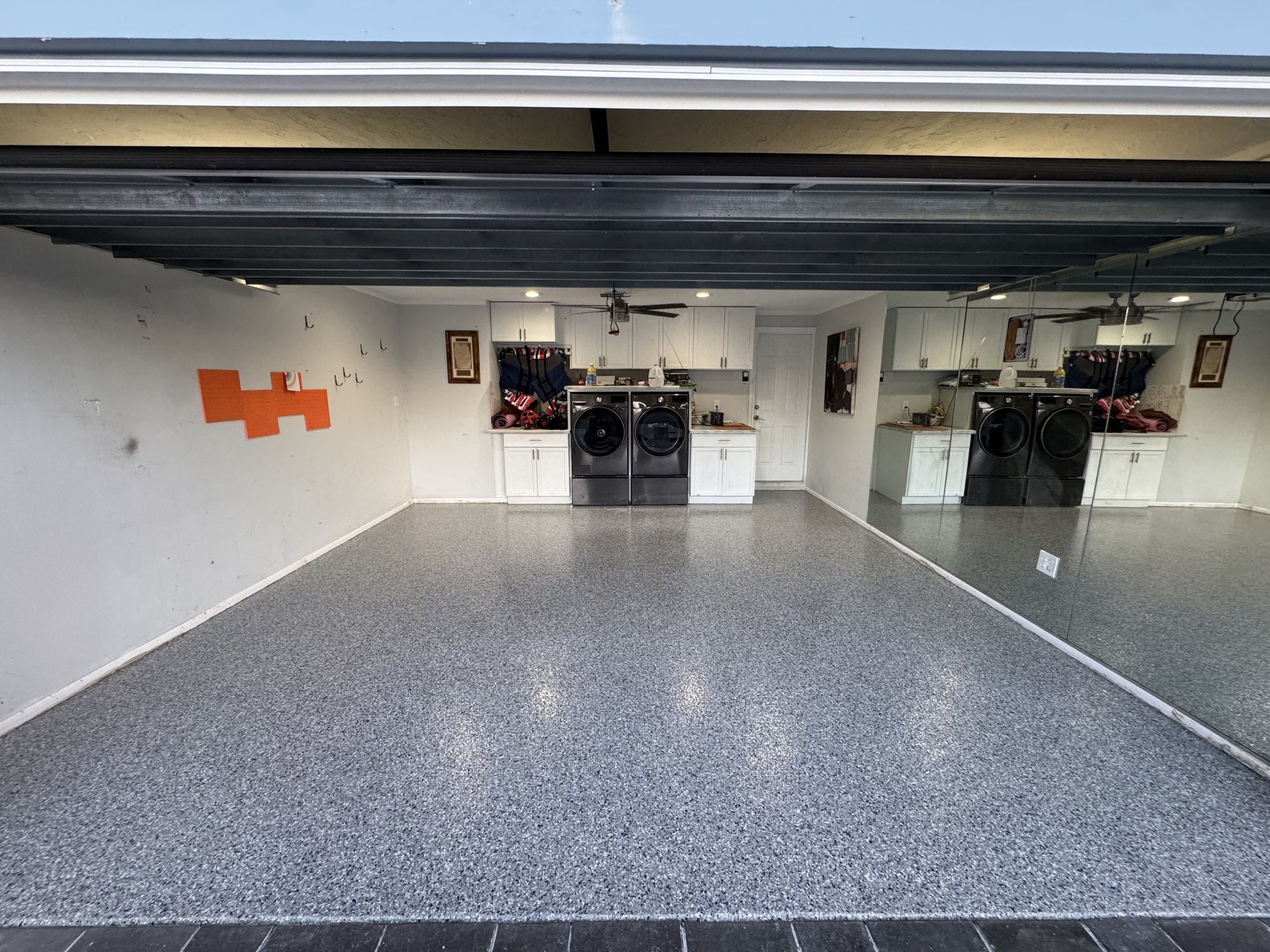
Plenty of garages double as the laundry room and the storage room. A washer that leaks or a shelf that drips onto a coated floor gets wiped up instead of soaking into the slab. Machines and shelving come out for the work and go back once the floor is ready for weight.
Salt, beach sand and a hot set of tires
Longboat Key is a barrier island, and salt air gets into everything here, the garage included. Sand comes in on beach chairs, coolers and boards and settles wherever the car parks. A flake floor with a proper clear coat takes both in stride, provided you rinse it now and then so salt does not dry on the surface.
Hot tires are the other test. After a drive in summer heat the rubber is soft and sticky, and on a weak topcoat it grabs the coating and pulls it up as the car leaves. That is hot-tire pickup, and it starts with thin prep or a cheap, thin clear. The answer is a ground slab, a primer picked after the moisture reading, and a clear coat laid at full thickness.
Prep runs the same as on every slab we coat: diamond grinding, cracks and pinholes filled, primer. Sandy ground and a high water table push vapor up through a garage slab around the clock, so the moisture reading comes before anyone talks numbers with you.
Walking on the finished floor is usually fine the next day. Cars go back in four to five days after the clear coat, depending on humidity.
How a garage day runs, start to finish
We drive over from Sarasota, a short trip up the coast, and once the crew pulls up the work goes in this order.
- The car goes out, and everything that can move comes off the floor.
- Diamond grinding across the slab, edges by hand, the dust drawn into a vacuum.
- Cracks opened and filled, pinholes filled, and the moisture read.
- Primer, then the base coat, then flake thrown until the resin refuses more.
- Loose chips swept up, the floor scraped, the cove and the step detailed.
- The clear coat, then your dates for walking on it and parking on it.
Humidity and afternoon storms move cure times, which is why your dates get worked out for your garage before the first day. If a storm shifts them, we phone you the same afternoon.
The night before, park outside and clear what you can. On the day itself nobody has to stay home, as long as we can get in and know which outlet the grinder can run from.
From the garage to the front door
Porch Floor Coatings
The first floor anyone sees at your house.
How it works →Lanai Floor Coatings
The room past the sliding doors.
Read the detail →Slip-Resistant Pool Deck Coatings
Cooler colors and grip by the ladder.
How it grips →Decorative Epoxy Flooring
Indoor color pours, each one a one-off.
What it suits →Full Flake Garage Floor Coatings
The full flake system across our counties.
The whole system →Longboat Key page · Other Sarasota County towns · Photos of finished floors · Contact page
Things to settle before the cars move out
Why full flake instead of a solid color?
A solid color shows everything: sand, dust, tire marks and the odd drip from under the car. Full flake breaks all of that up, so the floor still looks clean between sweeps. It also carries a little texture underfoot, and a damaged spot is far easier to touch up without the repair standing out.
Will hot tires lift the coating?
They can lift a floor that was rolled over unground concrete or finished with a thin clear. We grind the slab, pick the primer after reading the moisture, and lay the clear down at full build. That combination is what keeps a summer-hot tire from grabbing the surface when you back out.
How high does the cove go up the wall?
A few inches, enough to clear the band along the wall where water, sand and salt collect. The height can follow an existing trim line if your garage has one. We mark it with you before any grinding starts, so the top edge runs level all the way around the room and around the corners.
Can I hose out the garage afterward?
Yes, and the cove is part of why that works. Rinse toward the door now and then so salt never dries on the floor, and use a mild cleaner for anything greasy. Leave harsh acids and strong solvents out of it, since over time they dull the clear coat that the tires ride on.
Can you coat over an old garage epoxy that is peeling?
Not on top of it. Peeling means the old coating let go, usually from thin prep or moisture coming up through the slab, and anything laid over it inherits that failure. We grind all of it off back to sound concrete, take a moisture reading, then build the new floor from the slab up.
Does the whole garage need emptying?
The floor does, along with the base of every wall where the cove runs. Shelving, the washer and dryer and anything stored on the floor need somewhere to go for the duration, whether that is a driveway, a side yard or a spare room. Tell us early if something is too heavy to shift.
Photograph the floor, the walls and the step.
Three pictures and a rough size tell us most of what we need: how much prep the slab wants, how far the cove has to run and what is living on the floor right now. You get back the system, a few blends worth seeing in person and the number of days until the car goes back in.
Send the garage photos
Or call (941) 504-9132.