
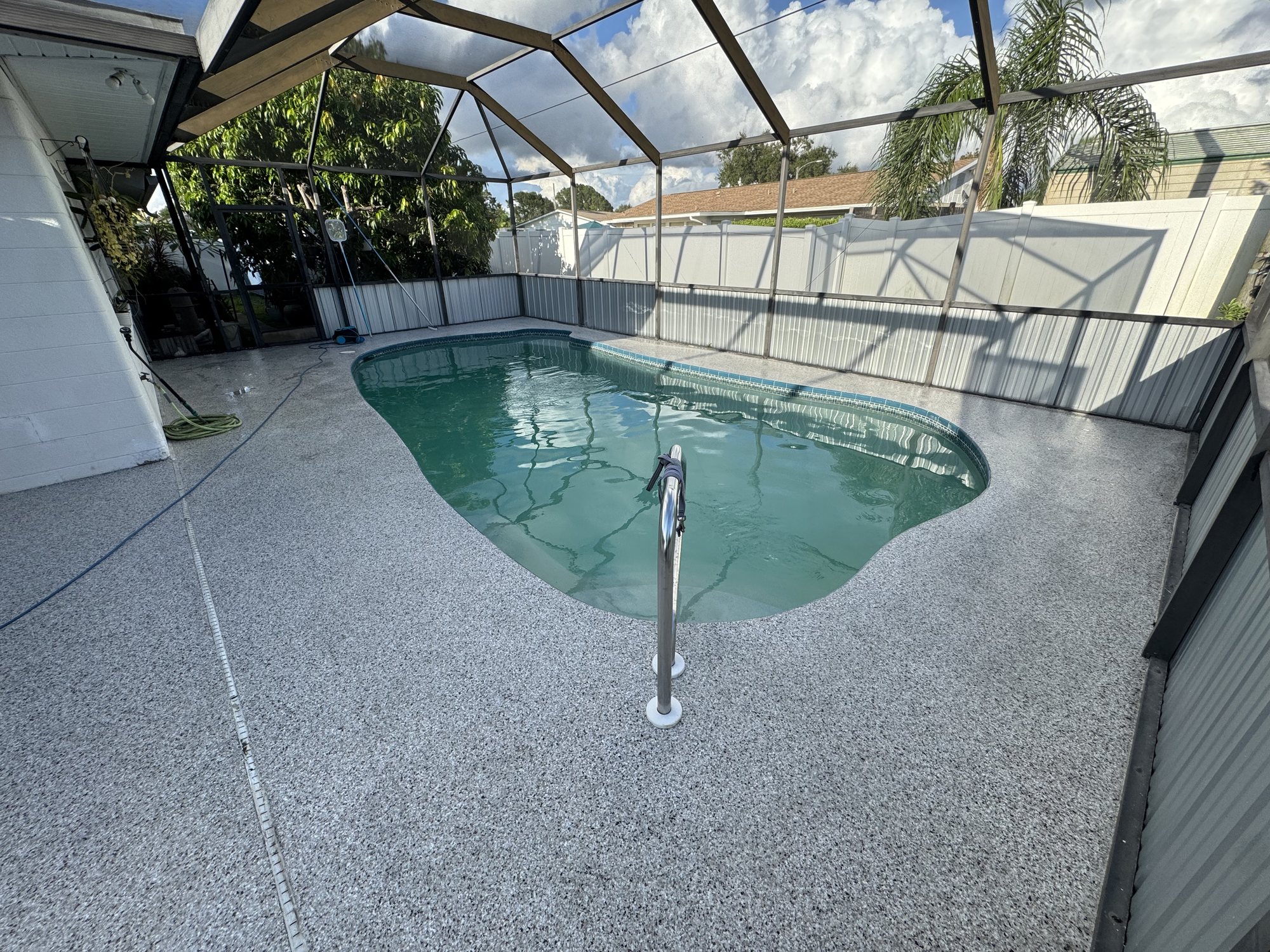
Outdoor
A deck that takes full sun and wet feet
Standard epoxy yellows in Florida sun and turns slick the first time somebody climbs out of the pool dripping. Outdoor concrete in Venice gets a UV-stable system with grip built into the topcoat, laid on a slab that has been ground, repaired and read for moisture first.
Pour this floor
Tell us about the deck and rough size. Or call (941) 504-9132.
Outside
Why indoor epoxy stays indoors
Indoor epoxy on a pool deck is a common mistake, and it usually ends with a grinder. Outside, concrete deals with conditions a garage never sees, and each one changes what goes on top.
Sun on the resin
Standard epoxy is an indoor material. Under ultraviolet light it ambers, so a gray deck drifts toward yellow, and the surface dulls first wherever the sun sits longest. A deck inside a screened enclosure still catches that light for most of the day. No amount of washing brings the color back. Polyaspartic and polyurea topcoats stay stable in sunlight, which is why every exterior job we do finishes in one of the two.
Water on the surface
A smooth clear coat looks lovely in a living room and is a hazard beside a pool. On outdoor work we put texture into the topcoat on purpose, so a wet foot has something to hold. How much is your call. More grip feels coarser and takes a little more effort with a brush when you clean it, so we set that level with you on a sample instead of guessing.
Bare feet on a warm slab
Nobody wears shoes on a pool deck. Color matters here almost as much as the system does, because lighter blends stay more comfortable underfoot in full sun than dark ones. If you are torn between two shades, stand on both samples at the hottest part of the day and let your feet decide.
The prep underneath all of that does not change. A pool surround gets the same diamond grinding, crack repair and primer as a garage ten minutes from our shop. The system on top is the part that moves with where the slab lives.
What the grinder finds on a Venice deck
Venice has older coastal homes near the water and newer builds further inland, so slab age varies street by street. The deck behind one house can be decades older than the one a few streets back. That age tells us a fair amount before any tooling comes off the truck, and the grinder tells us the rest.
Older decks have usually had something done to them already. A painted finish, a rolled-on sealer, a spray texture that has started lifting at the edges. All of it comes off mechanically. A new coating keys into open concrete, and anything left underneath becomes the weak layer that lets go first, taking the good resin with it.
Newer inland slabs tend to be cleaner and they still get ground. Hairline cracks and pinholes get chased out and filled, and the small spalls that show up near the coping get rebuilt, so none of it telegraphs through the finished surface a month later.
Then comes the moisture reading. Florida slabs sit on sand over a high water table and push vapor upward all the time, and a pool deck takes water from above as well. A film-forming coat with nowhere for that vapor to go is how bubbles start. The number on the meter picks the primer before anything else gets picked.
Screens, coping and the slab by the front door
Plenty of the decks we coat sit inside a screened enclosure. The cage keeps leaves and wind-blown grit off a fresh coat, which helps. It also means every hose, bucket and grinder comes in through a screen door, so the setup gets planned around that door before the first day.
- Chairs, planters and the grill come off the deck before grind day, and you know which day that is well ahead of time.
- The pool edge is covered before any dust gets made, and the coating stops in a clean, straight line at the coping.
- Deck drains are cleaned out and detailed so they still drain, never coated shut.
- Existing saw-cut joints stay where the slab needs them, so the concrete can keep moving where it was designed to.
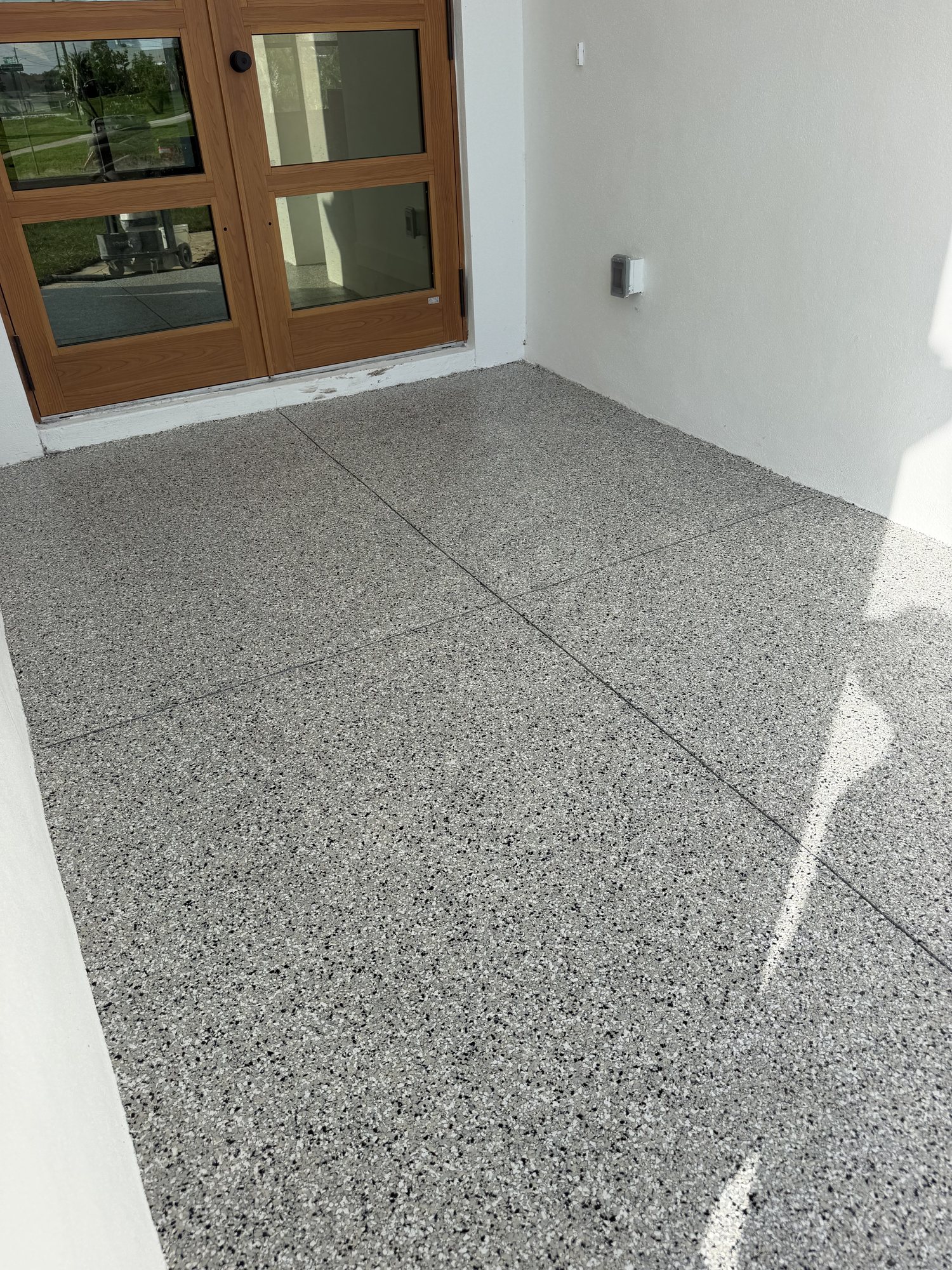
The same system goes on an outdoor entry slab or a front porch, like the one pictured running up to a pair of glass doors. It gets the same grind, the same repairs and the same UV-stable topcoat. Door frames are taped and the edge at the threshold is cut in by hand, since that is the line everybody sees on the way in.
If the deck and the entry get done in one visit they come out in one blend, and you only give up the outdoor space once.
Weather
Pour days get picked around the afternoon storms
Outdoor work runs on a weather window. High humidity slows a cure, and the storm that rolls in most summer afternoons can put water on a coat that is not ready for it. So we watch the forecast, start early in the day, and move the job when the window closes. Booking a deck blind and hoping is how people end up with a cloudy finish.
You get real dates before we start: grind day, coat day, and when the deck can take bare feet. People can usually walk the deck the day after the clear coat. If humidity or a storm shifts that, you hear it from us the same day, before anybody has carried the chairs back out.
Around a pool, the water stays clean while we grind and the line at the coping comes out straight.
Scheduling here is easy for us. The shop is in Sarasota, a short drive down the coast, and most Sarasota County jobs get onto the calendar inside the same week. Work heading the same direction gets grouped so nobody pays for a wasted trip, which means a call early in the week usually lands an earlier slot.
Living with the deck afterward is simple. Rinse it with a hose, use a soft brush on the textured areas when grit settles in, and reach for a mild cleaner when it needs more. Keep harsh solvents off it and the topcoat keeps doing its job.
The rest of the Venice lineup
Epoxy Garage Floors
Multi-car garages, golf carts and a clean stop at the driveway apron.
See the system →Flake Epoxy Flooring
Eighteen blends, chosen while standing on your own slab.
How it works →Metallic Epoxy Flooring
Color pushed and feathered by hand for a room on show.
What it suits →Commercial Epoxy Flooring
Lobbies, back rooms and suites still in the middle of a buildout.
Read the detail →Pool Deck Coatings
How the outdoor system works across every county we cover.
The whole system →The rest of our Venice work is on the Venice page, the other county towns sit on the Sarasota County page, and finished decks are in the gallery. When you have the deck size, send it over.
Questions
What pool owners ask before we book
Will a coated deck be slippery when it is wet?
Not when it is built for outside. Exterior work gets texture in the topcoat so a wet foot has something to hold, and you pick how coarse on a sample before we start. A glossy indoor finish around a pool is exactly what ends up being ground off.
How soon can we use the pool area again?
Foot traffic is usually the day after the clear coat goes down. Humidity and afternoon storms can push that back, so you get exact dates for your deck before we start, and if the weather moves the schedule you hear about it from us the same day.
Can you coat over a deck that has already been painted?
We coat once the paint is gone. Paint, old sealer and lifting spray texture all come off with diamond grinding, because a new system bonds to open concrete and whatever is left underneath lets go first. On an older deck, that removal can be most of the prep.
Does the coating get hot under bare feet?
Anything outdoors in full Florida sun warms up. The biggest thing you control is color, and lighter blends are kinder to bare feet than dark ones. We lay samples out on your own deck so you can judge them in the light they will actually sit in.
What happens to the cracks already in the deck?
They get chased out to a clean edge and filled before any coating goes down, along with pinholes and small spalls near the coping. A crack that is still moving can come back through a finish, and when a slab has one of those we tell you before quoting.
Can the front entry and porch match the pool deck?
Yes. An outdoor entry slab or porch takes the same grind, the same repair work and the same UV-stable topcoat as the deck. Doing them in one visit gives you one set of dates and one blend, with the edges at each door threshold cut in by hand.
Photograph the deck and tell us roughly how big it is.
A photo and a rough size is enough for us to come back with a system, a day count and real dates. Mention anything already on the concrete, like paint or an old spray texture, and whether the deck sits inside a screen. That covers most of the first conversation.
Pour this floor
Or call (941) 504-9132.