Outdoor
Fixing the concrete before anything goes over it
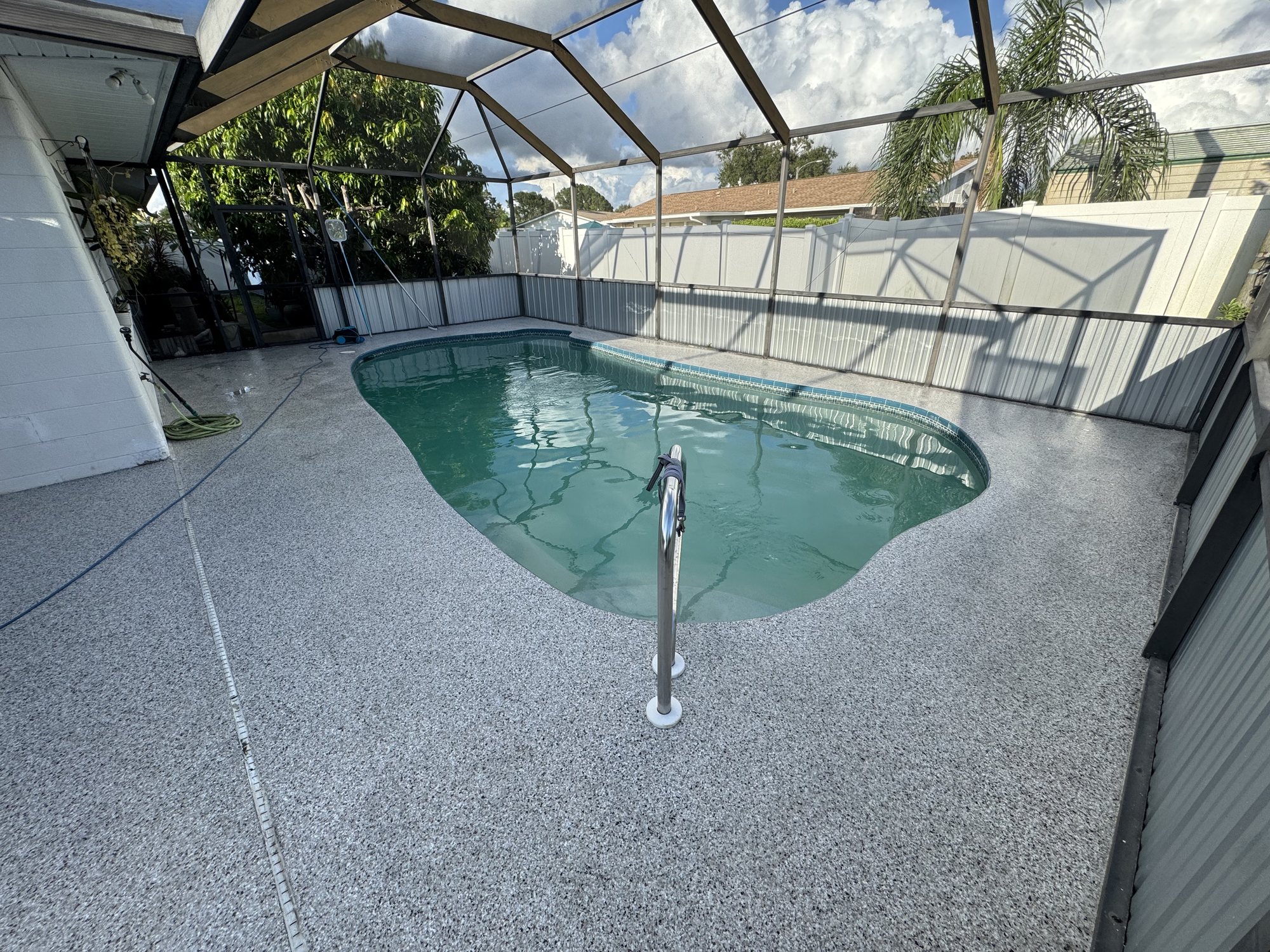
Resurfacing is a different job to coating. Coating is what you do to a sound deck. Resurfacing is what you do when the deck has spalled, cracked, sunk at a joint or lost its old finish in sheets, and the surface profile has to be rebuilt before any color goes anywhere near it.
Pour this floor
Tell us the space and rough size. Or call (941) 504-9132.
Detail
The damage we usually find
Spalling comes first. Water gets into the top layer of the slab, the surface pops off in flakes and dinner-plate patches, and what is left is rough and porous. On decks near the water, salt air accelerates it, and if there is rebar or mesh sitting shallow in the pour, corrosion pushes the concrete apart from underneath.
Cracks are the second one. A hairline shrinkage crack is cosmetic and stays put. A crack that has stepped, so one side sits proud of the other, means the slab has moved, and sandy subgrade around here shifts more than people expect once water has been running through it for a decade.
The third is the old finish itself. Kool deck and knockdown textures chalk and let go. Deck paint peels in sheets. Somebody’s interior epoxy has ambered and delaminated. All of it has to come off completely, because a new system is only as sound as whatever it is stuck to.

How we rebuild the surface
Everything starts with removal. Diamond grinding takes the old coating and the loose upper layer of concrete off and opens the surface so repair material and primer can bond mechanically rather than just sitting on top.
Cracks get chased out into a V, cleaned, and filled with a flexible polyurea joint filler that moves with the slab instead of cracking straight back through in the same line. Control joints are honored, not filled and forgotten, because a joint filled solid just relocates the crack somewhere you did not choose.
Spalled and low areas get a cementitious repair mortar, feathered out and reground flat. Where a deck ponds water we build the low spot up so it drains toward the edge. This stage is unglamorous and it is the part that decides whether the finished deck lasts.
When resurfacing is not the answer
Some decks are past it. If a section has settled several inches, if there is a structural crack running the full width of the slab, or if the concrete has broken down deep rather than just at the surface, a resin system will follow that movement and fail. We will say so.
That conversation happens at the walkthrough, not on install day. Five years of doing this has made it obvious that the expensive mistakes are the ones where somebody coated over a problem to keep a job moving.
Where the slab is sound and only the surface is finished, resurfacing gives you a genuinely new deck for a fraction of what tearing out and repouring costs, and without the demolition, the disposal or the weeks with a fenced-off pool.
Preparation
What happens before any resin comes out
Outdoor concrete in Florida takes ultraviolet light, standing water and constant vapor from below, so preparation matters even more here than it does inside.
Grinding comes first, always. Diamond tooling opens the surface so the coating has something to bite into, because a coating bonds mechanically rather than by sticking. The etching kit sold with retail epoxy does almost nothing to a slab that was power troweled smooth, which is most of them.
Moisture is the second reading. Concrete here pushes water vapor up through itself day and night, and a coating that seals it in will blister and let go regardless of what it cost. High numbers mean a moisture-tolerant primer goes down first, not that we carry on and hope.
Cracks get chased out to a clean edge and filled rather than skimmed over, spalls and pop-outs get rebuilt, and any previous coating comes off entirely. Only when the slab is sound, open and dry does anything get mixed.
The finish is what you see. The grind underneath it is what decides whether you are still happy in year eight, and it is where we spend the time other quotes save money.
It is also why we will occasionally tell someone their slab needs repair before it needs a coating. A floor that should be fixed structurally is not a floor we will put resin on, because the crack comes back through and then it is our name on it.
Related work
Slip-Resistant Pool Deck Coatings
Anyone can make a floor grippy. Throw enough sand in the topcoat and nobody will ever slip on it, and nobody will…
See the system →Garage Floor Coatings
A garage floor takes more punishment than anything else in the house. Hot tires, dropped tools, road salt in winter…
How it works →Epoxy Garage Floors
Epoxy earned its reputation twice over: once as the toughest thing you can put on a garage slab, and once as the…
Read the detail →Polyaspartic Floor Coatings
Polyaspartic is what you use when the space cannot be out of service for a week and when the floor is going to see…
What it suits →Questions
Pool Deck Resurfacing questions
How much does pool deck resurfacing cost?
Price follows square footage, the condition of the slab and the system you choose. A sound slab that only needs grinding costs far less to prepare than one with cracks, old coating or a moisture problem. We look at the floor and give you a real number rather than a range that means nothing.
How long does pool deck resurfacing take?
Most residential work is two to four days on site depending on size and system. Commercial and industrial floors are scheduled around your hours and often run nights or weekends. You get exact dates before we start, including when you can walk on it and when you can put weight on it.
Do you grind the floor first?
Always. Diamond grinding is the only way to get a profile the coating can key into, and it is the single biggest reason floors either last or fail. We do not acid etch and we do not coat over a sealed slab.
What about moisture in the slab?
Florida slabs move water upward constantly, and vapor trapped under a coating is a guaranteed failure. We take a reading before quoting. If the numbers are high we specify a moisture-tolerant primer rather than pretending the problem is not there.
Can you match a color or a look I have seen?
Usually. We carry eighteen flake blends and mix metallic per floor, so bring a photo, a cabinet door or a paint chip and we will get close. We put samples down in your own light before you commit.
Do you work outside Sarasota?
Yes. We cover a 120-mile radius from Sarasota, which is twenty-four counties from Naples up to Ocala and across to Orlando. Check the service areas page or call and ask.
Send us the space. We will send back a number.
Rough size and a photo is enough to start. We cover Sarasota and twenty-four counties around it, so tell us where you are and we will tell you when we can get there.
Pour this floor
Or call (941) 504-9132.