Outdoor
Under the cage, where the air never really moves
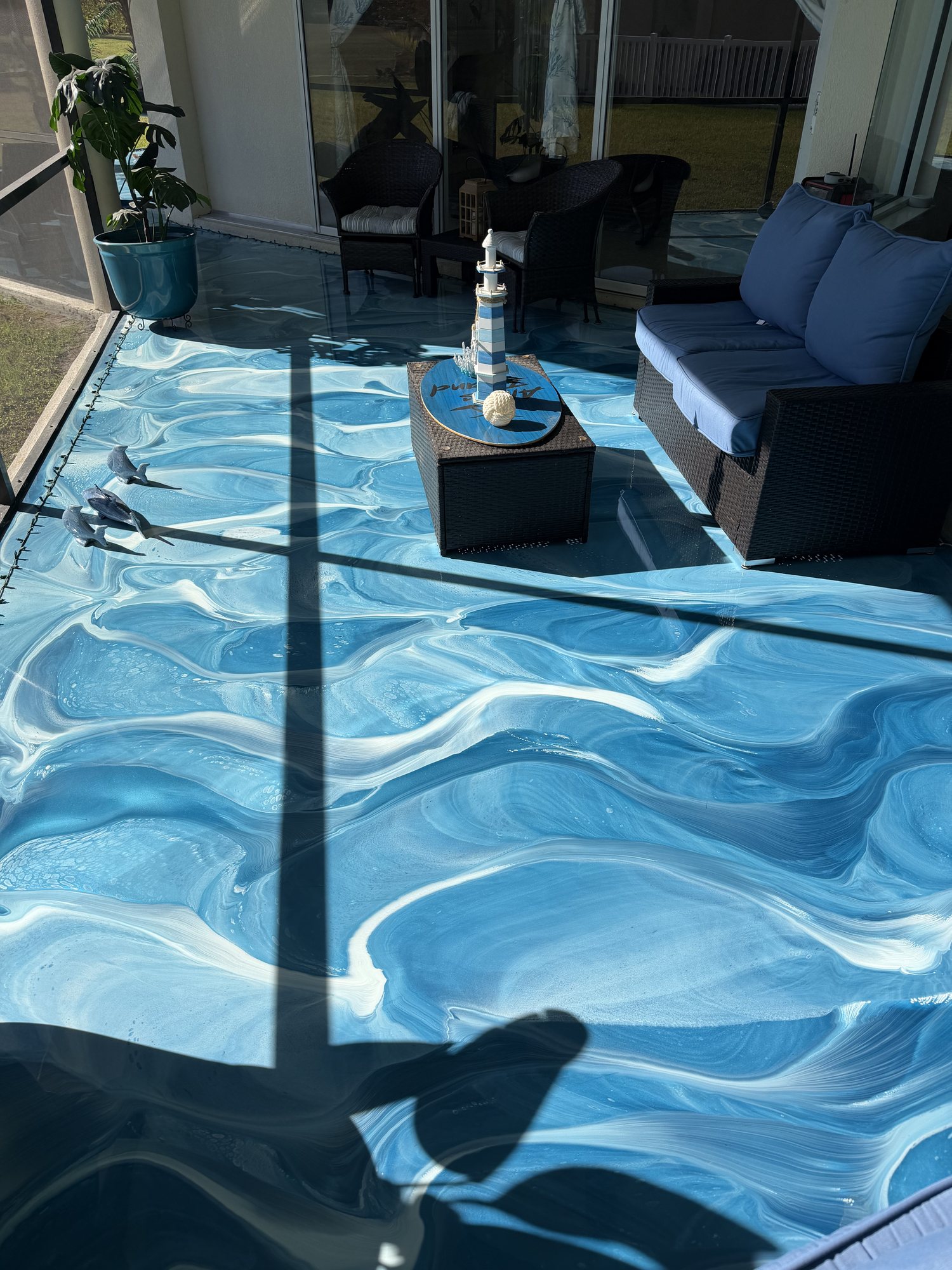
A screened lanai is its own environment. The cage cuts the sun and the bugs and it also cuts the airflow, so humidity sits in there, shaded corners stay damp for days, and algae takes hold in places an open patio would have dried out by lunchtime.
Pour this floor
Tell us the space and rough size. Or call (941) 504-9132.
Detail
Screen is not the same as shade
People assume a cage protects the floor from ultraviolet light. It reduces it and it does not stop it. Screen mesh passes a meaningful amount of UV, and a lanai that faces west takes hours of low, direct afternoon sun straight through the panels every day.
So a lanai still needs UV-stable chemistry. We have stripped plenty of ambered interior epoxy off screened floors where somebody reasoned that under a roof and behind a screen was close enough to indoors. It is not, and the yellowing is worst in exactly the strip where the afternoon light lands.
The cage does change one thing usefully: less direct rain reaches the slab, so the abuse is more about constant damp than about flooding.

Damp, shade and the algae problem
Low airflow plus Florida humidity keeps a lanai floor damp long after the weather has cleared. That is ideal for algae and mildew, which is why the green film always appears first along the north side, behind the furniture and in the corner nobody sweeps.
Bare or porous concrete gives that growth somewhere to root. A properly sealed, non-porous surface does not, so what grows on top sits on top and comes off with a rinse and a soft brush rather than needing pressure washing that erodes the concrete a little more every time.
Slab moisture is the other consideration. A lanai slab sitting on sand moves vapor upward continuously, and a shaded floor that never really dries has nowhere to release it. We take a moisture reading before pricing the work, because trapping that vapor under a film is how a coating blisters.
Working around a cage
A screen enclosure makes the job more of a puzzle. Grinding dust has to be contained inside a space with restricted airflow, equipment has to fit through a screen door, and we protect the lower panels and the kick plates rather than replacing them afterwards.
The perimeter detail is where cheap lanai jobs give themselves away. The coating has to run cleanly into the cage track and around every upright without a ragged edge or a smear on the aluminum. That is slow, careful hand work and it is a fair bit of the labor on a screened floor.
Cure timing is slower under a cage too, because the air does not turn over. We schedule around that rather than pretending a shaded, humid enclosure behaves like an open driveway.
Preparation
What happens before any resin comes out
Outdoor concrete in Florida takes ultraviolet light, standing water and constant vapor from below, so preparation matters even more here than it does inside.
The first day is the grinder. We work the slab with diamond tooling until it is uniformly open, vacuuming as we go so the dust stays out of the house. Skip this and you are relying on the resin to stick to a sealed surface, which is the reason so many coatings come up in sheets.
After grinding we measure what the slab is doing with water. Sandy subgrade and a shallow water table make vapor drive a constant in this climate, and it is the failure nobody sees coming because the floor looks perfect for the first season. We test before quoting so the system suits the slab.
Cracks get chased out to a clean edge and filled rather than skimmed over, spalls and pop-outs get rebuilt, and any previous coating comes off entirely. Only when the slab is sound, open and dry does anything get mixed.
The finish is what you see. The grind underneath it is what decides whether you are still happy in year eight, and it is where we spend the time other quotes save money.
It is also why we will occasionally tell someone their slab needs repair before it needs a coating. A floor that should be fixed structurally is not a floor we will put resin on, because the crack comes back through and then it is our name on it.
Related work
Retail Floor Coatings
Retail floors carry two jobs at once. They have to look considered, because the floor is a large share of what a…
See the system →Industrial Garage Floor Coatings
An industrial garage is not a big residential garage. Trucks, plant, trailers and forklifts put loads through a slab…
How it works →Concrete Grinding
Grinding is the unglamorous half of every floor we install, and it is the half that decides whether the floor is…
Read the detail →Diamond Grinding
Everyone with a grinder says they diamond grind. What separates a floor that bonds from one that does not is which…
What it suits →Questions
Lanai Floor Coatings questions
How much does lanai floor coatings cost?
Price follows square footage, the condition of the slab and the system you choose. A sound slab that only needs grinding costs far less to prepare than one with cracks, old coating or a moisture problem. We look at the floor and give you a real number rather than a range that means nothing.
How long does lanai floor coatings take?
Most residential work is two to four days on site depending on size and system. Commercial and industrial floors are scheduled around your hours and often run nights or weekends. You get exact dates before we start, including when you can walk on it and when you can put weight on it.
Do you grind the floor first?
Always. Diamond grinding is the only way to get a profile the coating can key into, and it is the single biggest reason floors either last or fail. We do not acid etch and we do not coat over a sealed slab.
What about moisture in the slab?
Florida slabs move water upward constantly, and vapor trapped under a coating is a guaranteed failure. We take a reading before quoting. If the numbers are high we specify a moisture-tolerant primer rather than pretending the problem is not there.
Can you match a color or a look I have seen?
Usually. We carry eighteen flake blends and mix metallic per floor, so bring a photo, a cabinet door or a paint chip and we will get close. We put samples down in your own light before you commit.
Do you work outside Sarasota?
Yes. We cover a 120-mile radius from Sarasota, which is twenty-four counties from Naples up to Ocala and across to Orlando. Check the service areas page or call and ask.
Send us the space. We will send back a number.
Rough size and a photo is enough to start. We cover Sarasota and twenty-four counties around it, so tell us where you are and we will tell you when we can get there.
Pour this floor
Or call (941) 504-9132.